

A Brief History
Chile’s wine making roots stretch back to the 1500s, when Spanish settlers first planted vines in South America. Modern Chilean wine, however, really begins in the mid-19th century, when growers imported Bordeaux varieties and wine making expertise from France. One important consequence of this exchange was the preservation of Carménère, a grape that was largely abandoned in France after phylloxera devastated European vineyards.
Chile’s geographic isolation — bordered by the Andes to the east, the Pacific Ocean to the west, desert to the north, and Patagonia to the south — has kept the country free of phylloxera. As a result, most vines are planted on their own roots rather than grafted onto American root stock, a rarity in the modern wine world.
The Regions
As in Argentina’s Mendoza region, the Andes play a vital role by supplying melt water for irrigation. While Chile stretches roughly 4,000 kilometres from north to south, its seven main wine-growing regions cover only about 1,400 kilometres.
The Pacific Ocean and the cold Humboldt Current moderate temperatures along the coast, while the Andes provide altitude and dramatic day-night temperature shifts inland. The climate is broadly Mediterranean, with long, dry growing seasons. Warm days allow fruit to ripen fully, while cool nights help preserve acidity and freshness. Compared to wines from hotter climates, Chilean wines often show lower alcohol, firmer structure, and better balance.
These conditions also make organic and bio dynamic viticulture relatively straightforward, a fact reflected in the growing number of producers working sustainably.
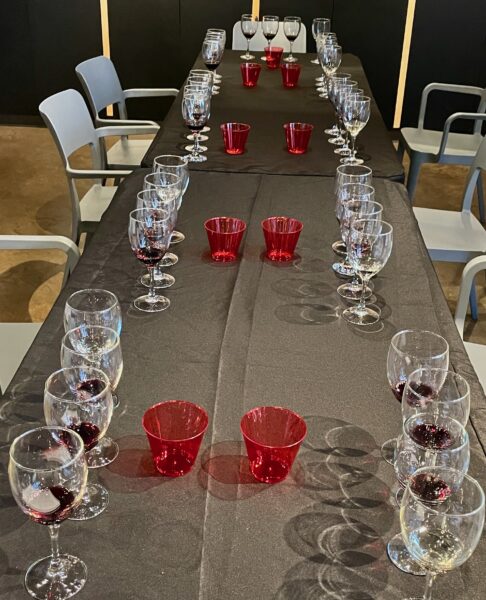
At Franco’s, Luigi led us through a tasting of four Chilean wines: one white and three reds.
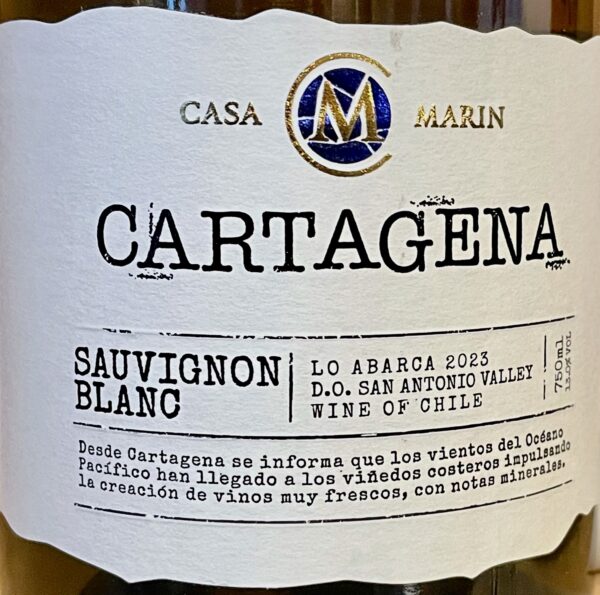
Wine 1
Casa Marín
Cartagena Sauvignon Blanc 2023
$26.99
Founded in 2000 by María Luz Marín, Casa Marín is a true boutique winery and remains the only producer with its own DO (Denomination of Origin), Lo Abarca, in the San Antonio Valley. At a time when most Chilean wineries were large-scale operations, Marín took a risk by planting just 25 acres in a cool, coastal site that many experts dismissed as unsuitable for fine wine.
Casa Marín is widely regarded as one of the closest vineyards to the Pacific Ocean in Chile, located just four kilometres from the sea. At 33° south latitude — roughly the same as San Diego — its proximity to the ocean keeps average temperatures below 14°C, closer to Kelowna than California in growing conditions, with relatively low number of growing degree days.
The Cartagena Sauvignon Blanc comes from the highest vineyard parcels, directly exposed to maritime influence. The wine is a blend of 85% Sauvignon Blanc and 15% Sauvignon Gris, fermented separately in stainless steel before blending.
This is a focused, precise Sauvignon Blanc, stylistically distinct from New Zealand examples and only loosely reminiscent of Sancerre. Aromas of citrus, fresh herbs, and saline minerality lead to a palate with real texture, mouth-watering acidity, and layered complexity. It clearly reflects its coastal terroir and was widely agreed to over-deliver for the price.
Notably, Casa Marín’s first Sauvignon Blanc release was hailed by Robert Parker as the best white wine made in South America. The winery continues to emphasize sustainability, including renewable energy use and vineyard waste composting.
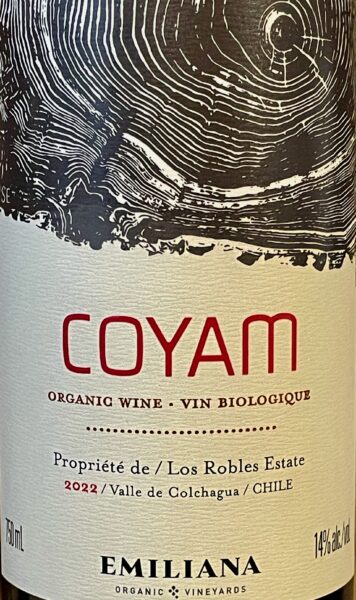
Wine 2
Emiliana
Coyam Red Blend
$32.99
Coyam is Emiliana’s flagship wine, sourced from the Colchagua Valley, south of Santiago (about 34° south latitude). Remember, in the southern hemisphere, the further south you go, the cooler it gets — the opposite of what we’re used to in Canada. Founded in 1986, Emiliana is Chile’s leading organic and biodynamic winery and a global reference point for sustainable viticulture.
Emiliana describes its philosophy as, “At Emiliana, we don’t just believe that organic and biodynamic agriculture is the best way to make wine; we are also sure that this way of life will help lead us into a future with respect and wisdom.” The winery is proud of their many accomplishments. Emiliana was the first winery in Chile — and the seventh worldwide — to receive ISO 14001 environmental certification. Their inaugural Coyam vintage in 2001 won Best in Show and Best Blend at the first Wines of Chile Awards. With their first vintage in 2001 they were awarded Best in Show and Best Blend in the 1st Annual Wines of Chile Awards.
The blend varies by vintage; this one is composed of 37% Syrah, 36% Carménère, with smaller amounts of Cabernet Sauvignon, Merlot, and Mourvèdre. The wine shows dark fruit, spice, earth, and savoury notes, with good structure and a strong sense of place. There’s a touch of smoke alongside red and black fruit, plenty of flavour, and a medium-long finish.
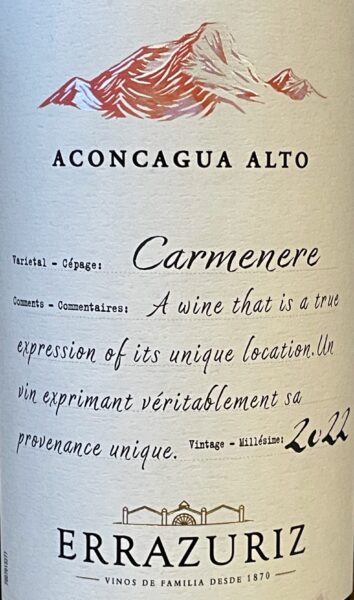
Wine 3
Viña Errazuriz
Aconcagua Alto Carménère 2022
$34.99
This wine comes from the Aconcagua Valley, about 100 kilometres north of Santiago. Viña Errázuriz was founded in 1870 by Don Maximiano Errázuriz and has played a central role in establishing Chile’s international reputation for quality wine. In the late 20th century, Eduardo Chadwick, a fifth-generation family member, modernized the winery and sharpened its focus on vineyard precision.
Errázuriz farms multiple sites across the region, including high-altitude mountain vineyards and coastal parcels closer to the Pacific. The winery follows organic and biodynamic principles and has been instrumental in demonstrating that Carménère can produce elegant, age-worthy wines.
This bottling is fruit-forward and immediately appealing, with red and black fruit, plum, spice, and subtle herbal notes. It has good balance, a medium-plus body, smooth tannins, and flavours that echo the nose through a satisfying finish. An easy match for grilled burgers or pizza.
Wine 4 Seña
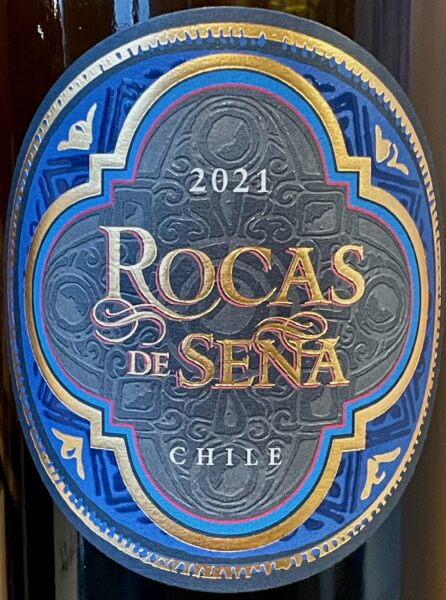
Rocas de Seña 2021
$82.99
Also from the Aconcagua Valley, Rocas de Seña is the second wine of Seña — analogous to a second growth in Bordeaux terms. Second wines typically use fruit from younger vines or barrels not selected for the flagship bottling, resulting in wines that are more approachable in their youth.
Seña was founded in 1995 as a joint venture between Eduardo Chadwick and Napa Valley’s Robert Mondavi. Their ambitious goal was to create Chile’s first truly world-class wine, capable of standing alongside Bordeaux First Growths.
Rocas de Seña is a Cabernet-led blend showing black currant, graphite, cedar, and spice, with well-integrated tannins. It is a refined, structured wine with clear cellaring potential. Additional notes of red fruit, game, tobacco, truffle, and dried herbs emerge with air. Treat it as you would a well-made Bordeaux at the table.
In Conclusion
Chile’s diverse geography and favourable climate have created ideal conditions for a wide range of wine styles, from crisp coastal whites to structured, age-worthy reds. Regions such as Elqui, Limarí, Aconcagua, Casablanca, San Antonio, Maipo, Cachapoal, and Colchagua each offer distinct expressions shaped by climate, soils, and proximity to the ocean or mountains.
Taken together, these wines show why Chile continues to earn its place among the world’s most compelling wine-producing countries.
(All photos – Sam Hauck)
