
Château Angélus: History and Portfolio
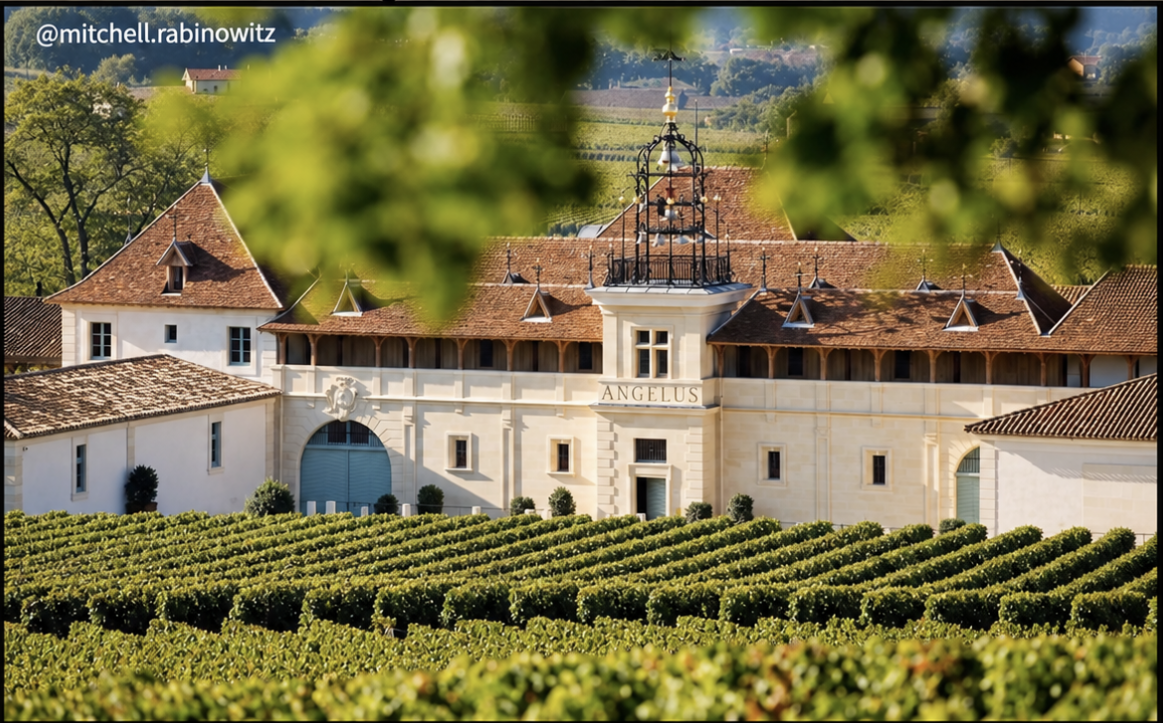
Château Angélus lies southwest of the village of Saint-Émilion in a naturally curved area of vineyards overlooked by the churches of Saint-Émilion. For generations, vineyard workers in this part of the appellation could hear the bells ringing in the morning, at midday, and in the evening for the Angelus prayer. The bells gave the property the name it eventually adopted, and a bell remains the principal image on the Château Angélus label. The location also has practical consequences for winegrowing. The vineyards extend across slopes and lower ground with variations in clay, limestone, sand, and gravel, giving the estate parcels with different drainage, water retention, and ripening conditions.
The de Boüard de Laforest family has been associated with Saint-Émilion since 1782, when Jean de Boüard de Laforest settled in the region. The property that became Château Angélus developed gradually during the following generations rather than beginning as a large estate under its present name. During the early twentieth century, important family holdings were associated with Château Mazerat. Elisabeth Bouchet encouraged the acquisition of Clos Angélus, a small neighboring vineyard whose name would eventually be adopted for the entire property. The marriage of Elisabeth Bouchet and Maurice de Boüard de Laforest also influenced the vineyard itself. Bouchet was the traditional Saint-Émilion name for Cabernet Franc, and Maurice planted a substantial portion of the property with the variety in connection with his wife’s family name.
Cabernet Franc consequently became unusually important at Angélus. Merlot dominates many Saint-Émilion vineyards because it ripens relatively early and performs well on the region’s clay soils, while Cabernet Franc generally ripens later and can be more demanding. At Angélus, the combination of soils, exposures, and long familiarity with the variety allowed Cabernet Franc to occupy a much larger role. The proportion varies with the vintage, and recent Château Angélus blends have sometimes contained as much Cabernet Franc as Merlot or even more. The 2021 wine, for example, was made from 60 percent Cabernet Franc and 40 percent Merlot. This longstanding commitment distinguishes Angélus from many neighboring estates where Merlot is considerably more dominant.
Maurice died before Elisabeth, leaving her responsible for the estate. She continued to enlarge and maintain the property before passing it to the next generation. Her role became especially significant in the later family history because she helped preserve the estate through a period when many Bordeaux properties faced economic difficulties. Angélus later commemorated her through Hommage à Elisabeth Bouchet, a small production wine made entirely from Cabernet Franc.
Saint-Émilion introduced its first official classification in 1955. Unlike the 1855 classification of the Médoc, the Saint-Émilion system was created with periodic revisions, allowing properties to move according to later assessments. Angélus was included as a Grand Cru Classé in the first classification. Over the following decades, the vineyard continued to grow as parcels were acquired around the original holdings. In 1969, Angélus added approximately three hectares from the Beauséjour property acquired that year by Michel Bécot, increasing its holdings on the Saint-Émilion limestone plateau. By the 1980s, Angélus had become a substantial Saint-Émilion property.
Hubert de Boüard de Laforest assumed an increasingly important role at the estate during the 1980s. Trained in oenology at the University of Bordeaux, he belonged to a generation of Bordeaux winemakers who placed greater emphasis on detailed vineyard management, grape selection, control during fermentation, and careful decisions about barrel aging. At Angélus, this period brought more exact parcel-by-parcel work and increasingly severe selection for the principal wine. Hubert also taught oenology and became a consultant to other properties, giving him considerable influence in Saint-Émilion and elsewhere on the Right Bank. His cousin Jean-Bernard Grenié joined the management of Angélus in 1987 and remained closely involved with the family estate for the following decades. The improvements were recognized formally in the 1996 revision of the Saint-Émilion classification, when Angélus was promoted from Grand Cru Classé to Premier Grand Cru Classé B.
This work coincided with substantial changes in the international reputation of Saint-Émilion. During the 1980s and 1990s, wealthy consumers and critics increasingly focused on small Right Bank properties producing concentrated wines from carefully selected fruit. Estates such as Le Pin and later Château Valandraud received considerable attention, although Angélus differed from these properties because it had a much longer family history, larger vineyard holdings, and an established place in the Saint-Émilion classification. International critical attention nevertheless contributed to Angélus’s increasing reputation during this period, and favorable reviews from Robert Parker were particularly influential in the American market.
Angélus also became unusually willing to promote itself outside traditional Bordeaux wine circles. Its best-known appearances came through the James Bond films. Château Angélus appeared in Casino Royale in 2006 and again in Spectre in 2015, followed by another appearance in No Time to Die. These placements introduced the estate to audiences who might never have encountered it through Bordeaux merchants or wine publications. The activity accompanied continued investment in the vineyards and winery, and Angélus gradually became one of Saint-Émilion’s most internationally recognized estates.
The estate adopted organic farming and received organic certification for the 2021 vintage. Cabernet Franc has become particularly valuable as Bordeaux has grown warmer because its later ripening can allow the grapes to retain freshness after Merlot has accumulated high sugar levels. Angélus vineyard manager François Lézian has also emphasized the variety’s relative resistance to some fungal diseases.
In 2012, the estate was promoted to Premier Grand Cru Classé A, placing it in the highest category then used in Saint-Émilion. Angélus joined Ausone, Cheval Blanc, and Pavie at that level. The 2012 classification also produced years of legal disputes. Several estates challenged the procedures used to determine the results, while questions concerning the roles played by individuals connected with classified properties led to further controversy. Cheval Blanc and Ausone eventually announced that they would not participate in the next classification. In January 2022, Angélus also withdrew from the process for the 2022 classification. By then the estate had spent decades establishing an international reputation that did not depend entirely upon its formal rank, and the family decided that continued participation was no longer desirable. Bottles from earlier vintages continue to bear the Premier Grand Cru Classé A designation appropriate to the classification under which they were produced.
Stéphanie de Boüard-Rivoal, Hubert de Boüard’s daughter, joined the management of Angélus in 2012 and eventually became chief executive and an owner of the estate. She subsequently worked to consolidate family ownership. This allowed Angélus to remain under direct family control at a time when numerous prominent Bordeaux estates were being purchased by insurance companies, luxury groups, and other large investors. The de Boüard family continued to present Angélus as a property intended to pass from one generation to the next.
On May 6, 2025, the president of the Commercial Court of Libourne appointed the judicial administration firm FHBX, represented by Maître Sylvain Hustaix, as provisional administrator of Château Angélus. The appointment followed disagreements among family shareholders and placed an outside administrator in the company while efforts were made to stabilize its governance. The development did not end family ownership of Angélus, but it demonstrated that keeping a large estate within one family can produce difficulties of its own as ownership passes among later generations.
Current figures for the wider Angélus holdings reach roughly 130 hectares, including vineyards outside Saint-Émilion used for other wines in the family’s range. The vineyard supplying Château Angélus itself is much smaller, with approximately thirty hectares associated with the principal Saint-Émilion property.
A separate winery for Carillon d’Angélus and several other Angélus wines was completed for the 2019 harvest. The partially underground building contains eighteen fermentation vats and operates by gravity, and several Angélus wines other than the principal Château Angélus are made there. The estate subsequently undertook another project for the grand vin under architect Olivier Chadebost. Construction began in the 2020s on a new winery buried approximately seven meters underground and equipped with twenty-two vats made from wood, stainless steel, and concrete. The new winery was inaugurated in April 2026 and is intended to receive its first harvest with the 2026 vintage. Grapes and wine can move through the facility by gravity with little reliance on pumping, reducing unnecessary handling during fermentation. A separate area within the winery was created specifically for Hommage à Elisabeth Bouchet.
Château Angélus remains the principal wine of the estate. Merlot and Cabernet Franc are the principal varieties in the blend, with their proportions changing according to the vintage and Cabernet Sauvignon sometimes appearing in much smaller quantities. Grapes are selected among the estate’s parcels according to the quality and character of each harvest, and further selection determines which lots will become Château Angélus. The wine is made with extended aging in French oak and is intended for long bottle development.
Carillon d’Angélus has been produced since the 1987 vintage. Although it began in the traditional role of a second wine, Angélus has increasingly treated Carillon as a separate wine with its own sources and production decisions. It is made from varying proportions of Merlot, Cabernet Franc, and Cabernet Sauvignon selected from Saint-Émilion vineyards, with fermentation and aging adjusted to produce a wine that can be approached earlier than Château Angélus. The creation of Carillon also allowed increasingly strict selection for the principal wine, since parcels and lots that did not meet the requirements for Château Angélus could still be used for a wine made and aged to a different purpose.
No. 3 d’Angélus provides another Saint-Émilion wine intended for earlier drinking. It relies heavily on Merlot, generally between 85 and 90 percent, and receives less intensive aging than Château Angélus. The wine allows the estate to use suitable fruit from its Saint-Émilion holdings without requiring every parcel to produce a wine intended for decades of aging.
Tempo d’Angélus joined the range when it was created in 2019. Produced under the Bordeaux appellation, Tempo is intended to be consumed considerably younger than Château Angélus. The vineyards used for it include properties acquired by the family beginning in 2017 in Castillon-la-Bataille, Saint-Magne-de-Castillon, Sainte-Colombe, and the Francs area, east of Saint-Émilion. These vineyards grow primarily on clay and limestone soils and allow the Angélus team to produce a Bordeaux wine outside the restricted vineyard area of Château Angélus.
Stéphanie de Boüard-Rivoal created Hommage à Elisabeth Bouchet in memory of her great-grandmother, whose acquisition of Clos Angélus and connection with Cabernet Franc had been so important in the development of the property. Hommage is made entirely from Cabernet Franc selected from a small parcel and is produced only when the estate believes the vintage permits it. The first vintage was 2016, and only a few barrels are produced. The bottles, magnums, double magnums, and larger formats are individually numbered.
Clos du Milieu is produced from Merlot grown on clay-limestone soils in Castillon-la-Bataille, east of Saint-Émilion, while Blanc du Milieu comes from white grape varieties planted there. These wines are made separately from Château Angélus and demonstrate the family’s continuing interest in nearby areas where similar limestone and clay formations extend beyond the boundaries of the Saint-Émilion appellation. The Carillon winery provides the facilities for these wines as well as several other wines produced by Angélus outside the principal château.
Angélus Grand Vin Blanc first appeared from the 2020 vintage in extremely small quantities. The project has included varieties such as Chardonnay, Chenin Blanc, Sauvignon Blanc, and Sémillon, some of which fall outside the varieties traditionally associated with white Bordeaux. Because Saint-Émilion is an appellation for red wine, such wines cannot be sold as white Saint-Émilion. They therefore exist separately from the classification and from the principal red wine that established the estate’s reputation.
Mitchell Rabinowitz
I’m a retired university professor with a Ph.D. in cognitive and developmental psychology. I taught cognition and education starting in 1984. In retirement I decided to take wine seriously, and I’ve been using AI to help me learn faster and create better. I’ve also learned you can’t just ask AI one question and call it done.
For me, an essay usually takes a number of iterations. I create a draft, then I check accuracy, hunt for gaps, revise the structure, and do it again until the piece feels coherent and useful. I also use other AIs as collaborators. It is an extensive process creating the essays.
I try to create these as stories because that is the format that sticks for most of us. Facts land better when they have a sequence and a few turning points. Connect with @mitchell.rabinowitz on Instagram
