

Buehler Vineyards: A Family History and Its Wines
John and Helen Buehler purchased their 300-acre property in the hills east of St. Helena in 1971, when John was approaching retirement from Bechtel. A West Point graduate and retired colonel, he had spent twenty years in the Army Corps of Engineers and another twenty at Bechtel. An old stone winery, dating to approximately 1880 and associated with the Salmina family, former owners of Larkmead, remained on the land, although wine had not been made there since before Prohibition. The old building was later used for horses and equipment, while the family developed new facilities for wine production elsewhere on the property.
Their son, also named John, wanted to grow grapes and took on the work of developing the property with his father. John Jr. planted his first Zinfandel vines in 1972 and built his home on the property in 1975. For several years the family sold Cabernet Sauvignon and Zinfandel grapes to other wineries while gaining experience with the site. The move into commercial winemaking came in 1978, when grapes crushed by hand yielded approximately 700 cases.
As production increased, Buehler hired Heidi Peterson Barrett in 1982, when she was twenty-five. She remained through 1988, during a period when reported production grew from roughly 6,000 to 20,000 cases. Her years at Buehler preceded the work at Screaming Eagle that would make her widely known. After she left, John Buehler Jr. resumed responsibility for making the wines until 1993.
During Barrett’s time, the family added White Zinfandel, first produced in 1983. Despite its name, White Zinfandel is a pink wine made from the same dark-skinned grape used for red Zinfandel; limiting contact between juice and skins produces the lighter color. Buehler’s stated approach has been to pick ripe fruit and leave less residual sugar, the grape sugar remaining after fermentation, than is customary in sweeter examples of the category. The resulting style emphasizes strawberry and other berry flavors, with enough acidity to keep the sweetness from becoming heavy. John later told Wine Spectator that without the boom in demand during the mid-1980s, he might have removed his Zinfandel vines, which also supplied grapes for red wine. The 1984 White Zinfandel was served at a White House luncheon in 1985 honoring governors’ spouses. Production subsequently shifted from Napa-grown grapes to purchased fruit from outside the valley.
After studying geology at Colorado College, David Cronin worked a harvest at Niebaum-Coppola in 1982 and subsequently studied grape growing and winemaking at UC Davis. He worked the 1984 harvest at Joseph Phelps, then joined Far Niente, where he served as winemaker from 1985 to 1993 and established the Dolce late-harvest sweet-wine program. Buehler recruited him in 1993 for a tenure that would extend for more than three decades, and his work there eventually covered wines made from the family’s own hillside grapes as well as fruit purchased from other growers. During his years at Buehler, he also pursued Blackford, his own small label specializing in Sonoma Coast Chardonnay and Napa Valley Cabernet Sauvignon.
The Russian River Valley Chardonnay was introduced in 1993, expanding the family’s production into neighboring Sonoma County. Its established sources have included Wood Vineyard on River Road and River Vineyard on , both within the Russian River Valley appellation, a designated winegrowing area. Buehler’s notes describe the River fruit as contributing lime, floral aromas, and a firmer impression of acidity, while Wood contributes peach, apricot, and greater fullness. In the cellar, the wine undergoes malolactic fermentation, in which bacteria convert sharper malic acid into softer lactic acid. It also ages on the lees, the yeast sediment left after fermentation, with stirring to increase contact between wine and sediment. These treatments contribute to a creamy texture, while a measured amount of new French oak adds toast and spice.
The Napa Valley Cabernet Sauvignon combines grapes from Buehler’s hillsides with purchased fruit from other Napa vineyards, including sites on the valley floor. The 2019 release, for example, contained 30 percent estate fruit, meaning grapes grown on the family’s own property, and was entirely Cabernet Sauvignon. It fermented for seven days, then went into barrels before malolactic fermentation. During its first year, Cronin racked it four times, transferring the wine between containers to separate it from sediment and allow controlled exposure to oxygen. Total aging lasted eighteen months in French and American oak. The winery describes blackcurrant, blackberry, and plum flavors with a full texture that can be enjoyed young, although further bottle age softens the tannins, the compounds responsible for the drying sensation in red wine. Earlier releases, including 2016, incorporated Merlot.
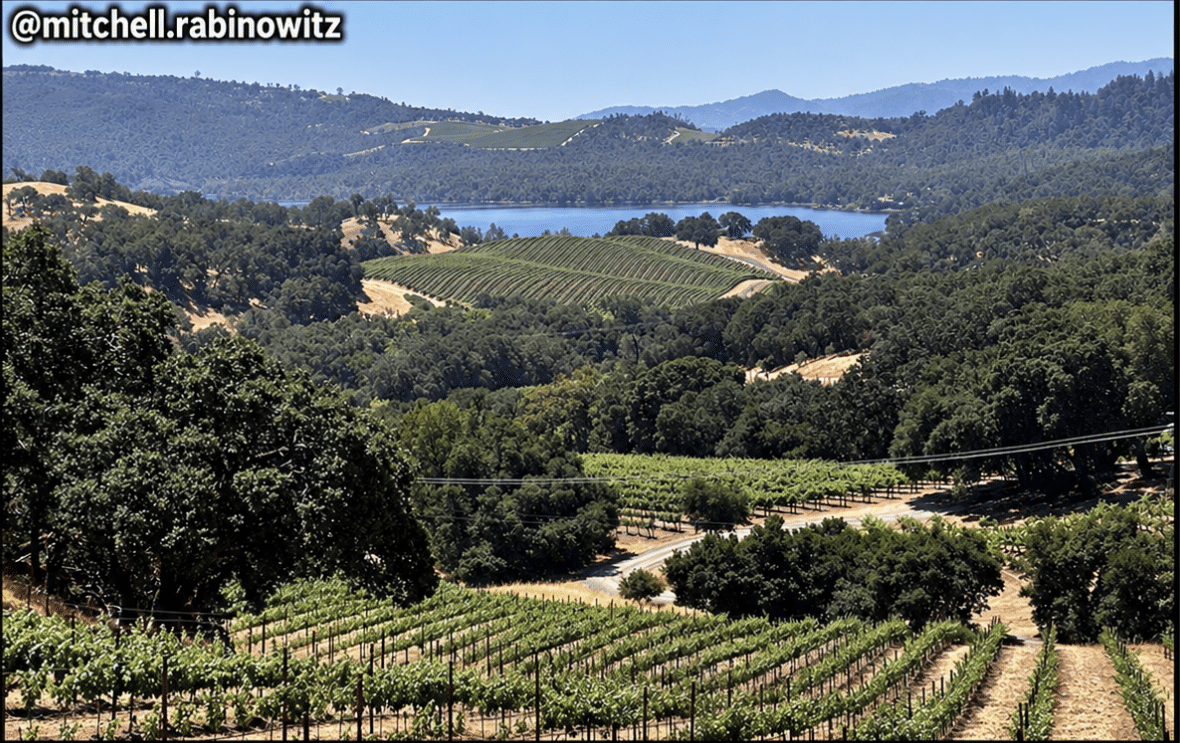
About fifty acres of the 300-acre property were planted to vines in the account John gave in 2024, with elevations extending from approximately 475 to 1,475 feet. The vineyards lie in the hills above Conn Valley, near the base of Howell Mountain, with steep slopes facing east and gentler slopes facing south and southwest. Geological faulting has produced at least three distinct soil types. These differences in soil and slope direction mean that Cabernet grown in one section need not ripen or taste exactly like Cabernet from another. The Estate Cabernet Sauvignon combines grapes from these different sections of the property and generally offers concentrated dark cherry and plum flavors with oak-derived spice. The published notes for the 2022 Estate describe eighteen months of barrel aging, including 35 percent new French oak and 5 percent new American oak. The remaining barrels contribute less fresh wood flavor, allowing the fruit to remain prominent while the wine develops during aging.
In 2004, Buehler began bottling Papa’s Knoll separately, narrowing the vineyard selection to a three-acre Cabernet block planted in 1971. The name refers to the knoll near the elder John Buehler’s home. Winery notes identify it as the estate’s dry-farmed Cabernet block, meaning that the vines are grown without routine irrigation and rely on water available in the soil. The block is steeply terraced on its eastern face and produces a small crop. In the winery’s account, its combination of dry farming and low yields brings harvest seven to twenty days ahead of the other estate Cabernet blocks. Papa’s Knoll has been described as the more concentrated, firmly tannic member of the Cabernet range, with dark fruit accompanied by dried-herb and spice notes.
For the 2019 Zinfandel, Buehler used a 4.5-acre estate block of approximately forty-five-year-old vines that had been dry-farmed for more than three decades. A small number of Petite Sirah vines grew among the Zinfandel, and the finished wine contained 95 percent Zinfandel and 5 percent Petite Sirah. Growing varieties together in this way follows an older California practice, with the additional grape contributing color, tannin, and peppery flavors. The vines were head-trained, with their branches arranged around the tops of individual trunks. Production was approximately 1,080 cases, and the wine aged for twelve months in French and American oak, with 20 percent new barrels. The wine’s berry and black-cherry flavors, pepper, and relatively supple tannins distinguished it from the estate Cabernets.
Before the wholly estate-grown 2019 Zinfandel, the family had also made a version using grapes from both the property and Pope Valley. An account of that earlier range records both Russian River and Carneros Chardonnays, along with a second label called Bon Marché. That red combined Zinfandel, Syrah, Merlot, and Malbec. Neither Carneros Chardonnay nor Bon Marché appears in the current principal wine list.
When fires approached the property in 2020, prevailing winds moved the Hennessey fire eastward, according to the winery, while the later Glass fire forced an evacuation after the estate’s Cabernet and Zinfandel had been harvested. Buehler reported that these circumstances allowed it to produce the wines without smoke damage. Two years later, heat created a different harvesting problem: estate Cabernet was picked rapidly around the early-September heat, while purchased Cabernet from vineyards farther south remained on the vines for approximately two additional weeks. Cronin described the resulting Napa Valley blend as brighter than the deeper, darker estate wines.
In 2023, approximately eight acres of older vines were replanted after yields had declined to around 1.5 tons per acre. A 2024 account describes the family’s farming as organic, although it does not establish organic certification. The family continued to manage the vineyards, make the wine, and bottle it on the property.
By 2024, all four of John’s children had returned to the business as employees and part-owners. Jonathan served as general manager, with Page working in the vineyards and cellar. Their sisters also held roles in the business: Lindsay as secretary of the family corporation and Helen in social media and sales. John described their involvement as arising from growing up with the land and seeing their parents and grandparents work there, while allowing them to pursue other interests before returning. With grandchildren growing up there as well, the next generational transition was already a practical concern.
In his 2024 account, John put annual production of the Napa Valley Cabernet at approximately 10,000 to 12,000 cases and the Estate Cabernet at about 3,500. The 2023 Chardonnay alone accounted for 7,700 cases, according to its vintage notes.
Cronin described John as viewing wine as something to drink regularly and willing to charge even less if the business allowed it. In September 2026, the winery offered the 2023 White Zinfandel at $15 and the 2023 Russian River Chardonnay at $25, followed by the 2022 Napa Cabernet at $42, Estate Cabernet at $50, and Papa’s Knoll at $65. The red Zinfandel had continued through at least the 2020 vintage, but was no longer included among the wines offered on the winery’s main sales page in September 2026.
Cronin announced his retirement in January 2026, following his final full vintage in 2025. On August 17, Buehler announced Elizabeth Kester as his successor after more than fifteen years at Wente Family Estates. As Wente’s director of winemaking, she had worked across both widely distributed wines and smaller selections, including Chardonnay and Cabernet Sauvignon.
Mitchell Rabinowitz
I’m a retired university professor with a Ph.D. in cognitive and developmental psychology. I taught cognition and education starting in 1984. In retirement I decided to take wine seriously, and I’ve been using AI to help me learn faster and create better. I’ve also learned you can’t just ask AI one question and call it done.
For me, an essay usually takes a number of iterations. I create a draft, then I check accuracy, hunt for gaps, revise the structure, and do it again until the piece feels coherent and useful. I also use other AIs as collaborators. It is an extensive process creating the essays.
I try to create these as stories because that is the format that sticks for most of us. Facts land better when they have a sequence and a few turning points. Connect with @mitchell.rabinowitz on Instagram