
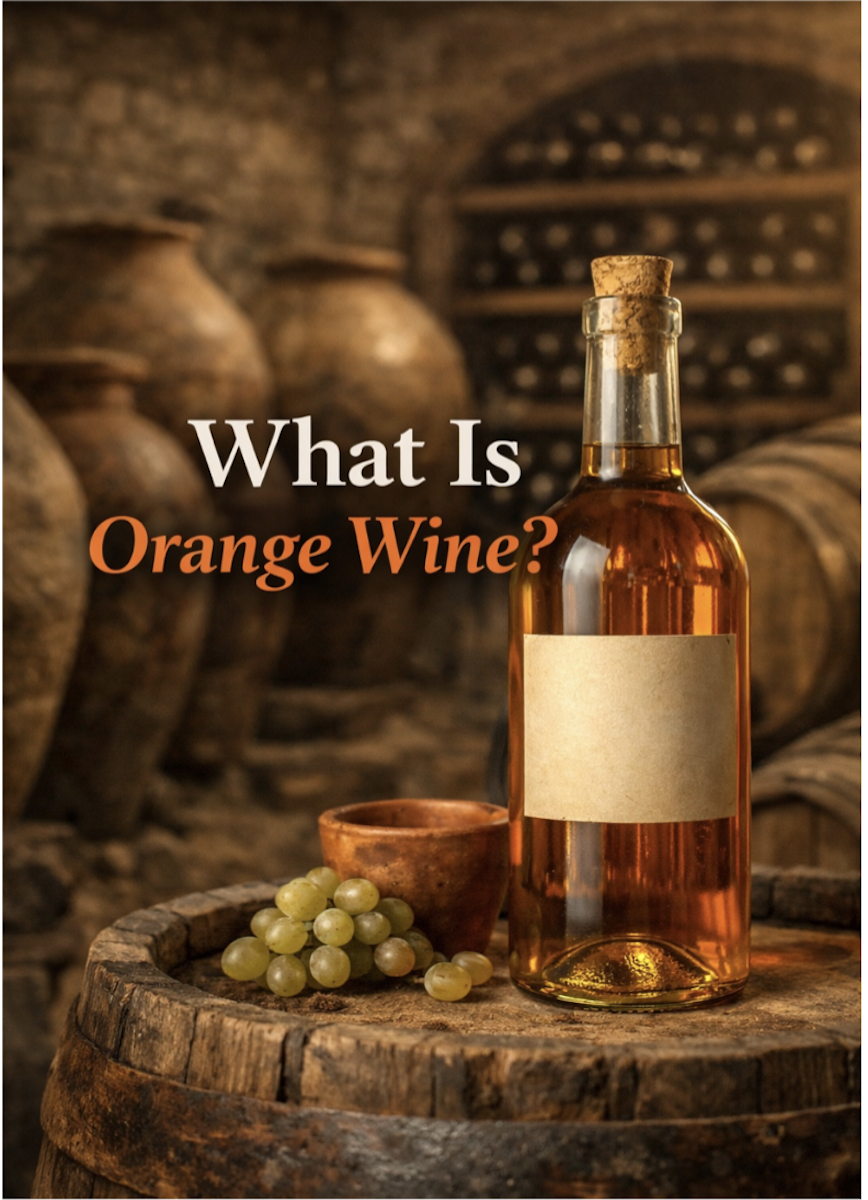

What Is Orange Wine?
Orange wine is often misunderstood before it is even poured. The name does not refer to oranges, orange flavour, or citrus infusion. It refers only to the colour that can appear when white grapes are fermented with their skins. Even that colour can vary widely, from pale gold to deep amber. The more useful starting point is the cellar practice. Orange wine is made from white grapes, but the juice remains in contact with skins, seeds, and sometimes stems for a period that may last from several days to many months. That contact changes the wine’s color, texture, aroma, and behaviour at the table.
Most white wines are pressed soon after harvest so the juice can be separated from the skins. That approach limits color extraction, reduces tannin, and preserves a fresher, cleaner profile. Orange wine follows a different path in the cellar. The winemaker allows the skins to remain with the fermenting juice, drawing out phenolic compounds that give the wine grip, dryness, and a more tactile finish. Ribolla Gialla, Rkatsiteli, Malvasia, Pinot Grigio, Chardonnay, and many other white grapes can be made this way, although some varieties respond more convincingly than others. The length of maceration, the ripeness of the grapes, the presence or absence of stems, and the vessel used for fermentation all shape the final wine.
The result is often closer in weight and feel to a light red than to a conventional white. Orange wine can have a dry, tea-like grip across the palate, with more chew and resistance than most white wines offer. That sensation comes from skin and seed contact. In moderate examples, it gives the wine firmness and food compatibility. In more extreme examples, it can become drying, rustic, or difficult for those who expect white wine to be polished and bright. Acidity still plays a central role, especially with grapes that naturally retain freshness, but acidity no longer works alone.
The aromas also differ from the usual profile of young white wine. Instead of fresh citrus, green apple, flowers, or tropical fruit, orange wines often show dried apricot, quince, bruised apple, orange peel, black tea, chamomile, hay, spice, nuts, and sometimes a savoury or saline edge. Some wines show oxidative notes, especially when they are made in porous vessels or with limited sulphur. Others are cleaner, more fruit-driven, and only lightly marked by skin contact. The category includes a wide range of wines, and that range is easy to miss when orange wine is treated as a single flavour.
The fermentation and aging vessel can deepen those differences. A lightly macerated white wine fermented in a closed stainless-steel tank may show colour, grip, and some added texture, but the wine remains relatively protected from oxygen. Qvevri and amphorae work differently. Their clay walls allow small amounts of oxygen to enter the wine over time, especially during long macerations and extended aging. That slow exposure can deepen colour, soften the feel of tannin through gradual polymerization, and add notes of nuts, dried fruit, tea, and spice. Oxygen does not define every orange wine, but in long-macerated clay-aged examples it helps explain why the wine can feel broader, darker, and more developed than a short skin-contact white made in a sealed tank.
The practice is old, even if its current popularity is recent. In Georgia, white grapes have long been fermented with skins in qvevri, large clay vessels buried underground. These wines belong to a continuous regional practice rather than a revived trend. In northeastern Italy, especially Friuli, and across the border in Slovenia, skin-contact white wines became important again in the late twentieth century as some producers moved away from highly controlled stainless-steel winemaking and returned to older cellar practices. Josko Gravner and Stanko Radikon were central to that return. Their wines showed how prolonged maceration, lower intervention, and alternative vessels could produce white wines with tannin, depth, and aging capacity rather than the bright, polished profile that had come to dominate much of modern white wine production.
Orange wine is also variable by design and by circumstance. Many examples come from producers who favour native yeasts, lower sulphur additions, longer lees contact, and little or no filtration. Those choices can give the wines greater complexity, but they can also increase bottle variation and make the wines less predictable. A mild cider-like note, haze, sediment, or a faintly wild aroma may be part of the wine’s style. That does not mean every cloudy or unstable wine should be excused. The distinction has to be made between deliberate texture and careless winemaking.
At the table, orange wine earns its place through texture as much as flavour. Its tannic grip allows it to handle dishes that would overwhelm many white wines, while its acidity and absence of heavy oak keep it from clashing with foods that might make red wine feel too forceful. It works well with braised chicken with preserved lemon, lamb tagine, mushroom risotto, aged cheeses, Korean banchan, Ethiopian lentils, grilled eggplant, fermented vegetables, and dishes built around spice, salt, fat, and umami. The wine’s dryness helps manage richness, while its savoury notes connect well with herbs, earthier vegetables, and slow-cooked foods.
Temperature changes the way orange wine presents itself. Around 55 to 60 degrees Fahrenheit, or 13 to 15 degrees Celsius, is often a better range than refrigerator cold. When served too cold, the aromas become muted and the tannins feel more severe. When served too warm, the wine may seem broad or heavy. Some bottles also improve with air, especially longer-macerated wines or examples showing reduction when first opened. Ten to twenty minutes in a carafe is enough for many examples. More powerful qvevri or amphora-aged wines may benefit from closer to an hour. Sediment is common and should not be treated as a defect unless it comes with signs of instability or spoilage.
Orange wine changes the expectations many people bring to white wine. It can be aromatic without being overtly fruity, dry without being sharp, and textured without being heavy. The best examples show that white grapes can carry grip, depth, and age-worthy complexity when the skins are allowed to take part in fermentation. The weakest examples remind us that cellar practice alone does not guarantee quality. Orange wine deserves neither automatic reverence nor easy dismissal. It deserves to be judged by the clarity of its farming, the care of its maceration, and the balance it achieves in the glass.
Mitchell Rabinowitz
I’m a retired university professor with a Ph.D. in cognitive and developmental psychology. I taught cognition and education starting in 1984. In retirement I decided to take wine seriously, and I’ve been using AI to help me learn faster and create better. I’ve also learned you can’t just ask AI one question and call it done.
For me, an essay usually takes a number of iterations. I create a draft, then I check accuracy, hunt for gaps, revise the structure, and do it again until the piece feels coherent and useful. I also use other AIs as collaborators. It is an extensive process creating the essays.
I try to create these as stories because that is the format that sticks for most of us. Facts land better when they have a sequence and a few turning points.
