
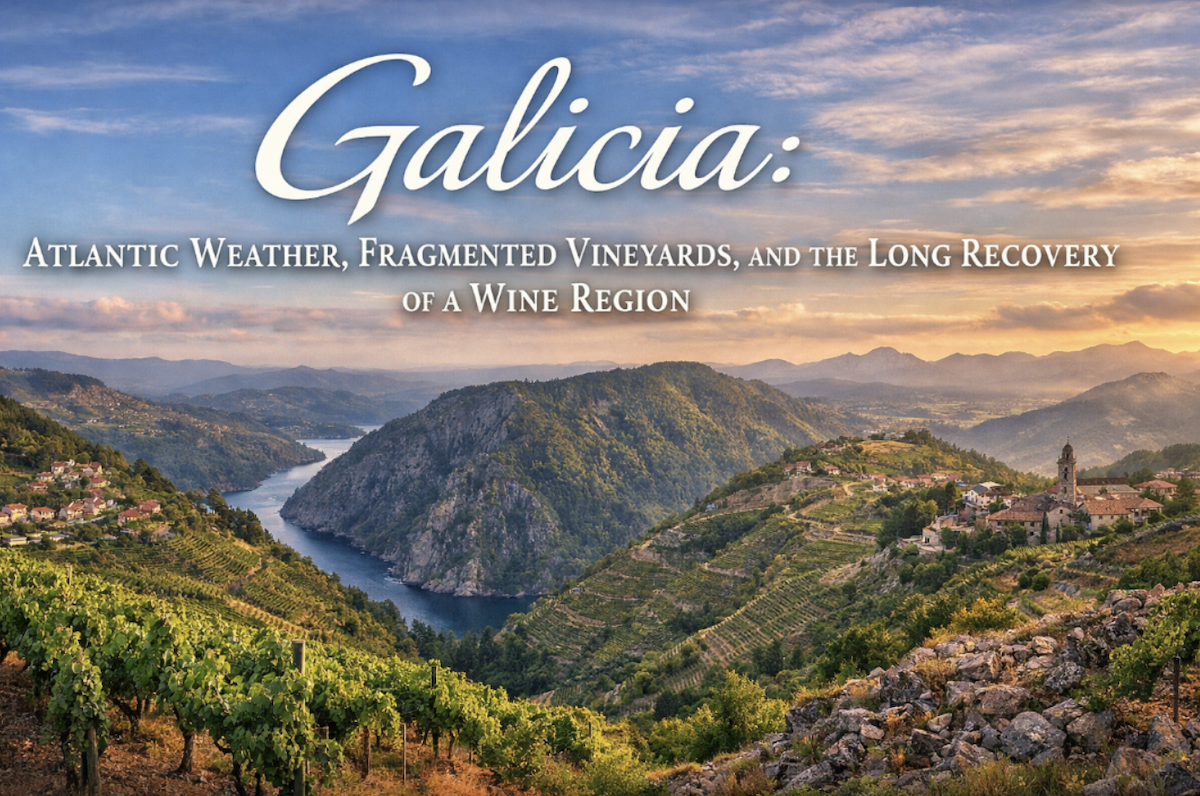

Galicia: Atlantic Weather, Fragmented Vineyards, and the Long Recovery of a Wine Region
Galicia occupies the northwestern corner of Spain, facing the Atlantic and bordered by Portugal to the south, Asturias to the east, and the inland lands of Castile and León beyond its mountain barriers. That position has always set it slightly apart from the image many drinkers carry of Spain as a dry, interior wine country. Galicia is wetter, greener, and more broken in shape. Its coastline opens into rías, which are river inlets flooded by the sea, and its interior is cut by river valleys. Its vineyard districts are scattered rather than continuous. Rías Baixas lies along the Atlantic edge. Ribeiro sits farther inland in the Miño, Avia, and Arnoia valleys. Ribeira Sacra follows the steep riverbanks of the Sil and Miño. Valdeorras and Monterrei push east and southeast toward warmer, less ocean-shaped conditions. The coastal inlets, inland river valleys, steep slopes, and warmer eastern districts kept winegrowing divided among different climates and farming problems from the beginning. Galicia today is divided among five main denominations of origin, usually shortened to DOs, which are legally defined wine regions with rules about where grapes come from and how wines are made.
The land divides the region further. In coastal and river-influenced zones such as Rías Baixas and much of Ribeiro, decomposed granite dominates. In Rías Baixas this weathered granite soil is often called xabre, and in Ribeiro sábrego. Both words refer to sandy material formed when granite breaks down over time. These soils drain water quickly, which is useful in a rainy climate, and they help account for the brightness and persistence of many of the region’s white wines. Farther inland, especially in parts of Valdeorras and Ribeira Sacra, slate and schist become more common. Schist is a layered rock that splits into thin sheets. These darker rocks
absorb and release heat differently from granite, which affects ripening in a region where elevation, sun exposure, and river influence can sharply alter the grapes. Galicia’s strongest wines come from this variation across soils, slopes, rivers, and climates.
Ancient viticulture in Galicia is commonly linked to Roman settlement, roads, and trade. Roman planting followed settlement, roads, and river corridors, where transport and local consumption could justify the labor of farming vines in a wet Atlantic region. In a wet Atlantic region, vine growing always required local adjustment. Galician wine depended from the beginning on finding workable places within a difficult climate. Historical accounts from the region connect the early spread of viticulture to Roman occupation and later continuity through local agriculture.
During the Middle Ages, that early base was deepened by monasteries, church institutions, and the movement generated by Santiago de Compostela. Pilgrimage routes created circulation, demand, and pressure to maintain vineyards. In places that would later become Ribeiro and Ribeira Sacra, wine belonged to the ordinary functioning of rural and religious life. Monasteries held land, organized cultivation, and helped stabilize farming in an area where vine growing required steady labor and local knowledge. The surviving terraces above the Sil and Miño, and the density of old monastic sites in what is now Ribeira Sacra, preserve the clearest visual reminder of that older order.
From the late Middle Ages into the early modern period, Galician wine entered a more openly commercial phase. Ribeiro, often associated historically with Ribadavia, became the leading name. Regional wine history records flourishing trade through the sixteenth century and into the first half of the seventeenth, with exports moving through Galician ports toward England, Flanders, and other markets. Ribeiro’s early export trade places modern recovery after a much
older period of commercial reach. Galicia was already producing wine of commercial reach long before the modern denomination period. At least one part of the region had become known enough to require rules against fraud and misuse. The later recovery came after earlier success, damage, and partial forgetting.
Rías Baixas, now the best-known Galician denomination abroad, is itself divided into five subzones: Val do Salnés, O Rosal, Condado do Tea, Soutomaior, and Ribeira do Ulla. These zones differ in temperature, rainfall pattern, and distance from direct Atlantic influence. Val do Salnés is the coolest and most ocean-facing. Condado do Tea is warmer and farther inland. O Rosal combines Atlantic exposure with the moderating effect of the lower Miño. Even within the region most closely associated with Albariño, Galicia resists simplification.
Those climatic differences shaped vineyard methods. Along the coast, humidity and disease risk encouraged training systems that lifted grape clusters above damp ground and improved airflow.
In Rías Baixas, the pergola system works only if growers manage the canopy with care. Albariño vines can carry dense leaf growth in the humid weeks of summer, and that canopy can trap moisture around the fruit. Leaf pulling and shoot positioning open the fruit zone to air and light. Without that work, downy mildew and rot can damage the crop before harvest. The clean, sharp profile associated with good coastal Albariño depends on repeated manual labor long before fermentation begins.
Inland valleys could offer warmer and more protected conditions, while eastern districts such as Valdeorras and Monterrei brought hotter summers, colder winters, and larger temperature swings between day and night than the coast. In Ribeira Sacra, the challenge was also gradient. The region is regularly described through the phrase viticultura heroica, or heroic viticulture, which refers to vineyard farming on very steep slopes, terraces, or high elevations where machinery cannot do much of the work and labor must be done largely by hand. In Ribeira Sacra, those conditions are visible in the socalcos, the stone terraces that hold the vineyards in place above the rivers. Much of the vineyard land lies on slopes above 30 percent, and the small size of many parcels makes cultivation even more demanding.
The nineteenth century and early twentieth century broke much of the region’s older continuity. Oidium, mildew, and then phylloxera forced replanting and altered the varietal balance of many districts. The consequences were biological and economic at once. In the effort to restore production, growers often turned toward more productive or commercially safer varieties, including Palomino and Garnacha Tintorera in some zones, at the expense of older local grapes. That kept vineyards alive, but it also reduced the specific qualities of many Galician wines and pushed parts of the region toward higher-volume production. The later return to native varieties, meaning grapes long established in the region itself, was a practical correction after decades of substitution and loss.
The current denomination map also shows how recent the formal rebuilding really is. Ribeiro became Galicia’s oldest official denomination in 1932. Valdeorras followed in the mid-twentieth century. Rías Baixas entered its modern phase much later, first around an Albariño-centered recognition in 1980 and then as the broader DO in 1988. Monterrei and Ribeira Sacra arrived still later, in the 1990s. What drinkers now see as a coherent set of Galician wine regions is therefore fairly recent in legal and commercial terms, even though the vineyards themselves are much older.
No part of that rebuilding is more instructive than the return of native grapes. Albariño became the best-known grape of Galicia through Rías Baixas, but it was never the whole story. Ribeiro rebuilt around Treixadura and mixed local white varieties. Valdeorras recovered Godello after it had come close to disappearance, with Horacio Fernández Presa’s ReViVal project beginning in 1974 and later replanting changing the future of the zone. Monterrei developed a broader balance
of whites and reds under warmer inland conditions. Ribeira Sacra emerged as one of the leading homes for Mencía. Across the region, improvement came when growers stopped treating yield and neutral flavor as sufficient goals and returned to grapes that could keep acidity, aroma, and flavours tied to particular places under Galician conditions.
The recovery of Albariño and Godello was not only a matter of replanting the right grapes. It required a different idea of how white wine should be handled after harvest. Earlier volume-driven production often depended on aggressive clarification and filtration, which could leave the wines clean but thin. Many current producers use stainless steel, concrete, or neutral wooden vessels, then keep the wine on fine lees, the spent yeast cells that remain after fermentation. Lees contact can give Albariño and Godello more weight and texture while preserving acidity. Neutral wood can add breadth without making the wine taste of new oak. The best examples show how cellar choices can support the fruit rather than cover it.
Godello is no longer only a rescued grape in Valdeorras. It has become one of Spain’s most closely watched white varieties, with enough recognition to draw attention from larger wine groups while still depending on old vines, slate soils, and careful farming for its best results. Ribeira Sacra has also entered a more complicated phase. Its steep vineyards and Mencía-based reds brought new attention to the region, but some ambitious growers now work partly outside
the DO, either because their vineyards, grape choices, or cellar decisions do not fit comfortably within the official category. That does not weaken the broader story. It shows that Galicia’s modern recovery is still active, with regulation, grower ambition, and old vineyard material not always moving at the same pace.
Galicia is still identified first with white wine, and in Rías Baixas Albariño accounts for the overwhelming majority of production, but native reds have become increasingly visible across the region. Caiño Tinto, Espadeiro, Loureiro Tinto, Sousón, Brancellao, and Merenzao are no longer only archival names or minor survivals. They are appearing in serious wines from coastal and inland districts, often with high acidity, moderate alcohol, and flavors that separate them from the fuller, oakier red wines many drinkers still associate with Spain. Mencía remains the
central red grape in Ribeira Sacra, but the broader revival of Galician red varieties has widened the region’s present-day range without forcing it to imitate Rioja, Ribera del Duero, or Priorat.
Caiño Tinto and Espadeiro can ripen late, and late ripening is difficult in Atlantic Galicia. If growers pick too early, the wines can carry green tannins and sharp edges. If they wait for full ripeness, autumn rain can swell the berries, dilute the fruit, or bring rot. Warmer autumns have made some of these red wines more commercially viable than they were in the past, but the grower still works close to the end of the season. Whole-cluster fermentation, now used by some producers with Mencía, Sousón, and other reds, adds another link between vineyard and cellar. Fermenting with intact bunches can help manage acidity and bring lift and spice, but it works
only when the stems are ripe enough. If the stems remain green, the method can make the wine harsher. The cellar decision therefore depends on the same late-season weather that determineswhether the grapes can stay on the vine long enough.
Before the modern denomination period, many Galician vineyards were not planted as neat blocks of one grape. A single parcel might contain Treixadura, Godello, Albariño, Loureiro, Caiño, Sousón, Mencía, or other local varieties mixed together according to family habit, exposure, and survival. Ribeiro and Ribeira Sacra often produced wines from co-fermented plots, meaning that different grapes were harvested and fermented together rather than separately. The late twentieth-century turn toward single-variety wines, especially Albariño in Rías Baixas and Godello in Valdeorras, helped Galicia communicate more clearly to export markets. It gave drinkers a grape name they could remember. Yet some growers are now returning to mixed parcels and co-fermentation because the old plantings can give a wine more breadth than a single grape can provide. This approach requires compromise at harvest. A mixed parcel is usually picked together, even if one variety is slightly ahead and another slightly behind. The grower accepts that unevenness because the finished wine carries the balance of the place as it was planted.
Galicia is marked by minifundio, the fragmentation of agricultural property into very small holdings divided across families and generations. The system complicates mechanization, scaling, and simple consolidation. It also helps account for the survival of old vines, local selections, and close knowledge of individual parcels. In the strongest current work, that inheritance has been used rather than flattened. Coastal pergolas in Rías Baixas still lift the fruit away from damp ground and improve airflow around the clusters. Terraced vineyards in Ribeira Sacra still demand exhausting hand labor. Inland districts still show a stronger continental pull than the coast. Galicia works best when its differences are farmed carefully rather than pushed toward uniformity.
Galicia now occupies a clear place in Spanish wine. It is not the country’s largest vineyard region, nor its warmest, nor its most straightforward. Its best wines are shaped by rain, by granite and slate, by river valleys and fractured ownership, by old varieties that nearly disappeared, and by a late but serious rebuilding based on local grapes and local conditions. The history of wine in Galicia runs through planting, trade, disease, substitution, recovery, and renewed attention to the farming and cellar decisions that make recovery durable. The present place of the region rests on
restoration carried out slowly and with unusual precision.
Mitchell Rabinowitz
I’m a retired university professor with a Ph.D. in cognitive and developmental psychology. I taught cognition and education starting in 1984. In retirement I decided to take wine seriously, and I’ve been using AI to help me learn faster and create better. I’ve also learned you can’t just ask AI one question and call it done.
For me, an essay usually takes a number of iterations. I create a draft, then I check accuracy, hunt for gaps, revise the structure, and do it again until the piece feels coherent and useful. I also use other AIs as collaborators. It is an extensive process creating the essays.
I try to create these as stories because that is the format that sticks for most of us. Facts land better when they have a sequence and a few turning points.
