
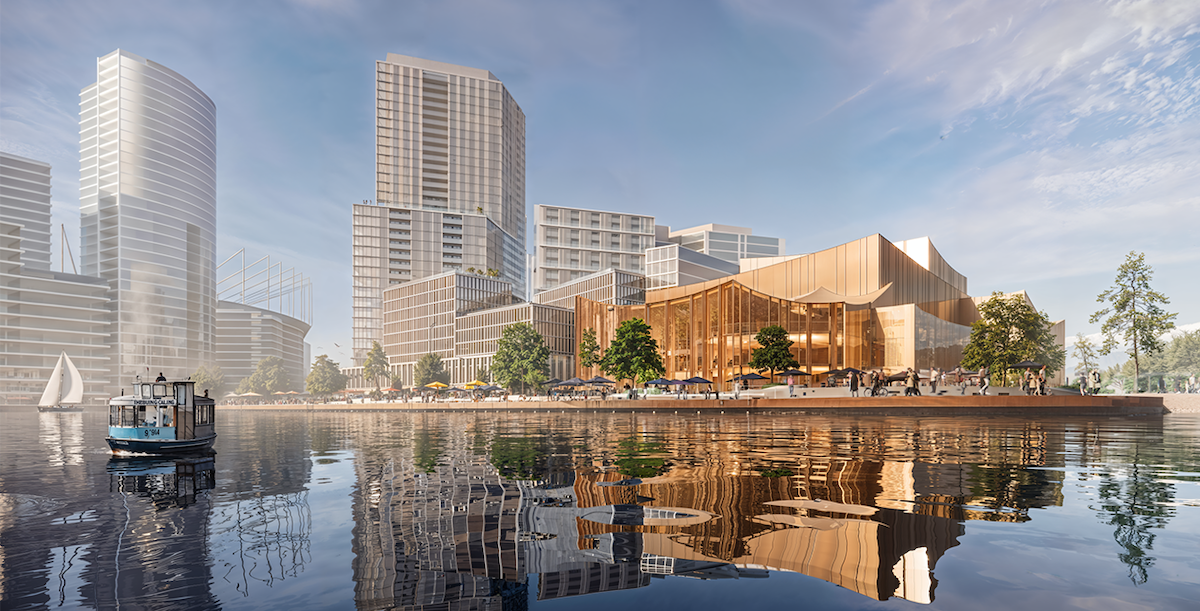

Vancouver Cultural Precinct Unveils Bold Vision for the
Most Significant Cultural Investment in the City’s History
Shaped by 32 of Vancouver’s leading performing arts organizations, the new cultural precinct will close a critical gap in purpose-built, acoustically-designed performance space, strengthening Vancouver’s standing among the world’s leading cultural centres.
Vancouver Cultural Precinct (VCP), an alliance of performing arts and community leaders led by the Vancouver Concert Hall and Theatre Society, today announced its vision for a state-of-the-art performing arts district in downtown Vancouver, featuring four new or renovated, acoustically-designed performing arts venues.
VCP’s proposal is the result of a two-year feasibility study, in consultation with 32 of Vancouver’s leading performing arts organizations, led by Diamond Schmitt Architects, renowned for its transformative, community-focused, sustainable approach to architecture and design. Addressing a well-documented gap in purpose-built, mid-scale and large-scale venues designed for performing arts, the four-venue proposal marks an unprecedented moment in Vancouver’s cultural history — the most ambitious and coordinated vision for performing arts infrastructure this city has ever seen. The proposal will guide the next phase of planning, including deeper technical analysis, partnership development, funding strategy, and meaningful engagement with civic, cultural, Indigenous, and community partners.
“This vision reflects a historic opportunity to give Vancouver’s artists and audiences world-class performance venues they have long deserved. By formally addressing the full venue ladder, from small to large, linked in one unified cultural precinct, we will unlock our city’s creative potential, supporting local artists, attracting world-class stars, spotlighting Indigenous performance, and transforming Vancouver into an international performing arts destination,” says Suzanne Anton, Chair, Vancouver Concert Hall and Theatre Society. “We are also deeply appreciative of the support shown across all three levels of government. This is a powerful signal of what becomes possible when culture is recognized as essential infrastructure.”
VCP began in 2022 as an alliance of arts and community leaders committed to strengthening Vancouver’s performing arts ecosystem by addressing the city’s lack of acoustically-designed venue space for organizations of varying sizes. At 0.52 seats per thousand residents, Vancouver has the lowest per-capita music hall capacity of any major Canadian or comparable international city – well behind cities such as Toronto (1.03) and Melbourne (1.44) – a gap that continues to widen as the region’s population is anticipated to grow by 67 per cent between 2001 and 2029 without a corresponding increase in performance venues. Some of the most recent contributions to Vancouver’s downtown cultural framework include the construction of the Queen Elizabeth Theatre in 1959, the Vancouver Playhouse in 1962, and the restoration of the Orpheum in 1977.
The critical venue shortage has led touring productions to bypass Vancouver in favour of cities such as Calgary and Seattle, and has left many of the city’s most acclaimed ensembles without a home suited to their scale and specific performance needs. Many organizations increasingly struggle to program regular season offerings due to the limited availability of existing spaces. Guided by Diamond Schmitt Architects, VCP’s 32 participating organizations — spanning orchestral, opera, dance, chamber, and choral companies — took part in bi-monthly planning meetings and in-person design workshops from 2025-2026 to define their space, acoustic, and programming needs. That process, grounded in audience data, venue-use modelling, and comparative benchmarking against peer cities and international precedents, produced a compelling proposal for a coordinated, four-venue precinct.
The four venues include a 400-seat Small Hall for recitals, chamber music, storytelling, and Cantonese opera; an 850-seat Medium Hall for chamber music, recitals, dance, opera, choral works, and small-scale orchestral performances; a 1,750-seat Concert Hall for large-scale orchestral and choral performances; and a 2,000-seat Large Proscenium venue for opera, ballet, and other large-scale performances requiring theatrical staging and an orchestra pit. Each has been designed around an acoustic-first philosophy, with flexible configurations intended to serve Vancouver’s full range of musical and performance traditions.
“The Vancouver Cultural Precinct is an opportunity to connect the excellence of award-winning performers to new venues, tailor-made for music, theatre, and dance. It will correct the shortfall of seats relative to other comparable cities and create a world destination for the arts. It is an extraordinary opportunity to shape a city’s identity through the transformative power of design,” says Don Schmitt, Principal, Diamond Schmitt Architects. “At Diamond Schmitt, we believe that great performing arts architecture can do more than house a performance. It can deepen connections between artists and audiences and extend those relationships into the broader community — dissolving the threshold between the performing arts and the city. Through that connection, these venues can create an arts precinct that will energize urban Vancouver economically, artistically, and culturally. To bring that vision to downtown Vancouver — to help define this city as a world-class cultural destination for generations to come — is among the most meaningful work we can do.”
While project investment estimates will be confirmed as part of the next phase of planning — anticipated in Spring 2027, following site selection finalization — the Vancouver Cultural Precinct represents a landmark public and private investment in the cultural future of this city. VCP is actively engaged in conversations with civic, provincial, federal, and Indigenous governments, as well as the philanthropic and private sectors, to build the funding coalition required to bring this vision to life.
“Vancouver has the artists, the audiences, and the ambition of a world-class cultural city,” says Mayor Ken Sim. “It’s encouraging to see organizations and community leaders advancing ideas that celebrate the arts and strengthen our cultural sector. We appreciate the vision and dedication that has gone into this proposal.”
Site locations are currently under active consideration, with VCP’s proposal identifying Georgia and Granville Streets as the defining axes of a future precinct, and early-stage concepts under review at Robson Square, Larwill Park, and Northeast False Creek – each offering strong transit access and the opportunity to link new venues into the surrounding cultural and civic fabric.
VCP’s feasibility phase has been funded to date with support from its 32 participating organizations through annual contributions, alongside funding from the Department of Canadian Heritage, the City of Vancouver, the BC Arts Council, Creative BC, as well as private donations. VCP will next undertake economic impact analysis, business case development, and site selection finalization, as the project advances into a predesign stage in 2026/27, with project definition and capital planning to follow in subsequent phases. The cultural precinct is anticipated to enter into a construction phase between 2029-2034, with rolling openings of completed venues to follow.
“Long before I was in politics, I was a music teacher, so I understand in a very personal way what it means for artists to have the right space to create and perform,” says the Honourable Anne Kang, Minister of Tourism, Arts, Culture and Sport. “British Columbia has proven, through events like the FIFA World Cup, that we know how to build world-class infrastructure and deliver for the world stage. The Vancouver Cultural Precinct is that same ambition applied to our performing arts sector – a sector that drives tourism, creates jobs in every part of our economy, and reflects the incredible diversity of the communities we serve.”
VCP participating organizations include: Ballet BC, Ballet Vancouver, Canadian International Arts and Music Society, Chor Leoni, City Opera Vancouver, Coastal Jazz and Blues Society, DanceHouse, Dancers of Damelahamid, Early Music Vancouver, Elektra, Friends of Chamber Music, Music on Main, Ne.Sans Opera & Dance, Opera West, Phoenix Chamber Choir, Turning Point Ensemble, Vancouver Academy of Music, Vancouver Bach Family of Choirs, Vancouver Cantata Singers, Vancouver Cantonese Opera, Vancouver Chamber Choir, Vancouver Chinese Choir Association, Vancouver Chopin Society, Vancouver Inter-Cultural Orchestra, Vancouver Men’s Chorus, Vancouver Metropolitan Orchestra, Vancouver Opera, Vancouver Recital Society, Vancouver Symphony Orchestra, Vancouver Youth Choir, Vancouver Youth Symphony Orchestra, and Vetta Chamber Music Society.
For more information on the Vancouver Cultural Precinct, visit vancouverculturalprecinc
Supporting Quotes:
“For decades, I’ve watched Vancouver’s performing arts community do extraordinary work without the purpose-built spaces they deserve. Many of them are too small to build their own spaces. A concept like this reflects years of dedicated work by 32 of our city’s leading arts organizations, and it addresses a gap that has held Vancouver back for far too long. Cultural infrastructure is not a luxury — it’s essential infrastructure, and it’s how we ensure our artists and audiences have a stage worthy of their talent for generations to come. I’m proud to support this vision as it moves forward.”
– The Honourable Hedy Fry, Member of Parliament for Vancouver Centre
“Arts and culture aren’t just part of what makes Vancouver a great place to live — they’re part of what makes it an economy that competes globally. A cultural precinct like this doesn’t just give our incredible performing arts community a home worthy of their talent — it creates jobs, drives tourism, and cements Vancouver’s place as a world-class cultural destination. I’m proud to see this vision come forward, and I’ll continue to be a strong voice for the partnerships that will help make it a reality.”
– Taleeb Noormohamed, Member of Parliament for Vancouver Granville
“Arts and culture help define who we are as a society. The Vancouver Cultural Precinct represents an exciting vision for strengthening our performing arts sector, creating more opportunities for artists, and ensuring residents and visitors alike can experience world-class cultural programming here in Vancouver. By bringing together organizations from across the performing arts community, this proposal demonstrates the power of collaboration and long-term planning to support a vibrant, inclusive, and creative city for future generations. I look forward to seeing this important work continue as the project moves into its next phase.”
– Zoe Royer, Member of Parliament for Port Moody–Coquitlam
“I have spent my career supporting the growth and development of Vancouver’s world-class music community. By working alongside dozens of organizations who have offered their expertise, real-world experience, and shared vision for future potential, this proposal will help enable artistic excellence at every scale and greatly expand access to arts and culture for both local residents and visitors alike.”
– George Laverock, Secretary of the Vancouver Concert Hall and Theatre Society, and Board member of the Vancouver Youth Choir and Vancouver Youth Symphony Orchestra
About Vancouver Cultural Precinct (vancouverculturalprecinct.ca)
Vancouver Concert Hall and Theatre Society’s mission is to transform and elevate music-based performing arts in Vancouver. The Society was formed in 2002, and is now working in collaboration with 32 participating music and dance organizations. VCP’s plan proposes four synergistic venues — new and renovated, acoustic-first, and flexible in use — to close a documented venue gap and establish Vancouver as a global performing arts destination. VCP operates as a project of the Vancouver Concert Hall and Theatre Society, a not-for-profit organization.
Featured image: rendering by Diamond Schmitt Architects
