
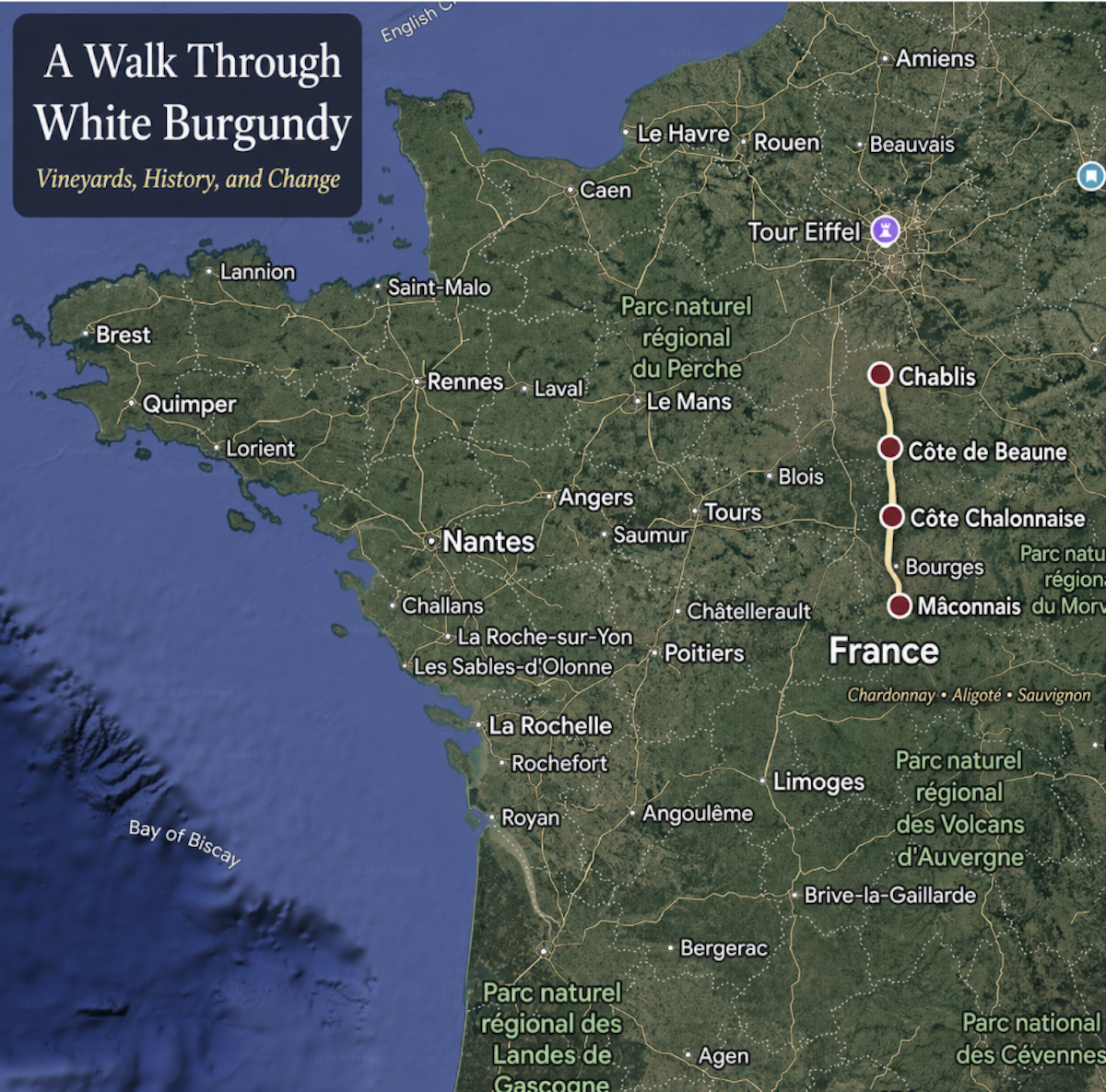

A Walk Through White Burgundy: Vineyards, History, and Change
Vines were growing in Burgundy during the Gallo-Roman period, although the surviving evidence does not establish when they first arrived or which grapes were planted. By the early Middle Ages, vineyards had become important to religious communities and secular landowners because wine was required for worship, consumed locally, and sold to support large estates. The history of white Burgundy began within that mixed agricultural economy, centuries before Chardonnay became its principal grape.
Monasteries, Dukes, and the Division of the Land
The Abbey of Cluny was founded in 910, and the Cistercians established Cîteaux in 1098. Both orders acquired vineyards through gifts, purchases, and exchanges. Their members improved drainage, built walls, tested cultivation methods, and recorded the results of their work. The Cistercians assembled the Clos de Vougeot over several centuries, while other religious houses controlled important vineyards throughout the Côte d’Or and Chablis.
These communities contributed to the close observation of individual parcels, although the modern system of climats developed through a much longer process. A climat is a named and precisely delimited vineyard parcel whose location has been recognized over time. Monasteries participated in that history, as did the dukes of Burgundy and later landowners. Wine merchants influenced reputations through the prices they paid, while local authorities eventually established legal rules for distinctions that had developed through cultivation and commerce.
The dukes used wine as an article of commerce and political prestige. In 1395, Philip the Bold prohibited Gamay in parts of his territory and promoted Pinot Noir, which he considered better suited to the reputation he wanted Burgundy to maintain. The decree concerned red wine, but it demonstrated that grape selection was already connected to regulation and commercial standing.
White vineyards contained more variation than they do today, and historical names do not always correspond neatly to modern grape varieties. Chardonnay, Pinot Blanc, and Pinot Gris could be confused or grouped under local names. Aligoté emerged in Burgundy during the seventeenth century, so it belongs to a later period than the medieval vineyards associated with Cluny and Cîteaux. Both Chardonnay and Aligoté are natural crosses between Pinot and Gouais Blanc, a widely cultivated medieval grape that later lost favor.
Chardonnay became more widely planted because it ripened reliably in many Burgundian sites and produced distinctive wines under different local conditions. Its dominance also resulted from replanting, commercial demand, and the rules adopted for individual appellations. The process cannot be reduced to a judgment that one grape was inherently superior to all the others.
Church property was confiscated during the French Revolution and sold at auction. Vineyards passed into private hands, and inheritance divided many holdings among successive generations. A grower might eventually own several rows in one climat and another small parcel elsewhere in the village. Merchants known as négociants became increasingly important because they could purchase grapes or finished wine from numerous owners, assemble commercial quantities, mature the wines, and distribute them beyond Burgundy.
During the nineteenth century, writers and local committees began organizing the established reputations of vineyards. Jules Lavalle published his classification in 1855, and the agricultural committee in Beaune produced another ranking in 1861. These efforts preceded the French appellation system, which created enforceable rules during the 1930s. Montrachet, Chevalier-Montrachet, and Corton-Charlemagne received Grand Cru appellations in 1937, establishing legal classifications for distinctions that had developed over several centuries.
Phylloxera, Replanting, and Chardonnay Selection
Phylloxera reached Burgundy during the late nineteenth century and killed vines by feeding on their roots. Replanting became possible after growers grafted European grape varieties onto resistant American rootstocks, the rooted lower portions of the new vines. The choice of rootstock affected vigor and the ability of a vine to obtain water from a particular soil, while the selection of Chardonnay material affected yield and the composition of the grapes.
Clonal selection became increasingly important during the twentieth century. A clone consists of vines propagated from a single plant chosen for particular characteristics. Some Chardonnay clones were selected for regular production and relatively high yields, qualities that assisted reconstruction and made commercial sense during periods when growers received modest prices for their wine. Excessive production could dilute flavor and delay ripening, so growers controlled vigorous clones through pruning, shoot removal, and crop reduction.
Producers later became more interested in lower-yielding clones and sélection massale, in which new vines are propagated from several desirable plants within an established vineyard. Sélection massale preserves greater genetic variation than planting a single clone, although it requires careful observation and can reproduce vine diseases that have not yet produced visible symptoms. Many contemporary vineyards contain a mixture of older selections, twentieth-century clones, and newer material chosen to accommodate warmer and drier seasons.
Chablis and the Northern Vineyards
Pontigny Abbey was founded in 1114, and its Cistercian community contributed to the development of vineyards near Chablis. Producers could move their wine along the Yonne and Seine rivers to Paris, giving the district access to a large urban market. Chablis expanded for centuries because its location supported production and distribution.
The nineteenth century removed several of those advantages. Railways allowed inexpensive wines from southern France to reach Paris, while powdery mildew, then known locally as oidium, and downy mildew increased the cost of cultivation. Phylloxera then destroyed vines whose roots offered no resistance to the insect. Two world wars reduced the available workforce, and recurring frost made replanting financially dangerous. By 1955, only about 550 hectares remained under vine.
The frost of 1957 destroyed almost the entire crop. Growers subsequently adopted vineyard heaters, followed by sprinkler systems that coat young growth with a protective layer of ice during freezing conditions. Mechanization reduced the labor required to maintain larger areas. These changes supported a recovery that accelerated after the abundant 1970 harvest, and the Chablis district now contains approximately 5,800 hectares of vines.
Chablis became a protected appellation in 1938, with Chardonnay established as its authorized grape. Its vineyards are divided among Petit Chablis, Chablis, Chablis Premier Cru, and Chablis Grand Cru. Petit Chablis is commonly planted on higher ground where younger Portlandian limestone is prevalent. Many of the leading Chablis vineyards occupy Kimmeridgian formations containing limestone, clay, and fossilized marine material, including the small oyster Exogyra virgula.
The seven Chablis Grand Crus occupy adjoining sections of the hillside above the Serein River. Les Clos has broad exposure and a substantial elevation range, while Valmur lies in a small valley between neighboring sectors. Their shared classification does not make their growing conditions identical. Differences in exposure and slope position affect ripening, while soil depth determines how much water remains available during a dry summer.
Eleni Theodoropoulos and Edouard Vocoret began making wine from family parcels during the 2010s. Les Pargues lies near the valley containing Montmains and has an exposure associated historically with Premier Cru vineyards, although it is classified as Chablis. Le Bas de Chapelot sits below the Premier Cru Montée de Tonnerre, closer to the Serein, where deeper clay contributes additional weight. The two parcels are fermented separately, allowing their differences to be examined without relying on the appellation hierarchy alone.
Julien Brocard began working biodynamically within the Jean-Marc Brocard estate and later developed wines under his own name. His cellar includes stainless steel and large wooden vessels, with concrete or amphora used for selected wines. Samuel Billaud established his domaine after leaving the family business in 2009 and now produces several Chablis Premier Crus, including Montée de Tonnerre. Their methods differ, but both have reconsidered farming and maturation while continuing to work within the established appellations.
Saint-Bris and Sauvignon in the Yonne
Southwest of Chablis, Saint-Bris occupies vineyards around Saint-Bris-le-Vineux and several neighboring communes. It received village appellation status in 2003 and differs from the other white-wine appellations of Burgundy because its authorized grapes are Sauvignon Blanc and Sauvignon Gris. The wines commonly retain pronounced acidity and can carry citrus or herbal aromas that distinguish them from nearby Chardonnay.
Saint-Bris developed within the Grand Auxerrois, where Chardonnay, Aligoté, Pinot Noir, and César are also cultivated under other appellations. Its inclusion prevents white Burgundy from being treated as an exclusively Chardonnay and Aligoté region. The appellation also demonstrates how local cultivation survived without being replaced by the dominant Chardonnay production of Chablis.
The Côte de Beaune
The principal white-wine villages of the Côte de Beaune occupy a narrow band of slopes formed from several Jurassic geological layers. Limestone, marl, and clay occur in different proportions, while faults and erosion have exposed different formations over short distances. Elevation changes affect temperature, and variations in exposure alter the amount of sunlight received during the day.
Oolitic limestone formed from small rounded particles of calcium carbonate deposited in shallow Jurassic seas. Some formations contain enough openings and fractures for roots to move through the rock. Marl contains more clay and holds water for longer periods. Harder limestone can restrict root growth where it remains compact, although natural fissures may allow roots to reach moisture below the surface.
Comblanchien limestone belongs to the same broad Jurassic history, but its principal outcrops occur farther north in the Côte de Nuits. It should not be used as a general description of the Montrachet or Corton slopes. Those hills contain their own combinations of limestone and marl, and the sequence changes with elevation. The amount and type of soil above the underlying rock affect drainage and determine how long moisture remains available during drought.
Corton-Charlemagne occupies parts of the hill of Corton above Aloxe-Corton, Pernand-Vergelesses, and Ladoix-Serrigny. Many Chardonnay vines grow on upper sections containing pale marl and limestone. Exposure changes as the hill curves from southeast through south to southwest, producing differences in morning sun and afternoon heat. These differences affect ripening even within the same Grand Cru appellation.
Pernand-Vergelesses occupies cooler slopes on the western and northwestern side of the Corton hill. Its white wines can retain acidity during warm years because some parcels receive less direct afternoon heat than vineyards facing south. Earlier ripening has increased interest in these locations, particularly when growers need alternatives to the warmer sections of the Côte de Beaune.
Farther south, Meursault has no white Grand Cru, although vineyards such as Perrières and Genevrières have longstanding reputations. Puligny-Montrachet and Chassagne-Montrachet share the Montrachet slope, but their village vineyards extend into areas with different soil depths and exposures. The common description of Meursault as broad, Puligny as restrained, and Chassagne as powerful provides only a starting point because vineyard location and producer decisions can outweigh a village generalization.
Saint-Aubin lies in a lateral valley behind the Montrachet vineyards. Its elevation and exposures historically made complete ripening less dependable during cool seasons, but warmer vintages have reduced that disadvantage. The village has consequently received greater commercial attention, while its prices have generally remained below those of Puligny-Montrachet and Chassagne-Montrachet. Vineyards close to the western end of the Montrachet slope can produce concentrated Chardonnay when their grapes ripen fully.
Cellar Work and Premature Oxidation
Barrel fermentation became closely associated with the white wines of the Côte de Beaune, although the amount of new oak has always varied. Producers also differ in their use of lees stirring, known as bâtonnage, which moves sedimented yeast through the wine during maturation. Malolactic fermentation usually occurs in these wines, converting sharper malic acid into softer lactic acid, but its speed depends on cellar temperature and the condition of the wine.
Premature oxidation became evident during the 1990s when some white Burgundies aged much faster than expected. Producers investigated reduced sulfur levels and oxygen exposure during pressing. Cork quality also received attention because natural corks can differ in density and in the amount of oxygen they allow to reach the wine, producing substantial variation among bottles from the same case.
Bâtonnage became part of the investigation because repeatedly opening a barrel and stirring its contents can introduce oxygen. Many producers reduced the frequency of stirring or stopped it after the early stages of maturation. Pressing practices were reconsidered, and sulfur levels at bottling received closer measurement. These changes did not constitute a single regional procedure because producers differed in their assessment of the causes.
Producers also began using technical closures more frequently, including DIAM closures made from treated cork particles. They are manufactured to admit a more predictable amount of oxygen than individual natural corks and also reduce the risk of cork taint. Some producers continue to use high-grade natural cork, while others select different DIAM versions according to the expected maturation period of the wine.
Domaine Roulot in Meursault and Domaine Raveneau in Chablis have long records of producing Chardonnay that can develop over extended periods when vineyard conditions and cellar work are carefully controlled. Talloulah Dubourg and Hugo Mathurin established Domaine de Cassiopée in Sampigny-lès-Maranges in 2020 under financial and climatic conditions that differed from those faced by earlier domaines. They farm organically and incorporate biodynamic practices.
The Boisset family created Domaine de la Vougeraie in 1999 by consolidating holdings accumulated through several earlier estates. It now works across numerous appellations. Its adoption of organic and biodynamic farming demonstrates how those methods can be applied across dispersed parcels, although each vineyard requires decisions suited to its exposure and soil.
The Côte Chalonnaise and Aligoté
Vineyards continue south from the Côte de Beaune into the Côte Chalonnaise, where slopes are interrupted by valleys and agricultural land. Rully received its appellation in 1939 and produces Chardonnay as well as Pinot Noir. The village also has a long association with sparkling wine. In 1822, merchants from Chalon-sur-Saône invited a producer from Champagne to make sparkling wine from their holdings in Rully, beginning a local activity that later became part of Crémant de Bourgogne.
Montagny received its appellation in 1936 and produces white Chardonnay exclusively. Its vineyards are distributed among Montagny-lès-Buxy and three neighboring communes, with 49 climats entitled to Premier Cru status. Limestone and marl are common, but the broken topography creates differences in altitude and exposure that cannot be represented by a single description of Montagny.
Aligoté remained important in the Côte Chalonnaise even as Chardonnay became dominant elsewhere. Bouzeron gained its own village appellation in 1998 and is the only Burgundian village appellation devoted exclusively to Aligoté. Aubert and Pamela de Villaine played an important role in increasing recognition of the grape through Domaine de Villaine, although the appellation resulted from the collective work of local growers. Aligoté generally retains high acidity and produces less body than Chardonnay, while mature vines on the limestone slopes of Bouzeron can give wines with considerable concentration.
The Mâconnais and New Premier Crus
The hills broaden around the limestone formations of Solutré and Vergisson, while the climate becomes warmer than it is in Chablis or the Côte d’Or. Chardonnay ripens more readily in these southern vineyards, although altitude and exposure can preserve acidity in cooler sites. The resulting wines vary considerably because the Mâconnais covers a large area with many soil types and elevations.
Cooperatives became especially important during the twentieth century because they allowed small growers to pool grapes and share the cost of production. Much of the region’s wine was sold under broad Mâcon appellations or through négociants. Estate bottling later increased, and individual villages or parcels received greater attention as growers sought to distinguish their wines.
Jean-Christophe Perraud founded his domaine in 2005 from vineyards cultivated by earlier generations of his family around La Roche-Vineuse. He produces wines from Mâcon appellations as well as Saint-Véran and Pouilly-Fuissé, and the estate now practices certified organic viticulture. His work belongs to a wider development in which growers have separated parcels, controlled yields, and extended maturation for wines intended to age.
Pouilly-Fuissé received 22 Premier Cru climats beginning with the 2020 vintage. The classification followed more than a decade of geological study and historical research, covering approximately one quarter of the appellation. It also showed that Burgundy’s legal classifications can be amended when growers establish a detailed case for particular sites.
Beginning with the 2024 vintage, Pouilly-Loché received Premier Cru status for Les Mûres, while Pouilly-Vinzelles gained three Premier Cru climats: Les Longeays, Les Pétaux, and Les Quarts. These wines must be harvested by hand, and herbicides are prohibited in the classified parcels. Their recognition expanded the Mâconnais hierarchy beyond Pouilly-Fuissé and gave legal standing to distinctions that local growers had pursued since 2006.
Trunk Disease and Vine Mortality
Esca and related grapevine trunk diseases have become persistent problems throughout Burgundy. The fungi associated with these diseases enter and damage the vine’s permanent wood, interfering with the movement of water. Visible signs can include striped discoloration on the leaves and reduced growth, followed in some cases by the sudden collapse of an established plant. Symptoms may disappear for a season and return later, making infection difficult to measure through visual inspection alone.
Pruning creates wounds through which the fungi associated with trunk diseases can enter a Chardonnay vine. An affected vine may produce fewer grapes for several years before a section of the plant or the entire trunk dies. Removing and replacing the vine creates an uneven vineyard in which young plants compete with established neighbors. The new vine then requires several seasons before producing a normal crop.
Guyot-Poussard pruning is intended to preserve continuous channels through which water and nutrients move inside the vine, while placing cuts where damaged wood is less likely to block that movement. Some growers retrain a surviving shoot from below the damaged section, while others remove decayed tissue from the trunk. These methods require additional skilled labor and cannot guarantee that an infected vine will survive.
Dead vines reduce yields, and their young replacements require individual care while competing with the roots and leaves of established neighbors; missing plants also complicate mechanized work. Widespread replanting removes old root systems that may be better equipped to reach moisture during drought. Vine mortality therefore affects annual production as well as the long-term composition of the vineyard.
White Burgundy Under a Warmer Climate
Harvest records from Beaune extend to the fourteenth century and provide unusually detailed evidence of long-term change. Since 1988, harvests have begun approximately thirteen days earlier on average than during the preceding historical period. Earlier ripening can produce healthy grapes and reduce exposure to autumn rain, but rapid sugar accumulation can also increase alcohol before flavor development and acidity reach the balance desired by the grower.
Spring frost remains dangerous because warmer winters can advance budbreak, leaving young growth exposed when freezing weather returns. Summer drought has created additional problems, especially for young vines with shallow root systems. The heat and lack of rain reported during the summer of 2026 intensified concern about reduced yields and an exceptionally early harvest.
Shallow soils over compact rock may lose accessible water quickly, while fractures in the limestone can allow roots to reach moisture at greater depth. Clay-rich marl holds more water, but it can become difficult for roots to penetrate after it dries and contracts. Two neighboring parcels may therefore respond differently to the same period of heat.
Some growers now preserve additional leaves to shade grapes during extreme heat, while others adjust planting material or examine cooler parcels at higher elevations. Pruning dates are also being reconsidered because they affect the timing of growth. Earlier picking can retain acidity, although harvesting too soon may leave the grapes without sufficient flavor. Soil cultivation and ground cover are being revised to conserve water and limit erosion.
Pressing and fermentation temperature can influence the finished wine, as can oak use and oxygen management, but cellar decisions cannot reverse conditions established during the growing season. All of those decisions begin with the composition of the harvested grapes. The differences among Chablis, the Côte de Beaune, the Côte Chalonnaise, and the Mâconnais therefore continue to depend on vineyard location as well as the decisions made during each vintage.
By July 2026, growers were preparing for an early harvest while replacing vines lost to disease and maintaining older plants through a dry summer. The work required decisions about when to pick and how much leaf cover to retain, followed by choices in the cellar once the grapes arrived. Appellation names identify the origin of the wine, while the differences visible between neighboring rows result from decisions accumulated over many seasons. A walk through those rows ends with current vineyard work because the continued production of white Burgundy depends on maintaining the vines that remain.
Mitchell Rabinowitz
I’m a retired university professor with a Ph.D. in cognitive and developmental psychology. I taught cognition and education starting in 1984. In retirement I decided to take wine seriously, and I’ve been using AI to help me learn faster and create better. I’ve also learned you can’t just ask AI one question and call it done.
For me, an essay usually takes a number of iterations. I create a draft, then I check accuracy, hunt for gaps, revise the structure, and do it again until the piece feels coherent and useful. I also use other AIs as collaborators. It is an extensive process creating the essays.
I try to create these as stories because that is the format that sticks for most of us. Facts land better when they have a sequence and a few turning points.
