
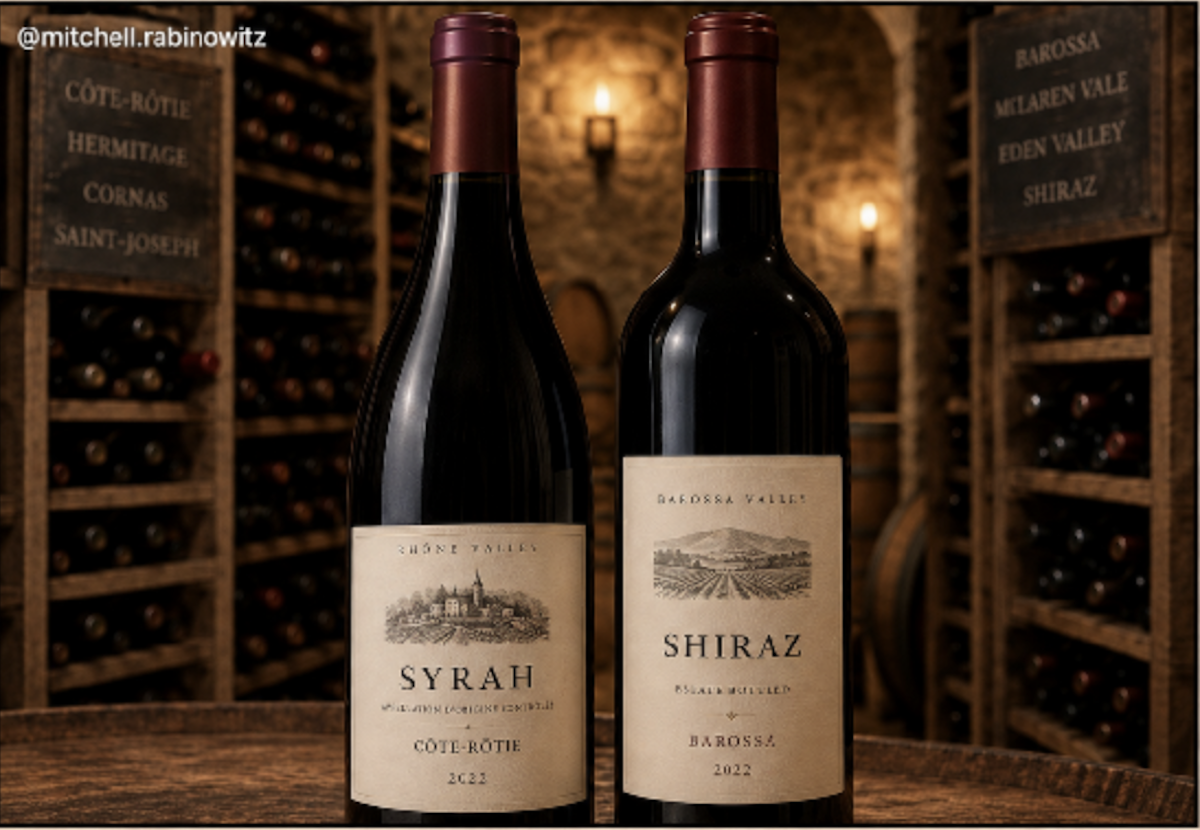

Syrah and Shiraz: How One Grape Acquired Two Names
Syrah and Shiraz are the same grape. The difference is linguistic and often stylistic. When a producer chooses one term over the other, the choice can signal the tradition the producer has in mind and the kind of wine they intend to make. Syrah began in southeastern France, traveled to Australia during the nineteenth century, acquired a new name there, and eventually became associated with two somewhat different ideas about what the grape could produce.
Genetic research established that Syrah is the offspring of Dureza and Mondeuse Blanche, two varieties associated with southeastern France. That finding ended older stories connecting the grape with the Persian city of Shiraz. The grape’s history is French, and its closest historical association is with the Northern Rhône. By the time Syrah became established in appellations such as Hermitage, Côte-Rôtie, Cornas, and Saint-Joseph, growers had learned how strongly the variety responded to differences in slope, exposure, temperature, wind, and ripeness. Much of the Northern Rhône vineyard occupies steep hillsides where the underlying geology includes granite and schist, although the soils vary considerably from one appellation and even one section of a hillside to another. Cornas is dominated by decomposed granite, while Hermitage includes granite as well as limestone, clay, flint, and alluvial deposits. These differences affect drainage and the amount of water available to the vines during the growing season.
Côte-Rôtie contains vineyards approaching gradients of 60 percent, and terraces supported by stone walls make cultivation possible on some of the steepest land. Much of the work must be done by hand because machinery cannot safely operate on these inclines. In parts of the Northern Rhône, vines are trained to individual wooden stakes called échalas, which support the shoots against strong winds. Northerly winds move through the Rhône corridor, although the hills and vineyard exposures can shelter individual sites from their full force. Dry winds after rain can also remove moisture from the vines and reduce conditions favorable to fungal disease.
Syrah decline, known in France as dépérissement de la Syrah, causes reddening of the leaves and cracks around the graft union and can eventually kill the vine. It has been observed in Syrah vineyards in several countries, and susceptibility varies among clones. Despite extensive investigation, no pathogen has been established as the cause, and the precise mechanism remains unresolved. The condition has influenced the selection of planting material and decisions about the long-term health of Syrah vineyards.
In these relatively cool vineyards, Syrah can retain acidity while developing firm tannins and a distinctive range of aromas. Black pepper, smoked meat, olive, violets, and dark fruit became closely associated with the wines of the region. Classic Northern Rhône Syrah is usually medium- to full-bodied, with firm acidity and tannin and less obvious fruit richness than warmer-climate examples. Blackberry, black raspberry, and sometimes plum can be present, but pepper, olive, violet, smoke, herbs, and cured meat often remain just as noticeable. A traditional warm-climate Australian Shiraz is more likely to be fuller-bodied and broader in texture, with riper blackberry, blueberry, and black-plum flavours, sometimes accompanied by chocolate, licorice, baking spice, mint, or eucalyptus. Alcohol may be higher, and the ripe fruit can create an impression of sweetness even when the wine contains little residual sugar and is technically dry. These are broad stylistic tendencies rather than rules, particularly as Australian producers increasingly work with cooler sites and earlier harvests.
In Côte-Rôtie, Syrah may be fermented with a small amount of Viognier, a white grape grown in the same region. Some producers ferment the varieties together rather than making separate wines and blending them afterward. Viognier can contribute floral aromas and can also help stabilize the wine’s color. The practice is traditional rather than universal, and many Côte-Rôtie wines contain little or no Viognier.
Northern Rhône Syrah works particularly well with dishes in which herbs and earthy flavors are prominent and sweetness remains modest. Roast lamb with rosemary and garlic works because the fat softens the impression of tannin while the herbs correspond with the wine’s own herbal and peppery aromas. Duck with lentils works for much the same reason, while mushrooms and thyme also suit the wine. Spice itself is not necessarily a problem, but sweet glazes and heavily sugared sauces can make a restrained Syrah seem more acidic and tannic. The same balance of acidity, fruit, and tannin can also allow the best examples to develop for decades. With age, fresh fruit aromas change and savory secondary aromas become more prominent. Pepper, smoke, and black fruit can develop into dried herbs, cured meat, leather, and forest-floor aromas.
Young Syrah can sometimes seem closed because of firm tannin or reduction, a temporary sulfur-like aroma that can dissipate after exposure to air, and decanting can help in those cases. Mature Syrah can be more fragile, and prolonged exposure to oxygen can diminish aromas that developed during years in the bottle. A young wine that seems closed may benefit from an hour or two in a decanter, while an older bottle may need only enough time to separate the wine from its sediment. The age and condition of the individual bottle are better guides than the name on the label.
In 1831 and 1832, James Busby traveled through vineyards in France and elsewhere in Europe collecting vine cuttings that he believed could be useful in the young Australian colonies, and Syrah was among the varieties he brought back. The cuttings reached Australia in 1832, and the variety subsequently became established in New South Wales, Victoria, and South Australia. During the nineteenth century, several spellings appeared, including Scyras and Shiraz. Shiraz eventually became the standard Australian name, although the surviving record does not establish precisely why that spelling prevailed.
The Barossa Valley contains hills and differences in elevation, but many vineyards occupy gentler terrain than the precipitous slopes of Côte-Rôtie and allow conventional trellising and much greater use of machinery. Its soils are varied, with combinations of loam, clay, sand, and iron-rich material occurring across the region rather than a single dominant soil type.
In the warmer parts of South Australia, Shiraz could reach greater ripeness and produce wines with more obvious black fruit and a fuller texture. Barossa Valley and McLaren Vale became especially closely associated with this style. Alcohol could be higher and acidity could seem softer, while the wine often felt broader and more mouth-filling than a traditional Northern Rhône Syrah. These differences arise from climate, vineyard site, harvest decisions, vine age, water availability, and winemaking rather than from any difference in the grape itself.
Australia never produced only one kind of Shiraz, and Hunter Valley developed its own tradition of long-lived wines while Victoria and South Australia contained vineyards that produced different results depending on elevation, exposure, and local climate. Some nineteenth-century Shiraz vineyards survived into the modern era, including old plantings in Barossa and other parts of South Australia. These vineyards became increasingly important as Australian producers and drinkers began to value the country’s surviving old vines. At the same time, Shiraz remained important in blends as well as varietal wines, and for much of Australian wine history the grape did not carry the international prestige it would acquire later.
Australian wine exports expanded rapidly during the late twentieth century, and Shiraz became one of the varieties through which international drinkers came to know Australian wine. Ripe fruit, generous body, and powerful flavor became closely associated with the name. Producers such as Penfolds and Henschke demonstrated that Australian Shiraz could also age for decades. Penfolds Grange and Henschke Hill of Grace became the most famous examples, although longevity was never confined to those wines. As serious Shiraz matures, fresh blackberry and plum can develop into dried plum, fig, leather, spice, and more savory aromas while the tannins soften and the texture becomes smoother.
Smoked brisket, ribs, peppercorn steak, and spiced lamb can suit the fruit and weight of richer Australian Shiraz. Very hot spice can make a high-alcohol Shiraz seem hotter, but smoke and rich meat generally work well. Sweeter sauces that can overwhelm a restrained Northern Rhône Syrah are often easier for a ripe Shiraz to accommodate. Young, concentrated Shiraz can also benefit from air when oak, alcohol, or tannin seems prominent immediately after opening. Older bottles may contain considerable sediment and can benefit from careful decanting, but extended exposure to air is no more automatically desirable for old Shiraz than it is for old Syrah.
During the late twentieth and early twenty-first centuries, Australian producers increasingly explored cooler regions such as the Yarra Valley, Adelaide Hills, Canberra District, Grampians, Eden Valley, and Frankland River, where the grape can retain more acidity and produce peppery, savory wines with less obvious fruit richness. These wines can be medium-bodied rather than massive, with firmer acidity, more noticeable pepper and floral aromas, and less of the broad, ripe texture traditionally associated with warm-climate Shiraz. Even within the Barossa region, cooler Eden Valley can produce wines that differ considerably from those of the warmer Barossa Valley floor. Some producers began using the name Syrah for these wines to signal an association with the Northern Rhône. Others continued to call equally restrained wines Shiraz because the Australian name remained part of their regional and historical tradition.
Producers in California and Washington generally used Syrah, even when warmer vineyards produced wines as ripe and powerful as many Australian examples, while South African producers used both names. Australian producers could call a cool, savory wine Shiraz, while another producer working nearby might call a similar wine Syrah.
Syrah still carries its strongest association with southeastern France and the Northern Rhône, while Shiraz remains inseparable from the history of Australian wine. Today the region, vineyard, vintage, and producer usually tell more about what will be in the glass than the choice between Syrah and Shiraz on the label.
Mitchell Rabinowitz
I’m a retired university professor with a Ph.D. in cognitive and developmental psychology. I taught cognition and education starting in 1984. In retirement I decided to take wine seriously, and I’ve been using AI to help me learn faster and create better. I’ve also learned you can’t just ask AI one question and call it done.
For me, an essay usually takes a number of iterations. I create a draft, then I check accuracy, hunt for gaps, revise the structure, and do it again until the piece feels coherent and useful. I also use other AIs as collaborators. It is an extensive process creating the essays.
I try to create these as stories because that is the format that sticks for most of us. Facts land better when they have a sequence and a few turning points. Connect with @mitchell.rabinowitz on Instagram
