
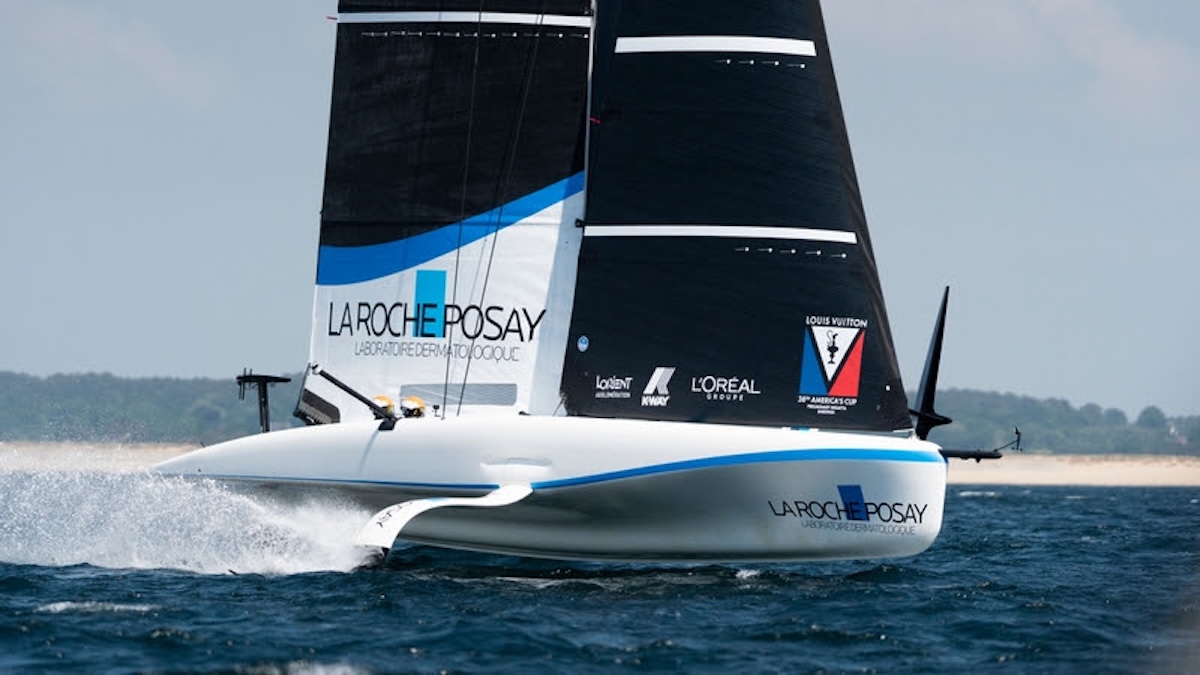

Louis Vuitton 38th America’s Cup Preliminary Regatta Sardinia
T-1 for La Roche-Posay Racing Team
From Training to Competition
With 24 hours to go before the first fleet races, the French La Roche-Posay Racing Team is preparing to face its first real test against the competition it will face in the 38th America’s Cup.
Much work has been done away from the eyes of others, with hours spent repeating manoeuvres, fine-tuning reflexes, learning how their boat reacts, and building a common language within the race team.
And now there is the moment when all of it must hold up against the fleet, the starts, the opponents, and the pressure. For the La Roche-Posay Racing Team, that moment begins in Cagliari.
Starting Thursday, May 21, the French team led by Quentin Delapierre will take part in the Louis Vuitton 38th America’s Cup Preliminary Regatta Sardinia, the first preliminary regatta of the 38th America’s Cup cycle. On the Gulf of Angels, eight AC40s will compete in a short and intense format: one official training day followed by three days of racing, with up to eight fleet races before a match-race final between the top two crews.
For La Roche-Posay Racing Team, the objective is clear: move from solitary preparation to direct competition. Measure. Learn. Adjust. And begin to establish its level within the fleet.
A first confrontation, more than a first ranking
Cagliari will not contribute any points toward Naples 2027. This preliminary regatta will have no direct impact on the final standings of the 38th America’s Cup. But it will reveal a great deal.
It will show where the teams stand in their preparation. It will reveal how crews react in traffic. It will highlight reflexes, weaknesses, relative speeds, starting precision, manoeuvre quality, and the ability to stay composed when eight AC40s are racing together at very high speed.
In Lorient, La Roche-Posay Racing Team built its foundations alone, away from the competition. The spring training camps allowed the team to work on their roles, timing, communication, and sailing modes. In Cagliari, that work will now be tested against another reality: the others.
Quentin Delapierre, skipper and helmsman of La Roche-Posay Racing Team, said: “This is our first real milestone with our new crew. In Lorient things came together really well, and the six of us feel comfortable together. We completed some very strong training blocks, but alone in Lorient we were a bit like kings of the track. Here, it’s a reality check. The goal is to apply in the racing, with all the competitors around us, everything we learned on our own.”
The team approaches this “reality check” with clear-eyed awareness. Some teams have logged more sailing days, and in some cases have had the opportunity to train with two boats. La Roche-Posay Racing Team arrives with a different trajectory: less prior competition, but a strong focus on its own boat, sensations, and processes.
Philippe Presti, the sporting director of La Roche-Posay Racing Team, said: “We have a different approach because we trained alone. We focused on ourselves, our manoeuvres, our strategy, and our performance. The first few days will allow us to draw conclusions, adapt, and keep improving. That’s the most important thing.”
Cagliari, a Mediterranean racecourse that will set its own pace
The Gulf of Angels is not just a backdrop. In Cagliari, the racecourse can quickly become a major factor in the regatta. The course layout is expected to be fairly standard, but more crowded with eight AC40s on the line, so less space, more crossings, a high-pressure starting phase, and close-quarter situations that can completely change a race.
The first days on site have already reminded everyone that the Mediterranean is not always easy to read. Arriving in Sardinia late last week, the French team were faced with too much wind before finally being able to sail on Sunday, Monday, and Tuesday in very light breeze.
The weather outlook forecasts sunshine, a southerly airflow, and probably some sea state – an important factor for the AC40, a very fast and highly reactive boat but one that becomes demanding whenever transitions, flight phases or manoeuvres are executed in rougher water.
Philippe Presti: “The race area is fairly classic, but with eight boats there will be less room. The starting phase is a bit larger, fairly close to a match-race box. Over the weekend there will probably be some sea state, and we’re happy to have sailed in those conditions in Lorient.”
In Lorient the team accumulated 19 sailing days, with at least three hours on the water every day. Intense sessions, sometimes highly focussed, which allowed the team to cover a wide range of conditions and sailing modes.
Quentin Delapierre: “The conditions in Lorient were exceptional. We had a lot of high-quality hours on the water and were able to cover the full range of techniques we wanted to test, both in terms of our own needs and the work of the performance department. Training alone also has advantages: it allows you to learn how to feel your boat, recognise the sensations that generate speed, and focus the whole team on a single objective.”
On board, an organisation designed to learn quickly
On an AC40 roles are assigned with extreme precision. Two helmsmen, two trimmers. Each person sees part of the race, acts on part of the boat, and contributes to a sequence of decisions. At this speed, performance does not depend on a single action, but on the quality of coordination.
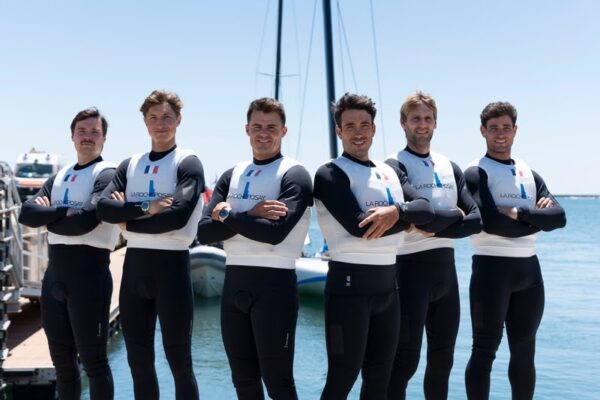
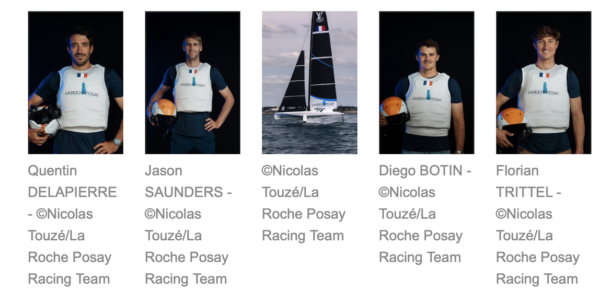
For this preliminary regatta, La Roche-Posay Racing Team will field Quentin Delapierre and Diego Botín as helmsmen, with Jason Saunders and Florian Trittel as trimmers. The crew will be completed by two reserve athletes: Enzo Balanger, helmsman, and Timothé Lapauw, trimmer.
The crew composition follows a dual logic: relying on the existing experience from the 2024 campaign, with Quentin and Jason, while integrating two world-class sailors, Diego and Florian, Olympic champions and newcomers to the AC40 environment.
The choice of onboard positions was guided by the need to build reference points quickly. With limited sailing time, the team prioritised role stability, continuity of experience, and the rapid development of system automation.
Philippe Presti: “With around twenty days on this boat, we had to establish reference points quickly. We organised the boat by maintaining continuity with those who already had experience in certain positions, while integrating Diego and Florian. We worked on manoeuvres, starts, communication, timing, but also on the ability to build decisions as pairs and as a group of four.”
Quentin Delapierre stresses this point: even when one helmsman “finalises” a sailing phase, the decision is never individual. It is built onboard by the team, through a sequence where every piece of information matters.
“The start is really built by two and by four. If Diego doesn’t give me the tack exactly in the right place, things become very complicated. And if the tack is good but I don’t correctly apply our strategy in the final phase, it’s just as complicated. We spend a lot of time working on our timing and discussing these sequences.”
In Cagliari this coordination will be one of the major topics. Fleet starts, crossings, trajectory choices, transitions, and high-pressure moments will test the quality of this still-young team chemistry, already considered promising by the sporting management.
Clear ambitions: improve under pressure, build for the future
La Roche-Posay Racing Team arrives in Sardinia to measure itself and improve. Cagliari is not an end in itself: it is a first pressure test, a rare opportunity to see how the boat, the sailors, and the organisation react together in a competitive environment.
This regatta must provide far more than a ranking. It must generate lessons, benchmarks, work priorities, and a better understanding of what the team still needs to build.
Philippe Presti: “The America’s Cup is made up of big machines. You have to learn how to put yourself under fire, see how the organisation reacts, and improve from those situations. This regatta is one of the rare opportunities to put everyone into real confrontation.”
This first fleet appearance will also allow the team to measure how far it has come since the start of the previous cycle. The team has grown in scale, strengthened its management, structured its performance approach, and integrated new profiles.
Quentin Delapierre:“Compared to the start of the previous campaign, the team has really taken a major step forward. The arrival of Philippe Presti, Philippe Mourniac, Lucas Delcourt, Diego Botín, and Florian Trittel changes a lot of things.
We worked extremely well in Lorient, dissecting manoeuvres, the feel of the boat, and making sure we are all on the same page. On the eve of Cagliari, I am reasonably confident. We have very good feelings onboard, and above all we are excited to race against eight boats.”
In Sardinia, La Roche-Posay Racing Team wants to turn every race into a data source, every high-pressure situation into learning, and every improvement into a foundation for what comes next.
How to follow the regatta
The regattas will be broadcast live starting at 3:00 p.m. CEST on the official America’s Cup website and the competition’s official YouTube channel.
Replays will be available after the races.
Eight teams entered:
New Zealand – Emirates Team New Zealand
New Zealand – Emirates Team New Zealand: Women & Youth
Great Britain – GB1
Great Britain – Athena Pathway: Women & Youth Team
Italy – Luna Rossa 2
Italy – Luna Rossa 1: Women & Youth Team
Switzerland – Tudor TeamAlinghi
France – La Roche-Posay Racing Team
About the America’s Cup
Founded in 1851, the America’s Cup is the oldest trophy in international sport and remains one of the most prestigious competitions in the world. Standing at the crossroads of sailing, technology, engineering, and strategy, it pits the planet’s finest crews against each other aboard boats capable of reaching spectacular speeds.
Since its inception, the America’s Cup has continually evolved, reinvented itself, and pushed the boundaries of its time, making each edition a new chapter in the history of maritime performance. More than just a regatta, it is a laboratory for innovation where every detail matters: the design of the foil, the reliability of the system, the precision of each manoeuvre, and the cohesion of every team.
The America’s Cup is a complete sporting ecosystem structured around several key highlights: the preliminary regattas, the challenger qualification phases, the semi-finals, and the final to determine the team that will face the Defender. The winner of this selection series will then challenge the trophy holders, Emirates Team New Zealand, in the America’s Cup Match, scheduled to begin on 10 July 2027 in Naples.
Alongside the main event, the Youth America’s Cup and the Women’s America’s Cup provide a major stage for the next generation and the top female talents in international sailing.
To date, teams in the 38th America’s Cup include: Emirates Team New Zealand (Cup Defender), GB1 (Challenger of Record), Luna Rossa, Tudor Team Alinghi, La Roche-Posay Racing Team, and American Racing Challenger Team.
About La Roche-Posay Racing Team
La Roche-Posay Racing Team is the French Challenger competing in the America’s Cup, the 38th edition of which will take place in Naples in 2027.
Supported by an experienced team both on the water and ashore, skipper and pilot Quentin Delapierre leads a highly regarded team that embodies the excellence and audacity of French sailing on the world stage.
The team is operated by K-Challenge, France’s leading sports-tech company dedicated to high-performance competitive sailing, managed by Stéphan Kandler and Bruno Dubois. Driven by a forward-looking vision, the company actively promotes diversity, the development of female athletes in competitive sailing, and the training of young talent.
This sporting and social drive is backed by the support of an exceptional title partner, La Roche-Posay (a L’Oréal Group brand), alongside the strong commitment of a collective of official partners and supporters.
Feature image: ©Nicolas Touzé/La Roche-Posay Racing Team
