
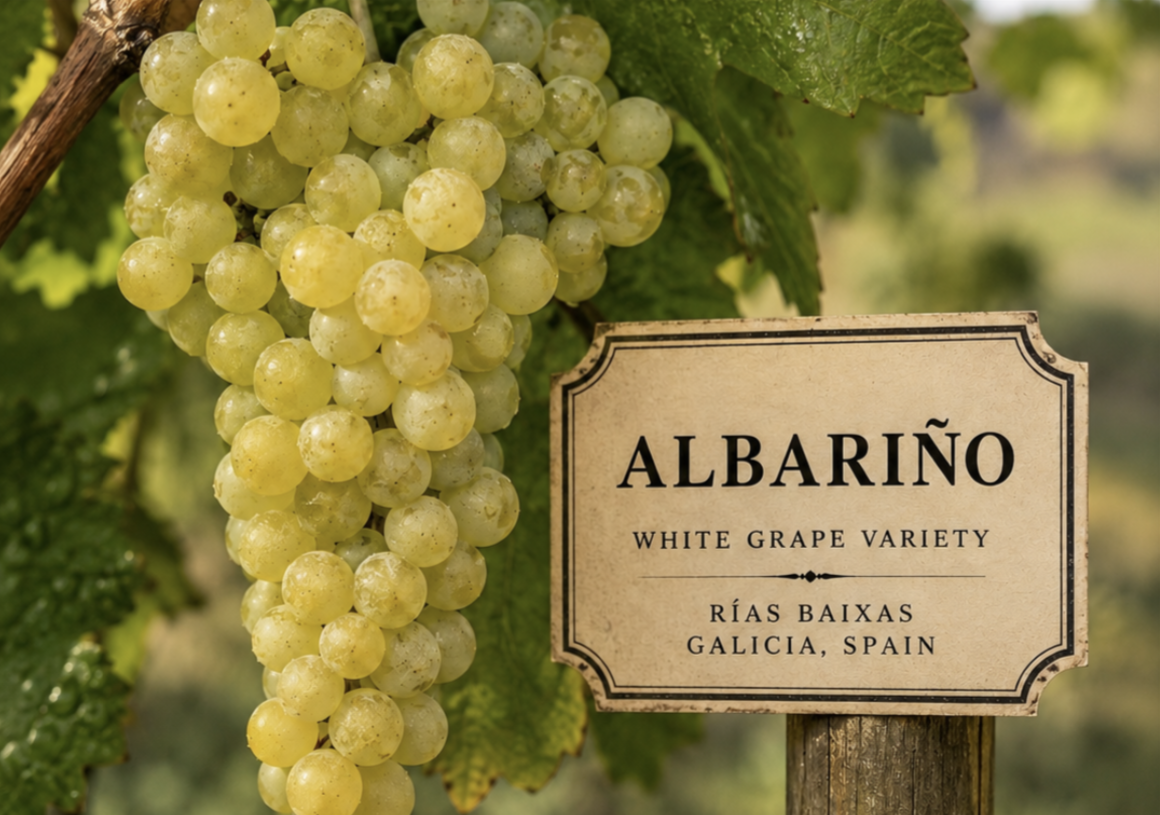

Albariño: Coastal Farming and Atlantic Viticulture
In Galicia, vines grow under Atlantic moisture, where rain is not an interruption but one of the governing facts of agriculture. The coast is cut by rías, the long tidal inlets that bring ocean air inland and keep humidity high through much of the growing season. In this setting, Albariño did not become valuable because it was easy to grow. It became valuable because it could survive where many other white grapes would struggle. Its small berries, thick skins, and loose clusters reduce rot risk in a climate where mildew and botrytis remain constant concerns. The grape’s acidity, now treated as one of its commercial virtues, began as part of its agricultural usefulness. It could ripen in cool, wet conditions while retaining enough freshness to make stable, direct, locally useful wine.
The vineyard system that developed around Albariño was equally practical. Growers trained vines high above the ground on pergola systems known locally as parrales. The raised canopy moved the fruit away from damp soil, allowed air to circulate through the leaves and bunches, and gave coastal winds a chance to dry moisture after rain. Beneath the vines, families could still cultivate vegetables, maize, or other crops, an advantage in a region shaped by small parcels and divided inheritance. The parral was not a visual signature created for visitors. It was a practical response to rot pressure, land scarcity, and humid air. In a place where rainfall can exceed 1,500 millimeters, vine training became one of the basic tools of survival.
The soils reinforced this form of adaptation. Much of Rías Baixas rests on granite, but the most useful material for growers is often the degraded granite known locally as xabre or sábrego. This weathered granite breaks into sandy, loose-textured soil that drains quickly during heavy spring and winter rains. In a wetter, more compact soil, vines would sit too long in water, roots would suffer, and disease pressure would increase. In xabre, water moves through the soil while roots can work into cracks and fissures in the underlying stone. The result is a practical condition for viticulture: drainage in a region with heavy rainfall, low nutrient levels that restrain excessive vigor, and root access that can help vines through drier summer intervals.
Albariño’s origin was long wrapped in a story of travel. Older accounts linked it to Cistercian monks and suggested that the name meant “white from the Rhine.” That explanation gave the grape a northern European pedigree, but it now looks less convincing than the evidence for a long Iberian presence. Genetic and archaeological work has strengthened the view that Albariño belongs to northwestern Iberia and may have been cultivated there for centuries before the modern appellation existed. This changes the history of the grape because Albariño was not introduced into Galicia as a modern specialist variety. It belonged to a mixed farming world of smallholders, pergolas, household plots, and wines consumed close to where they were grown.
For much of the twentieth century, that local world remained outside international wine culture. Albariño was made in small quantities, often consumed locally, and rarely presented as a fine white wine. Production came from thousands of growers farming tiny parcels. Many did not bottle under their own names. Wine moved through local networks, served in homes, taverns, and coastal restaurants rather than exported through a unified regional brand. Older cellar practice reflected that world. Before stainless steel became dominant, fermentation and storage often took place in old vessels, including chestnut barrels, a local material suited to Galicia’s forest economy but less useful for preserving the precise aromatic range now associated with Albariño. Some wines would have shown more oxidative handling, broader texture, and less of the clean citrus and floral detail expected today.
Rías Baixas received DO status in 1988, two years after Spain entered the European Economic Community, and that regulation changed how Albariño moved beyond Galicia. The new designation gave the region boundaries, recognized subzones, rules, yield limits, permitted varieties, and a system of record-keeping that allowed the wines to move with greater consistency into export markets. This administrative change did not invent Albariño, but it changed how the grape could be presented. Local wine could now carry a defined origin, and fragmented farming could be gathered under a regional name. Producers could invest in modern equipment, and buyers outside Galicia could begin to associate Albariño with a specific Atlantic region rather than a vague coastal white from northwest Spain.
The five subzones of Rías Baixas show why that origin cannot be reduced to a single flavor sequence. Val do Salnés, centered around Cambados and close to the Atlantic, is the coolest and wettest major area for Albariño. Its wines often show firm acidity, citrus, green apple, and a saline finish, with less overt ripeness than warmer inland sites. O Rosal lies farther south near the Miño River and the Portuguese border, where slightly warmer conditions allow peach, apricot, and floral tones to come forward, often in blends that include Loureira or Treixadura. Condado do Tea, farther inland along the river, is warmer again, producing wines with more body, riper fruit, and sometimes higher alcohol. Ribeira do Ulla, in the north, offers cooler but somewhat drier conditions and often produces lighter, more floral wines. Soutomaior, the smallest subzone, remains limited in scale but adds another variation to the appellation’s geography.
Cellar practice now centers on preserving Albariño’s aromatics while managing its acidity. Temperature-controlled stainless steel allowed producers to protect citrus, peach, apple, and floral aromas that could be lost through warmer fermentation or rougher handling. Many producers block malolactic fermentation to retain the grape’s crispness, especially in warmer years when freshness can be harder to preserve. In colder vintages, or in selected lots with particularly high malic acid, some winemakers may allow partial or full malolactic conversion to soften the edge. This decision shapes whether the wine remains sharply angular, gains roundness, or loses the directness that many drinkers expect from Albariño.
Lees aging has become another useful cellar tool. By keeping wine in contact with spent yeast cells after fermentation, producers can add texture, body, and a faint savory dimension without relying on obvious oak flavor. In the best examples, lees contact gives the wine more physical presence while leaving the acidity intact. Some producers extend this aging substantially, especially for old-vine or selected-parcel bottlings. Others use oak or larger neutral vessels in measured ways, particularly in warmer subzones where fruit and body can support a broader cellar approach. These choices have expanded the category beyond young, stainless steel Albariño without erasing the grape’s coastal traits.
Climate change has complicated every part of this calculation. Earlier harvests, warmer summers, and shifting rainfall patterns require closer attention to canopy density, pruning, crop load, and picking date. In cooler years, the old problem remains excessive rain and disease pressure. In warmer years, sugar can rise quickly, pushing alcohol upward before skins, seeds, and aromatics have reached full maturity. Growers must decide whether to pick early and preserve acidity, or wait for fuller flavor while risking higher alcohol and lower freshness. Some producers are looking to higher or better-ventilated sites. Others adjust canopy work to protect fruit from sun while still preventing humidity from building inside the vine. The same region that once solved wet-weather viticulture through parrales and drainage now has to answer a more variable climate without losing the qualities that made Albariño recognizable.
Albariño’s spread beyond Galicia has extended the agricultural comparison. In Portugal, where the grape is called Alvarinho, Monção and Melgaço produce wines that are often fuller, riper, and more tropical than many examples from Val do Salnés. The warmer conditions and different cellar traditions give the wines more body while preserving acidity and aromatic lift. In California, especially in coastal areas such as Santa Barbara and Edna Valley, Albariño has found sites where marine influence helps preserve freshness. Uruguay and Australia have also explored the grape, particularly in regions where maritime air or moderate temperatures can support its natural balance. These wines do not reproduce Rías Baixas. They show how Albariño behaves when its basic traits are moved into new soils, new climates, and new commercial settings.
Albariño now travels widely because of the same agricultural traits that made it useful in Galicia. Its acidity, thick skins, loose clusters, and capacity for aromatic ripeness made it suitable for wet Atlantic farming. Granite-derived xabre gave growers drainage where rainfall could otherwise defeat the vine. Parrales lifted fruit into moving air. Chestnut barrels belonged to an older local cellar economy, while stainless steel, lees aging, and careful malic acid management brought the wines into modern precision. Regulation gave the region a shared name and market access. The best Albariños still carry the evidence of that history in their freshness, citrus and stone fruit, saline finish, and ability to sit naturally beside the foods of the Galician coast.
Mitchell Rabinowitz
I’m a retired university professor with a Ph.D. in cognitive and developmental psychology. I taught cognition and education starting in 1984. In retirement I decided to take wine seriously, and I’ve been using AI to help me learn faster and create better. I’ve also learned you can’t just ask AI one question and call it done.
For me, an essay usually takes a number of iterations. I create a draft, then I check accuracy, hunt for gaps, revise the structure, and do it again until the piece feels coherent and useful. I also use other AIs as collaborators. It is an extensive process creating the essays.
I try to create these as stories because that is the format that sticks for most of us. Facts land better when they have a sequence and a few turning points.
