
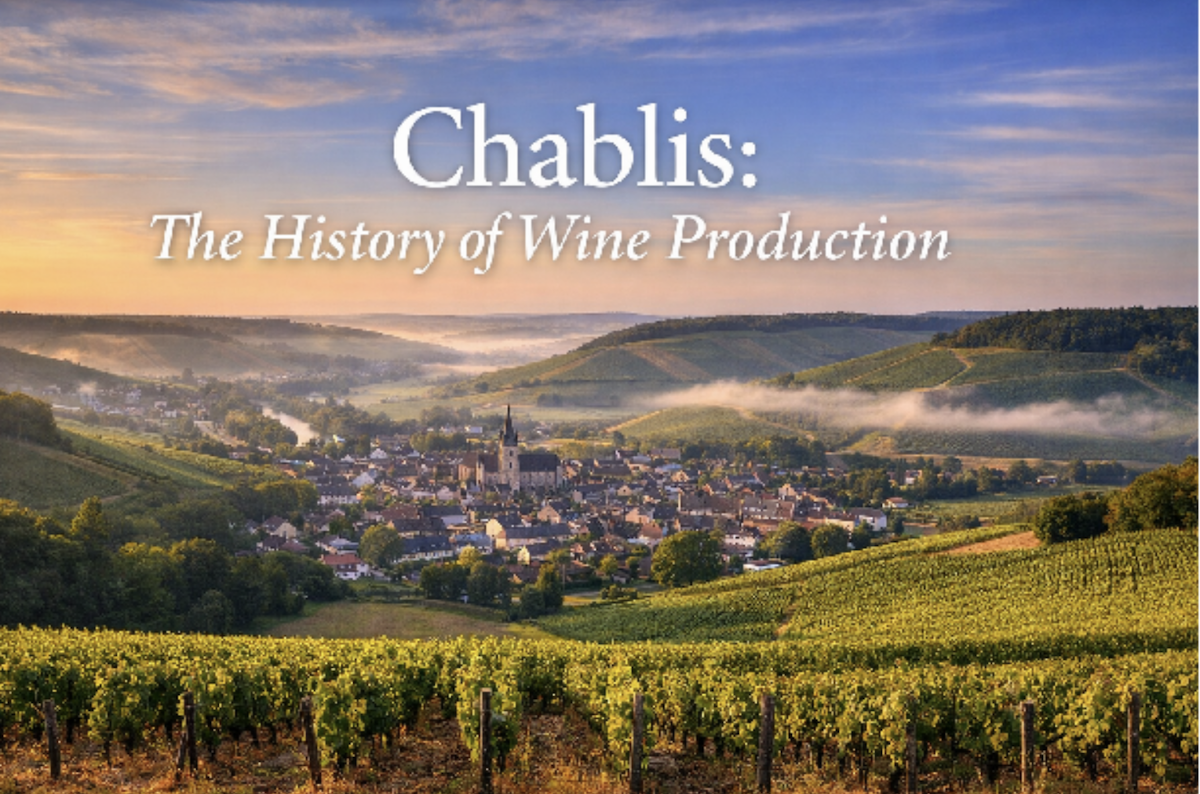

Chablis: The History of Wine Production
Chablis sits in northern Burgundy, in the Yonne along the Serein, geographically distinct from the Côte d’Or villages to the south. That position has always shaped the work. Chablis is cool, exposed, and vulnerable in ways that force wine production to be organized around risk as much as around quality. The bedrock that made the place famous is Jurassic, especially Kimmeridgian marl and limestone filled with fossilized marine life, while much of Petit Chablis lies on younger Portlandian soils. Those differences in bedrock, combined with slope, aspect, and cold-air drainage, shaped the hierarchy of the vineyards long before the hierarchy was formalized. Historically, that marginal climate also meant that adequate sugar levels could not be taken for granted. In weaker years, chaptalization was often necessary to bring potential alcohol to a stable level. In warmer recent vintages, that old necessity has receded, and the pressure has shifted toward protecting acidity and avoiding excessive ripeness.
The story reaches back well before the appellation era. The Chablis site includes traces of very early settlement in the Serein valley, and the official regional history places a fortified Gallic farm here before the Roman period. Under Rome, villas were established, vines were planted, then removed under Domitian and restored under Probus. By the ninth century, the region was tied to ecclesiastical authority, and by the twelfth century Pontigny Abbey had become central to the area’s expansion. The Cistercians held land, recorded results, and compared sites over time. In a marginal climate, that meant identifying slopes where spring frost drained away, where soils held enough moisture through summer, and where exposure allowed grapes to ripen before autumn rain. The vineyard map begins there, in repeated observation carried out over generations.
Medieval and early modern Chablis grew because it could reach Paris through the Serein and Yonne river system. That route shaped production and sharpened the distinction between stronger and weaker sites. Slopes with southern and southwestern exposure above the river gained standing, while flatter or colder parcels remained secondary. Over time, the name Chablis came to designate wine that buyers in Paris could recognize and reorder. Commercial repetition gave the place-name weight, and repeated comparison of parcels gave growers a practical basis for ranking land.
That early vineyard was not yet the Chardonnay monoculture suggested by the modern appellation map. Nineteenth-century Chablis and the wider Auxerrois still contained a broader set of varieties, including Sacy and Aligoté among whites and local reds such as César and Tressot in the surrounding northern Burgundian landscape. Chardonnay did prove especially well suited to the better Chablis slopes, but the exclusive attachment of Chablis to Chardonnay was consolidated later, through twentieth-century appellation law and replanting. The modern rule that Chablis must be Chardonnay B was therefore the end point of a long narrowing process, not the unchanged starting point of the region’s history.
The nineteenth century enlarged Chablis and then exposed its limits. Rail transport reduced the commercial advantage of river shipment and brought cheaper southern wines more easily into Paris. Oidium and mildew weakened vineyards, phylloxera destroyed them at the end of the century, and the First World War removed labor from an already damaged system. By 1955, only 550 hectares remained under vine. Chablis today comes out of reconstruction after collapse, not out of uninterrupted continuity.
That reconstruction changed both the vineyard and the cellar. Grafting onto resistant rootstocks addressed phylloxera, and fungicide use made mildew control more reliable. Frost remained the central threat. The 1957 freeze destroyed almost the entire crop and pushed growers toward active vineyard protection, first with heating and later with broader use of aspersion and related systems. At the same time, cellar practice moved away from the older feuillette system, in which wines were fermented and aged in small used oak barrels of about 132 liters. During the 1960s and 1970s, stainless steel spread through the region. That shift reduced oxygen exposure, gave growers tighter control over temperature and handling, and helped define the brisker, cleaner, more reductive profile that became identified with modern Chablis.
The abundant 1970 vintage marked the return of viable production, but recovery also depended on scale, mechanization, and commercial organization. Domaines, cooperatives such as La Chablisienne, founded in 1923 during a period of economic difficulty, and négociant firms each played a role in keeping the region present in domestic and export markets. La Chablisienne alone accounts for roughly a quarter of the region’s volume, which helps explain its importance in Chablis’s survival and commercial continuity. Larger operators could buy fruit or wine, blend across parcels, and maintain supply in years when frost or hail sharply reduced individual harvests. This commercial layer supported the region’s growth after the mid-century collapse and helped turn Chablis back into a dependable presence in the market.
The appellation hierarchy developed alongside that recovery. Chablis and Chablis Grand Cru were established as AOCs in 1938, Petit Chablis in 1944, and Chablis Premier Cru in 1967. The hierarchy followed exposure, soil, and position along the Serein. The Grand Crus occupy a single hillside on the right bank with strong exposure and favorable drainage. The seven official Grand Cru climats are Blanchot, Bougros, Les Clos, Grenouilles, Preuses, Valmur, and Vaudésir. Les Clos is especially useful historically because its name preserves the older language of enclosed vineyard holdings. Premier Cru sites are spread across both banks and vary by slope, orientation, and soil depth. The classification formalized distinctions growers had long observed in the field.
The hierarchy also produced argument. In the 1970s and 1980s, Chablis was divided by a major dispute over whether the village appellation should remain tightly linked to the classic Kimmeridgian core or be extended onto suitable Portlandian slopes and plateaus around it. One side defended a stricter geological reading of Chablis. The other argued that controlled expansion would allow the region to grow and benefit more fully from global demand. National authorities ultimately approved expansion, which increased the surface area able to produce wine under the village Chablis name and changed the economic scale of the region. That decision remains essential to understanding why modern Chablis is both a historically delimited place and a much larger commercial vineyard than the older core alone would have allowed.
The Premier Cru system shows how this vineyard map works in practice. There are 40 officially recognized Premier Cru climats, but they are grouped administratively so that a smaller set of names serves as the main commercial reference on labels. Vaillons, for example, can function as an umbrella for neighboring lieux-dits such as Chatains, Beugnons, Mélinots, Roncières, Sécher, Les Epinottes, and Les Lys. Fourchaume can likewise cover neighboring sectors such as L’Homme Mort, Vaupulent, Côte de Fontenay, and Vaulorent. For growers, that arrangement reflects contiguous sites and shared market recognition. For drinkers, it means that Premier Cru Chablis is not one style but a cluster of places with different ripening patterns, fruit weight, and acid retention.
Production data makes the region easy to see. Petit Chablis covers plateaus and upper slopes and contributes substantial volume. Village Chablis forms the economic base. Premier Cru and Grand Cru account for much smaller shares of total production and command higher prices because of their site advantages and lower volumes. The map is economic as well as geological. It determines which land supports the region’s base business and which parcels carry its prestige bottlings.
Chablis also spent much of the twentieth century defending its name outside France. Producers in places such as California and Australia used “Chablis” on generic white wines that had no geographic link to the region. That practice diluted the meaning of the name in export markets and forced French growers and regulators into a longer legal and commercial struggle over geographical origin. The modern defense of Chablis is not only a vineyard story. It is also a story about protecting a place-name from becoming a generic product term in global trade.
Geology still works through the hierarchy in direct ways. Kimmeridgian marl and limestone combine water retention with drainage and help vines continue functioning through dry periods on exposed slopes. Portlandian sectors, more common in Petit Chablis and in the expanded outer parts of the appellation zone, generally yield lighter wines, especially where altitude and exposure are less favorable. The Grand Cru slope brings together orientation, drainage, and soil continuity in a way that supports greater concentration and longer aging. The region’s ranking system continues to rest on those physical differences.
The present period extends the older pattern of adjustment under pressure. Frost remains a recurring threat. Hail and heavy rain still cut yields. Warmer seasons now accelerate ripening and can shift the balance between sugar and acidity in late summer. Growers answer with the same practical logic that shaped the postwar rebuild: frost systems, canopy adjustments, harvest timing, and cellar choices calibrated to preserve freshness without losing ripeness. Chablis remains a vineyard where production depends on active management at each step of the season.
The history of wine production in Chablis is a record of repeated rebuilding in a cold and commercially exposed place. Roman planting, monastic landholding, river trade, disease, phylloxera, labor loss, frost protection, stainless steel, appellation law, geological dispute, and name protection all belong to the same history. The region did not arrive at its present form by simple continuity. It arrived there through repeated decisions about what to plant, where to plant it, how to protect it, how to vinify it, and how to defend the name in the market. That is why Chablis remains one of the clearest examples in wine of a place shaped as much by survival and administrative choice as by soil and slope.
Mitchell Rabinowitz
I’m a retired university professor with a Ph.D. in cognitive and developmental psychology. I taught cognition and education starting in 1984. In retirement I decided to take wine seriously, and I’ve been using AI to help me learn faster and create better. I’ve also learned you can’t just ask AI one question and call it done.
For me, an essay usually takes a number of iterations. I create a draft, then I check accuracy, hunt for gaps, revise the structure, and do it again until the piece feels coherent and useful. I also use other AIs as collaborators. It is an extensive process creating the essays.
I try to create these as stories because that is the format that sticks for most of us. Facts land better when they have a sequence and a few turning points.
