
Appassimento: The History of Drying Grapes Before Fermentation
In most wineries, harvested grapes reach the press within hours. Appassimento introduces an interval that may last several weeks or several months. Selected bunches are placed in a dry, ventilated space and allowed to lose part of their water before they are crushed. The Italian verb appassire means to wither or dry, and appassimento names the process. As water leaves the berries, the remaining juice contains higher concentrations of sugar, acidity, color, flavor compounds, and grape solids. The eventual wine can be sweet or dry. Its character depends upon the grapes, the length and conditions of drying, and how far fermentation is allowed to proceed.
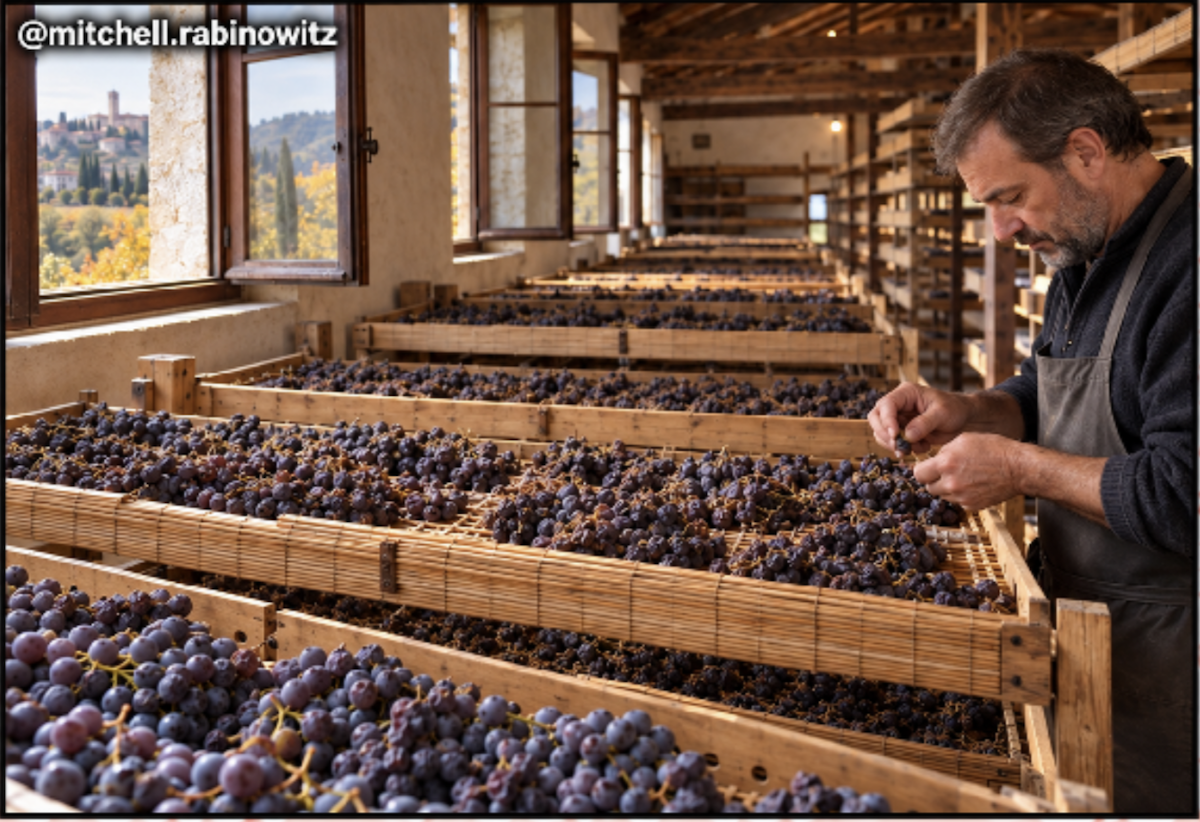
The process begins in the vineyard because damaged fruit cannot survive a long drying period. Because the grapes retain moisture and sugar, they can develop mold if humidity remains high or air fails to circulate. Growers select healthy bunches with sound skins and enough space between the berries for air to circulate. Thick-skinned varieties and loose clusters are particularly well suited to the method. In Valpolicella, near Verona, Corvina, Corvinone, and Rondinella have these qualities. The bunches were traditionally spread in a single layer on bamboo racks called arele or hung from ceiling supports. Many producers now use shallow wooden or perforated plastic crates that allow air to pass beneath the fruit. The drying takes place in a fruttaio, a room with large openings that admit the cool autumn air. Producers inspect the bunches regularly, separate clusters that touch, and remove fruit affected by damaging forms of mold.
Under cool, humid conditions followed by adequate ventilation, limited noble rot caused by Botrytis cinerea can develop within some Corvina clusters. The fungus pierces the berry skin, encourages additional water loss, and changes the chemical composition of the fruit. Botrytized grapes can lead to higher glycerol and acetic acid in the resulting wine. Glycerol contributes viscosity and a smoother physical sensation in the mouth, while excessive acetic acid can produce vinegar-like aromas. The effect depends upon the extent and behavior of the infection. Beneficial noble rot can pass into destructive gray rot when humidity remains high or air circulation is poor. Some traditional producers accept a limited amount of Botrytis, while others remove every affected berry. Modern climate-controlled fruttai usually provide steady ventilation and lower humidity, reducing the presence of the fungus.
During appassimento, the grape remains biologically active. It continues to respire after harvest, consuming and altering some of its sugars and acids as dehydration places the berry under stress. Water loss concentrates what is already present, while the berry’s continuing metabolism changes color and tannin compounds and the chemical precursors that later contribute aroma. Temperature, humidity, ventilation, grape variety, and the speed of dehydration influence these changes. Research on Corvina has found measurable differences between grapes dried slowly under natural conditions and grapes dried more rapidly in controlled rooms. Wines made from traditionally dried grapes have sometimes shown higher concentrations of certain aroma compounds, while controlled drying gives producers greater protection against spoilage and irregular dehydration.
Corvina and its blending partners commonly lose between 30 and 40 percent of their original weight during appassimento. In a long drying period, the loss may approach 50 percent. A hundred pounds of harvested grapes may therefore weigh only 50 to 70 pounds when they reach the press. Some of the remaining weight consists of skins, seeds, and pulp, leaving a small amount of concentrated juice. The grower must cultivate, harvest, select, transport, and dry considerably more fruit for Amarone than for ordinary Valpolicella. Depending upon the degree of dehydration and the amount of juice recovered at pressing, the quantity of grapes required for a bottle can approach twice that of a conventional wine. Dedicated drying rooms, repeated inspections, discarded berries, and long cellar aging add further expense.
Drying grapes for wine predates the Italian language and the modern boundaries of Italy. Around 700 BCE, the Greek poet Hesiod instructed farmers to cut their grape clusters, expose them to the sun for ten days and nights, cover them for another five days, and then draw the wine into vessels. Greek communities throughout the Mediterranean used variations of the method. The Romans later produced passum, a sweet wine made from grapes dried in the sun. Pliny the Elder described it during the first century CE. Drying raised the concentration of sugar in the must and could produce wines with greater sweetness and alcoholic strength, qualities that were highly valued when fermentation was difficult to control and concentrated sweet wines were reserved for prosperous households, religious observances, and trade.
The method acquired a particularly long history in the hills north of Verona. During the early sixth century, Cassiodorus served at the court of the Ostrogothic king Theodoric. In his official correspondence, he requested a local wine called acinaticum for the royal table. His description identifies a dark, concentrated wine made from carefully selected, dried grapes in the region that included present-day Valpolicella. The surviving text establishes that dried-grape wine from the Veronese area had acquired a distinguished reputation by late antiquity, even though Cassiodorus did not provide a production recipe. The name changed during the following centuries, while the practice continued in farms, monasteries, and landed estates.
Farmhouses had upper floors where autumn air could move through broad windows, keeping the grapes dry as temperatures fell. From the eighteenth century, silk production gave many Veronese families stacks of cane racks on which silkworms were raised during the warmer months. Once the silk season ended, those racks could hold harvested grapes. The sequence followed the agricultural calendar: silkworms in spring and summer, grapes in autumn and early winter. The same households cultivated vines, raised silkworms, dried fruit, and made wine, so appassimento remained part of ordinary farm work long before it supported expensive internationally traded bottles.
The principal dried-grape wine of Valpolicella was Recioto. Its name may come from recie, the Veronese word for ears, referring to the upper lobes of a grape cluster that received greater sun exposure and were once selected for drying. Another proposed origin connects the word to the ancient Raetian wines of northern Italy, so the etymology remains uncertain. Recioto della Valpolicella is sweet because fermentation ends while a substantial amount of grape sugar remains. Before refrigeration, filtration, and modern microbiology, stopping fermentation at the desired point required close attention and some good fortune. Cold winter cellars could slow the yeast, and repeated rackings removed wine from the sediment, but fermentation might begin again when temperatures rose.
That possibility eventually produced the dry wine now called Amarone. The familiar account places its birth in 1936 at the Cantina Sociale Valpolicella in Negrar, where a vat of Recioto supposedly continued fermenting until the yeast had consumed nearly all its sugar. The cellar master, Adelino Lucchese, is said to have called it Amarone, an intensified form of amaro, meaning bitter. The story gave Amarone a memorable origin, although dry versions of Recioto had existed earlier and archival work indicates that some were made deliberately. The term Amarone came into regular use during the 1930s. Cantina Negrar records a 1936 bottling, and its cellar preserves a bottle from 1939. Bolla’s commercial release during the 1950s brought the wine to a wider market.
After drying, the shriveled grapes produce a dense must, the unfermented juice that will become wine, containing far more sugar and far less water than fresh grape juice. Pressing is difficult because the berries contain little free-running juice and the skins absorb part of what remains. The high sugar concentration also places yeast under osmotic stress, reducing its ability to reproduce and convert sugar into alcohol. Fermentation commonly proceeds at low winter cellar temperatures and may require 30 to 50 days. It can slow or stop before the desired level of dryness is reached. As yeast works through this concentrated must, it can produce additional glycerol, increasing the viscosity and perceived weight of the wine independently of any Botrytis in the grapes. Cellar workers monitor temperature, sugar consumption, nutrient availability, and the condition of the yeast throughout this period. Controlled warming, selected yeast strains, or gradual adjustment of the must may be used to maintain fermentation. A stalled fermentation intended for Amarone can leave excessive residual sugar and create opportunities for unwanted microorganisms.
Recioto and Amarone begin with closely related grapes and the same drying tradition. Their separation occurs during fermentation. For Recioto, fermentation is stopped while the wine remains distinctly sweet. For Amarone, yeast converts most of the concentrated sugar into alcohol, creating a dry wine that commonly reaches 14 to 16 percent alcohol. Italian regulations recognized Amarone and Recioto within the Valpolicella denomination in 1968, and both received separate DOCG status in 2010. DOCG is an Italian designation that regulates a wine’s geographical origin and production. Current Amarone rules require the dried grapes to contain enough natural sugar to produce at least 14 percent alcohol if fully fermented. The rules also restrict the place and conditions of production and require aging before release. Many producers dry their grapes for approximately three or four months and press them during winter, although the duration changes with the harvest and the producer’s intended style.
Appassimento also appears elsewhere in Italy. It contributes to Vin Santo in Tuscany, Sagrantino Passito in Umbria, sweet wines made from Moscato on Pantelleria, and numerous regional wines labeled passito. Appassimento names the act of drying grapes, while passito describes a wine made from dried grapes. Ripasso uses a separate Valpolicella method. A finished or partly finished Valpolicella undergoes renewed fermentation in contact with the grape skins and residue from Amarone or Recioto. It acquires some of their concentration and dried-fruit character, although its own grapes have generally been fermented soon after harvest.
The condition of the grapes, the speed of drying, the presence or absence of Botrytis, and the progress of fermentation all affect the finished wine. Slow water loss can produce flavors of dried cherry, plum, fig, spice, cocoa, and tobacco, accompanied by greater body, glycerol, and alcoholic warmth. Poorly managed drying can produce gray rot, volatile acidity, excessive oxidation, or heavy raisined flavors. Careful appassimento retains enough acidity to support the concentrated fruit and enough freshness to prevent the wine from seeming thick or tiring. The method began as a practical response to fruit, weather, and the agricultural calendar. Its long survival in Valpolicella allowed Recioto to preserve an ancient preference for sweet dried-grape wine and gave Amarone a dry form produced through demanding winter fermentation.
Mitchell Rabinowitz
I’m a retired university professor with a Ph.D. in cognitive and developmental psychology. I taught cognition and education starting in 1984. In retirement I decided to take wine seriously, and I’ve been using AI to help me learn faster and create better. I’ve also learned you can’t just ask AI one question and call it done.
For me, an essay usually takes a number of iterations. I create a draft, then I check accuracy, hunt for gaps, revise the structure, and do it again until the piece feels coherent and useful. I also use other AIs as collaborators. It is an extensive process creating the essays.
I try to create these as stories because that is the format that sticks for most of us. Facts land better when they have a sequence and a few turning points. Connect with @mitchell.rabinowitz on Instagram
