

LEARNING ABOUT WINE Château Beau-Séjour Bécot:A Saint-Émilion Estate Reassembled
Château Beau-Séjour Bécot stands on the western side of Saint-Émilion, a short distance beyond the medieval town on the plateau of Saint-Martin de Mazerat. Château Canon lies close by, and the property now called Château Beauséjour occupies the neighboring half of the old Beau-Séjour estate. The similarity of the two names is the result of a family division in the nineteenth century, and it still causes confusion. Château Beau-Séjour Bécot is the larger property owned by the Bécot family and classified among the Premiers Grands Crus Classés of Saint-Émilion. Château Beauséjour, formerly identified by the name of the Duffau-Lagarrosse family, is a separate estate with its own owners, vineyard, cellar, and wine. The distinction is worth making at the beginning because Beau-Séjour Bécot’s history repeatedly concerns the definition of an estate: which parcels belonged together, which name they could bear, and which grapes could enter the classified wine.
The château occupies one of the principal limestone sites of Saint-Émilion. Its shallow clay-limestone soil rests on calcaire à astéries, a pale local limestone containing the fossil remains of small marine animals, including the star-shaped organisms that supplied the French name. Rain drains through the upper soil, while fissures and porous sections of the limestone retain water that deep roots can reach during dry periods. The clay above it holds additional moisture and nutrients. These conditions suit Merlot because the vine can ripen generous fruit without losing all access to water during a hot summer, while Cabernet Franc can retain floral, herbal, and red-fruited detail when it is harvested fully ripe. The effect in the wine is often described as chalky or saline. Those sensations do not mean that dissolved limestone passes directly into the grapes; they describe the combination of acidity, fine tannin, restrained fruit sweetness, and the dry tactile impression left on the finish.
Saint-Émilion has an oceanic climate influenced by the Atlantic. Winters are usually mild, rainfall is spread across the year, and warm summers can be interrupted by storms. Spring frost, rain during flowering, summer drought, mildew, and wet weather near harvest remain recurring dangers. The elevated plateau is comparatively open to moving air, which can dry leaves and fruit after rain, yet the thin soil can expose vines to drought when long periods of heat arrive. The limestone reserve has therefore become increasingly valuable during the warm, dry seasons that have occurred more often in recent years. Merlot ripens earlier and supplies the broad fruit and pliant texture at the center of the wine. Cabernet Franc ripens later and adds perfume, acidity, and a firmer line of tannin. Beau-Séjour Bécot has been increasing the latter variety as the vineyard is replanted, partly because Cabernet Franc can extend the harvest and moderate the weight of Merlot in warm years.
The oldest accounts associated with Beau-Séjour Bécot place vines on the site during the Gallo-Roman period, although the surviving ownership history becomes firmer in the Middle Ages. The land was then connected with the church of Saint-Martin de Mazerat and with religious communities that cultivated vines as part of a mixed agricultural property. The area was known as Peycoucou, a name usually translated as the hill or height where the cuckoo sings. During the seventeenth century it belonged to the de Gères family. In 1722, Jeanne de Gères married François de Carle de Figeac and brought the land into the de Carle family, which also possessed Château Figeac. Jacques de Carles, a general who enjoyed residing on the property, gave it the name Beau-Séjour in 1787. The words mean a pleasant or beautiful stay, a domestic name that preceded the later prestige of the wine.
After Jacques de Carles died in 1803, the property passed to a relative, André de Carle-Trajet, and then changed hands amid the economic difficulties of the early nineteenth century. Charles Troquart, a Saint-Émilion pharmacist, bought it in 1823, repaired the estate, and enlarged it with neighboring land. His relative Pierre-Paulin Ducarpe took possession in 1847. Beau-Séjour received a gold medal at the Paris Universal Exposition of 1867, evidence that its wine had acquired a reputation before the creation of the modern Saint-Émilion classification. In 1869, the Ducarpe succession divided Beau-Séjour between two children. One portion eventually became Château Beauséjour, associated for many years with the Duffau-Lagarrosse heirs. The other became the direct ancestor of Beau-Séjour Bécot and passed in 1924 to Dr. Jean Fagouet, whose name appeared for a time in Beau-Séjour-Fagouet and Beau-Séjour Dr. Fagouet. The two present properties therefore share earlier land and a name, while their wines have developed separately for more than a century and a half.
Beau-Séjour-Fagouet entered the first Saint-Émilion classification of 1955 as a Premier Grand Cru Classé. Saint-Émilion’s hierarchy differs from the Médoc classification of 1855 because it is periodically reconsidered. A château can rise or fall according to tasting results, reputation, vineyard composition, and other requirements defined for each review. The rank had commercial value as well as ceremonial importance, since it affected distribution, price, and the confidence of merchants. When Michel Bécot acquired the property in 1969, he therefore purchased an established classified growth with an unusually good limestone site. He also brought adjoining family land into the future of the estate. The Bécots had lived around Saint-Émilion for generations and had owned Château La Carte, beside Beau-Séjour, since 1929. Michel added his surname to distinguish the property from the other Beau-Séjour and created the name used today.
Michel Bécot modernized the working estate soon after the purchase. Temperature-controlled stainless-steel vats were installed in the early 1970s, drainage and vineyard work were improved, and the underground quarries were restored for use as cellars. Approximately seven hectares of galleries extend beneath the vineyard. They were cut from the limestone that supplied building stone for Saint-Émilion and Bordeaux, leaving broad passages in which temperature and humidity remain naturally steady. Tens of thousands of bottles are stored there, including examples from more than one hundred vintages. The galleries provide useful aging conditions, but their greater significance lies in the physical continuity between the vineyard and the cellar. The bedrock that regulates water for the vines is also the rock through which workers and visitors pass beneath them. The Union des Grands Crus de Bordeaux records the restored quarries, historic collection, and present estate information.
The decision that enlarged the wine also produced the most difficult period in the Bécot family’s ownership. In 1979, grapes from Château La Carte and from the newly acquired Château des Trois-Moulins were incorporated into Beau-Séjour Bécot. Each property contributed roughly four and a half hectares, so the classified vineyard grew substantially. The parcels were adjacent and shared the plateau’s clay-limestone geology, but the family had not obtained the required approval from the Institut national de l’origine et de la qualité, known as the INAO, before changing the land base of the classified growth. When the classification was revised in 1986, Beau-Séjour Bécot was reduced from Premier Grand Cru Classé to Grand Cru Classé. The official list from that year places the estate in the lower classified category. The penalty concerned the unauthorized addition of land rather than a simple conclusion that the wine had failed in the glass, although tasting and reputation would both be needed if the château was to recover its earlier rank. The official 1986 classification confirms the estate’s placement among the Grands Crus Classés.
Michel retired in 1985 and his sons, Gérard and Dominique, assumed responsibility during the classification dispute. They reduced yields, introduced green harvesting, which means removing part of the crop before ripening, and used small harvest crates so that bunches reached the cellar with less crushing. Sorting became more exact, and the family invested in both the vineyard and winery. Michel Rolland began advising the estate during the 1980s and remained associated with it for many years. The wines from this period increasingly favored ripe fruit, prolonged maceration, generous extraction, and a high proportion of new oak, an approach that brought concentration and a polished texture. The work in the vineyard and cellar, together with the formal acceptance of the enlarged property, allowed Beau-Séjour Bécot to regain Premier Grand Cru Classé status in 1996. The rank was confirmed in 2006 and 2012, and the INAO included the château among the Premiers Grands Crus Classés again in 2022. The current official list reserves the additional distinction A for Figeac and Pavie, while Beau-Séjour Bécot belongs to the group still commonly called Premier Grand Cru Classé B. The INAO’s 2022 classification lists Beau-Séjour Bécot among the fourteen Premiers Grands Crus Classés.
The classification experience affected a second chapter of vineyard consolidation. In 1995, the family bought La Gomerie, a 2.52-hectare property near Beau-Séjour Bécot. Most of its soil was sand over clay with iron deposits, with a smaller limestone portion, and its old Merlot produced a wine quite different from the plateau blend. La Gomerie became a small-production Saint-Émilion Grand Cru made entirely from Merlot, with low yields, ripe harvesting, extensive cellar work, and aging in new barrels. It belonged to the garage-wine period of the 1990s, when tiny Right Bank estates used meticulous selection and conspicuous new oak to make dense wines in very small quantities. The family purchased the site in 1995, and La Gomerie was established as a separate cuvée during the later 1990s. Its last independent vintage was 2011. Once the parcel was accepted into the land registered for Beau-Séjour Bécot, its grapes entered the grand estate beginning with 2012. Some current directories and merchant descriptions continue to list La Gomerie as an active companion wine, but that information preserves the former portfolio rather than the present one. The absorption of La Gomerie beginning with 2012 is also recorded in Vinous’s estate retrospective.
Juliette Bécot, Gérard’s daughter, joined the family business in 2001 and initially concentrated on the commercial side. She also worked with her father at Château Joanin Bécot in Castillon, which gave her direct experience beyond the established routines of a classified Saint-Émilion property. By the middle of the 2010s, Juliette and her husband, Julien Barthe, had taken leading roles at Beau-Séjour Bécot. Julien serves as managing director, while Juliette remains closely involved in ownership, communication, blending decisions, and the public presentation of the wines. Thomas Duclos, who had already advised Joanin Bécot, replaced the Rolland team as the principal consultant at Beau-Séjour Bécot for the 2018 vintage. Jean de Cournuaud joined as technical director at about the same time. Their work has retained fully ripe fruit while reducing forceful extraction, lowering the share of new oak, and giving Cabernet Franc a larger place in both the vineyard and the final blends.
Published vineyard figures can appear contradictory because some describe the entire property, others count planted land, and recent figures exclude parcels temporarily removed for replanting. The estate covers about twenty-two hectares in total. Historical technical sheets recorded 18.5 hectares of property and 16.52 hectares of vines, while recent releases commonly cite between 15.5 and 17 hectares in production. The older vineyard was planted at approximately 6,600 vines per hectare, and newer sections have been planted at about 7,200. Replanting has lowered the reported average vine age and has allowed rows to be reoriented in selected parcels. The long-term plan favors roughly two-thirds Merlot and one-third Cabernet Franc, with the remaining Cabernet Sauvignon gradually disappearing. Recent general descriptions already simplify the planted mix to 80 percent Merlot and 20 percent Cabernet Franc, even though individual vintages have still contained a small amount of Cabernet Sauvignon.
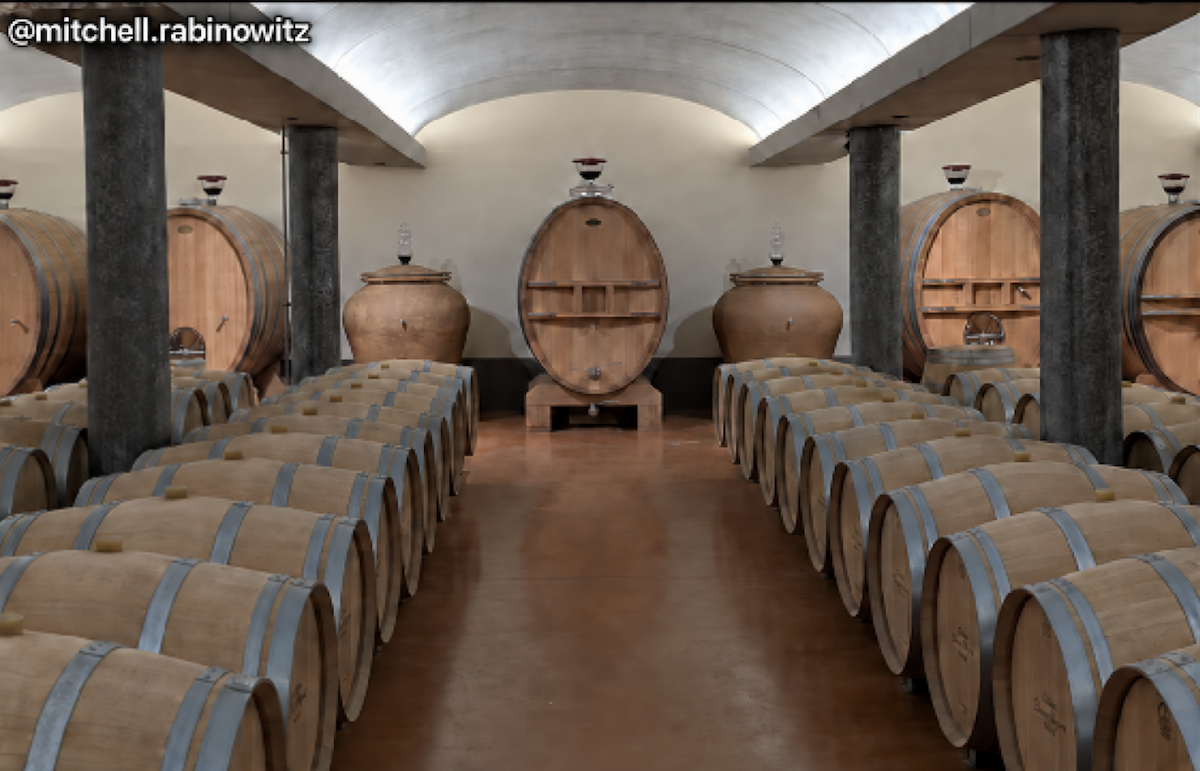
The 2023 vintage was the first made in the new vat room and aging cellar. Grapes continue to be picked by hand and handled by parcel, with harvest dates determined separately for Merlot and Cabernet Franc. Cold maceration before fermentation, the use of whole berries in some lots, and the duration of skin contact vary with the year. Extraction is now gentler than it was during the estate’s most powerful period, so color and tannin are taken from the skins without making density the only goal. The wine completes its second fermentation, called malolactic fermentation, after which sharper malic acid is converted into softer lactic acid. Aging lasts about sixteen months and uses several vessels. A little more than half of a recent grand vin has generally gone into new French oak barrels, while the balance has been divided among used barrels, amphorae, and foudres, which are large oak casks with less wood surface in contact with each liter of wine. The mix changes with the vintage, allowing oak to support the fruit without supplying the dominant aroma.
The grand vin, Château Beau-Séjour Bécot, is the center of the present portfolio. Its exact blend records the increasing role of Cabernet Franc: the 2018 contained 80 percent Merlot, 15 percent Cabernet Franc, and 5 percent Cabernet Sauvignon; the 2020 and 2021 contained 85 percent Merlot, 13 percent Cabernet Franc, and 2 percent Cabernet Sauvignon; the 2022 contained 76 percent Merlot, 22 percent Cabernet Franc, and 2 percent Cabernet Sauvignon; and the 2023 and 2024 rose to approximately 22 or 23 percent Cabernet Franc without Cabernet Sauvignon in the published final blends. Production changes with the harvest and selection, generally falling near 60,000 to 85,000 bottles. In youth, the wine commonly shows black cherry, plum, raspberry, violet, licorice, cocoa, and a dry chalk-like finish. Bottle age can bring tobacco, cedar, dried flowers, truffle, and earthy aromas. Merlot supplies the middle-palate breadth, Cabernet Franc adds aromatic detail and acidity, and the limestone site contributes indirectly through the vine’s water supply and the resulting balance of ripeness, freshness, and fine tannin.
Petit Bécot is the estate’s second wine and the only continuing companion label drawn directly from the Saint-Émilion property. It was formerly called Tournelle de Beau-Séjour Bécot, with an earlier form of the name referring to the monks, and it became Petit Bécot in 2012. The wine is generally made from younger vines and lots selected for earlier accessibility. Recent examples have been entirely Merlot and have been raised in a combination of stainless steel and barrels, including some new oak. The shorter, fruit-centered treatment gives red and black cherry, plum, mild spice, softer tannin, and an earlier drinking period than the grand vin. The name also carries a family joke. Gérard Bécot was known for sending visitors away with a petit bécot, a little kiss, so the label joins the family surname to the informal French phrase.
Instant Bécot belongs to the wider family range, although it should not be confused with a third wine made from rejected Beau-Séjour Bécot parcels. It is an AOC Bordeaux red produced from vineyards outside the Saint-Émilion appellation and commonly blends Merlot with Cabernet Franc. The same team oversees it, but its purpose is immediate drinking at a lower price, with fresh fruit and modest tannin. Château Joanin Bécot is also separate from Beau-Séjour Bécot. Juliette and Gérard acquired that Castillon Côtes de Bordeaux property in 2001, and its elevated clay-limestone vineyard permits the family to work with Merlot and a substantial share of Cabernet Franc under a different appellation. Château Bernon Bécot in Puisseguin-Saint-Émilion was acquired in 2015 by Caroline and Pierre Bécot, members of the next generation; its roughly nine hectares are planted mainly to Merlot with a small amount of Cabernet Franc. Château Grand-Pontet, once managed by another branch of the family, was sold to Domaine Clarence Dillon for incorporation into Château Quintus in 2021. These wines and former holdings belong to the history of the Bécot family, while the château’s own current portfolio remains concentrated on Beau-Séjour Bécot and Petit Bécot.
Beau-Séjour Bécot’s present wines can be followed through the successive decisions that formed the estate. The 1869 division explains the neighboring château with almost the same name. Michel Bécot’s purchases explain the present breadth of the vineyard and the 1986 demotion. Gérard and Dominique’s work explains the return to Premier Grand Cru Classé in 1996. La Gomerie’s absorption explains part of the land accepted in 2012, while Juliette Bécot and Julien Barthe’s replanting and new cellar explain the growing share of Cabernet Franc, the wider choice of aging vessels, and the more restrained use of oak. Beneath all of these changes remains the plateau of Saint-Martin de Mazerat, with thin clay over fossil-bearing limestone and old quarry passages below the vines. The modern portfolio is small, but each wine records a different selection from that place: the grand vin for depth and long aging, and Petit Bécot for an earlier account of Merlot from the same estate.
Mitchell Rabinowitz
I’m a retired university professor with a Ph.D. in cognitive and developmental psychology. I taught cognition and education starting in 1984. In retirement I decided to take wine seriously, and I’ve been using AI to help me learn faster and create better. I’ve also learned you can’t just ask AI one question and call it done.
For me, an essay usually takes a number of iterations. I create a draft, then I check accuracy, hunt for gaps, revise the structure, and do it again until the piece feels coherent and useful. I also use other AIs as collaborators. It is an extensive process creating the essays.
I try to create these as stories because that is the format that sticks for most of us. Facts land better when they have a sequence and a few turning points. Connect with @mitchell.rabinowitz on Instagram