
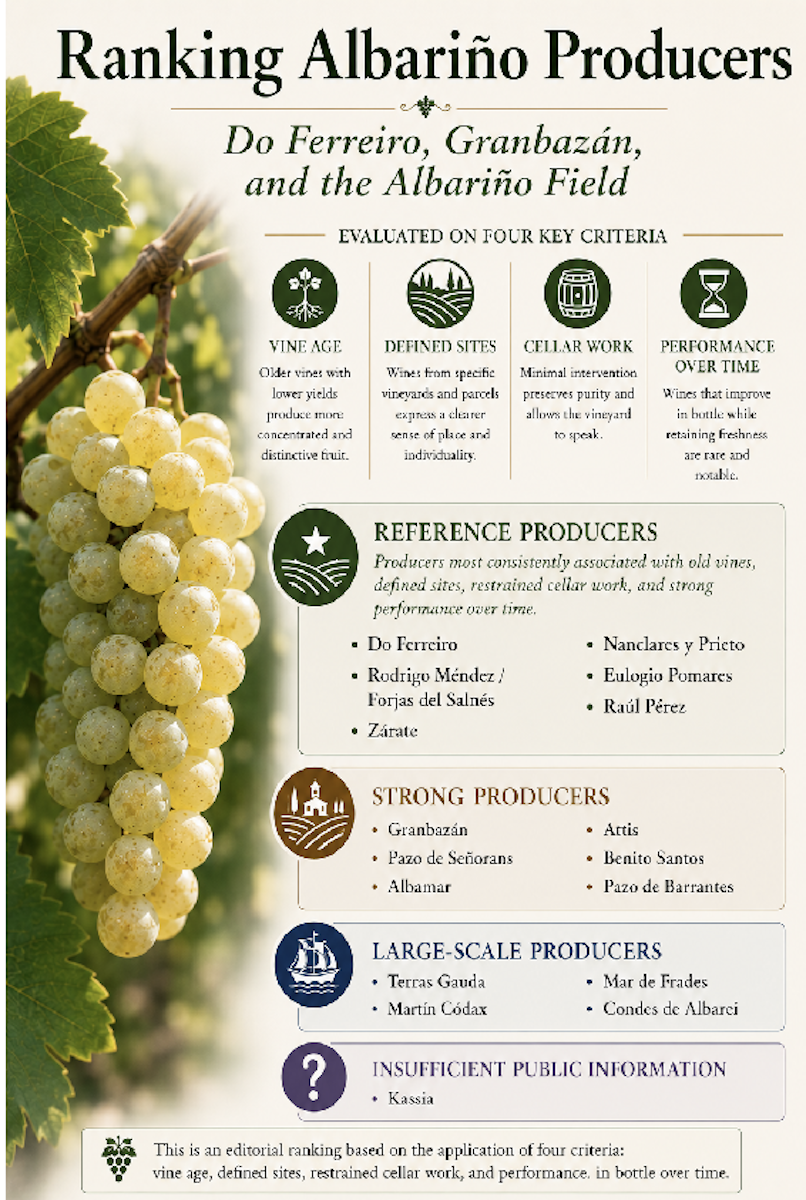

Ranking Albariño Producers: Where Do Ferreiro, Granbazán, and the Field Fit
Albariño producers are often discussed together, but they are not all working from the same conditions or toward the same result. Some draw on old, low-yielding vines rooted in granite. Others depend on broader sourcing and aim for consistency across a larger range of wines. Some have shown that Albariño can develop for many years after release. Others are built mainly for early drinking. Any ranking that hopes to be useful has to begin with clear criteria. Otherwise, names like Do Ferreiro and Granbazán remain isolated examples rather than part of a broader order.
Four criteria help separate the strongest producers from the rest. The first is vine age, since older vines with naturally lower yields often give fruit with greater concentration and more distinct character. The second is site definition, since wines from specific vineyards or small parcels usually show clearer differences than blends drawn from wide areas. The third is cellar handling, since excessive oak, heavy manipulation, or decisions aimed mainly at polish can blur the qualities the vineyard supplies. The fourth is performance over time. Most Albariños are at their best young. A much smaller number keep their freshness while gaining depth over several years. Those producers deserve to be judged differently from estates whose wines are mainly valued for immediacy.
Once those criteria are applied, the field begins to sort itself.
Do Ferreiro belongs in the highest group. The estate works with a large number of small parcels in Salnés, including many very old vines, and the wines have shown over many vintages that Albariño can carry more than freshness and aroma. The regular Albariño establishes the standard house wine, but bottlings such as Cepas Vellas show what the grape can do when yields are low and root systems are old and well established in granite. These wines do not simply hold. At their best, they gain detail and persistence with time. That record, taken together with the estate’s long standing in the region, places Do Ferreiro among the benchmarks of Rías Baixas.
Rodrigo Méndez and Forjas del Salnés also belong in that top group. The work is closely tied to old vines and specific places, and the wines combine weight with energy rather than sacrificing one to the other. The single-vineyard bottlings make the vineyard basis of the project even clearer. Zárate belongs in the same company. It has historical depth as an estate and has also pushed harder in recent years toward parcel definition and wines that show the differences between sites rather than smoothing them out. Nanclares y Prieto also deserves placement here. The wines are often lighter in body, but they are precise, Atlantic in character, and closely tied to site. Eulogio Pomares belongs in the same conversation, with careful vineyard work and a sustained interest in individual parcels. Raúl Pérez, working on a smaller scale and often from more exposed coastal sites, also reaches this level when the wines show the concentration and staying power that only a few Albariños attain.
Granbazán belongs in the next group. It is an important producer, and it deserves to be taken seriously, but it does not usually stand at the very top when the ranking turns on old-vine depth, site specificity, and long development in bottle. Its vineyard base is broader and more distributed, supported in part by grower relationships, and the wines are more unified by house style than divided by place. That is not a defect. It helps explain why the wines are polished, reliable, and widely successful. Limousin shows that Albariño can take oak without losing its varietal character, and D. Álvaro de Bazán points toward greater selectivity and vine age. Even so, the estate is usually judged just below the small cluster of producers whose wines set the highest standard for site-specific Albariño.
Pazo de Señorans also sits in this second group, though close to the top. It has a strong record, especially with wines intended to age longer, but the overall impression is less about sharply separated parcels than about a controlled and recognizable estate style. Albamar belongs nearby. It works from coastal conditions and keeps acidity high, but the wines usually show themselves earlier and with less weight than the very top bottlings in the region. Attis is more difficult to place cleanly because the portfolio moves across different methods, including amphora and oak. Some wines rise higher than the tier suggests, but the range as a whole is less consistent in purpose. Benito Santos has historical importance and access to valuable vineyard material, yet the wines are less regularly cited among the region’s clearest reference points. Pazo de Barrantes makes clean, capable, carefully made wines, but the emphasis falls more on refinement and finish than on sharply drawn site differences.
A third group includes the larger and more market-facing producers. Terras Gauda, Martín Códax, Mar de Frades, and Condes de Albarei all play an important part in the region’s visibility and commercial reach. They produce dependable wines and often very good ones. Their scale, sourcing patterns, and stylistic priorities differ from those of the producers at the top of the hierarchy. These are not the names most often cited when the question turns to how far Albariño can go as a site-specific and age-worthy wine.
A wine such as Kassia falls outside this ranking for a simpler reason. There is not enough clear public information about vineyard holdings, parcel-level bottlings, or performance in bottle over time to place it with confidence alongside the better-established producers of Rías Baixas. That does not mean the wine cannot be good. It means only that it does not yet have a record that allows comparison on the same terms.
Seen this way, the ranking rests on evidence applied consistently. The strongest producers tend to combine old vines, defined sites, restrained cellar work, and a record of wines that improve in bottle. Do Ferreiro belongs securely in that top group. Granbazán sits just below it, important to the region and worth drinking, but not usually treated as the point at which Albariño reaches its highest level.
Mitchell Rabinowitz
I’m a retired university professor with a Ph.D. in cognitive and developmental psychology. I taught cognition and education starting in 1984. In retirement I decided to take wine seriously, and I’ve been using AI to help me learn faster and create better. I’ve also learned you can’t just ask AI one question and call it done.
For me, an essay usually takes a number of iterations. I create a draft, then I check accuracy, hunt for gaps, revise the structure, and do it again until the piece feels coherent and useful. I also use other AIs as collaborators. It is an extensive process creating the essays.
I try to create these as stories because that is the format that sticks for most of us. Facts land better when they have a sequence and a few turning points.
