

This week we welcome a new contributor, Mitchell Rabinowitz. Watch for LEARNING ABOUT WINE every Monday.
Why Should You Care How Old Vines Are?
You should care about vine age when it tells you something concrete about how a vineyard behaves, how it handles difficult weather, and what kind of wine it can produce without constant correction from the grower or winemaker. “Old vines” is often used as a prestige cue, but the term only becomes useful when it is tied to a verified age and to a specific block of vines. Without that grounding, it functions as suggestion; with it, it becomes an agricultural fact. The International Organisation of Vine and Wine, usually abbreviated OIV, is the intergovernmental body that publishes technical definitions and standards for the wine sector. It now defines an old grapevine as a single vine officially documented to be thirty-five years or older, and an old vineyard as a legally delimited block in which at least 85 percent of the vines meet that standard. That definition does not prove that a wine will taste better, but it gives the term a clear starting point and moves attention away from vague prestige toward what is physically in the ground.
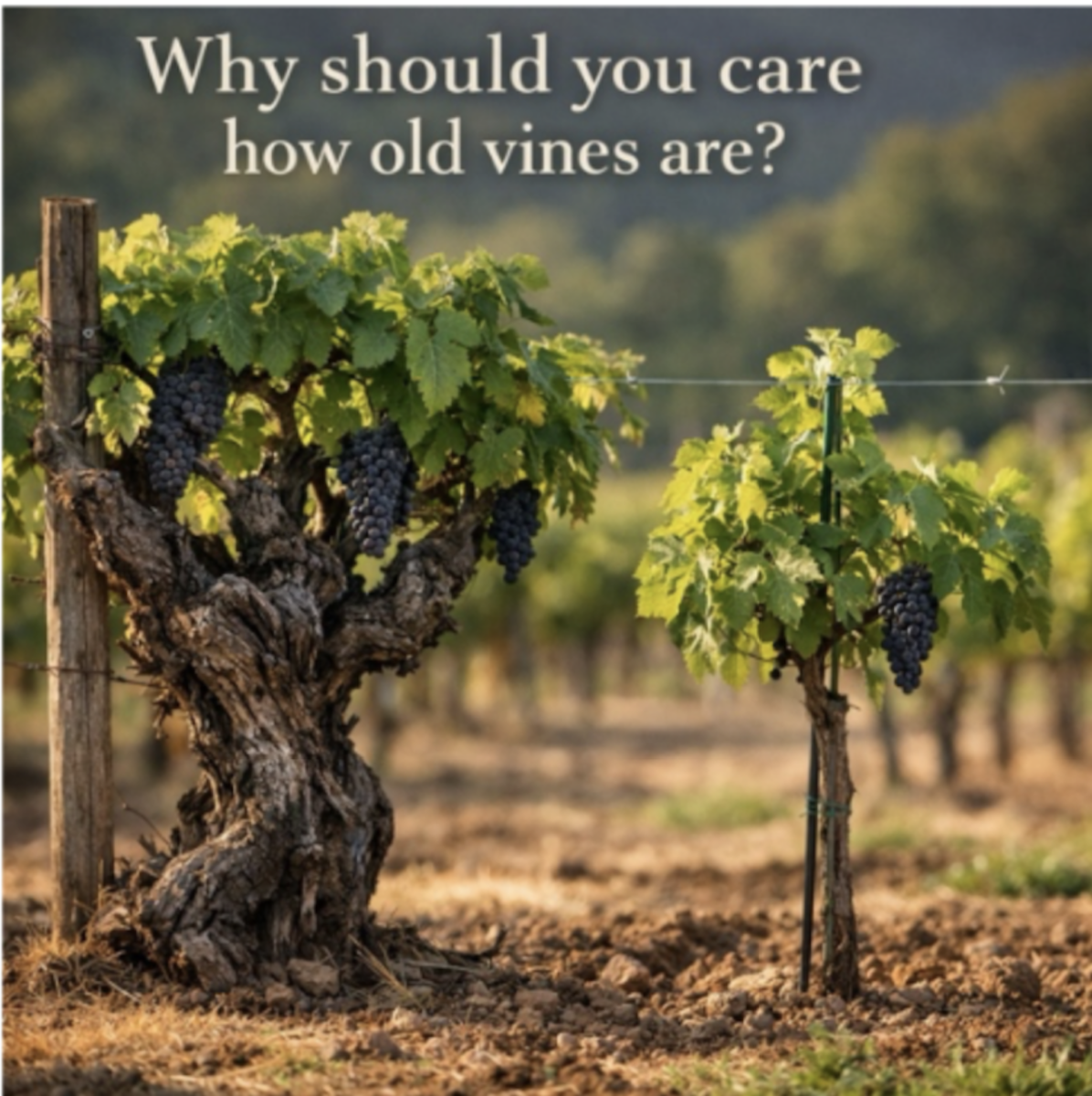
A vine is a perennial plant that takes years to settle into a durable working relationship among trunk, cordons, roots, leaves, and crop. Early in life, it is building trunk and cordons, developing internal pathways that move water, nutrients, and stored energy through the plant, and expanding roots that can support consistent cropping. Older vines often carry a larger amount of permanent wood, and that wood stores carbohydrates. Those reserves can help the vine during delayed spring warming, early stress, or the period before new leaves are fully feeding the plant through photosynthesis. Young vines can produce good fruit, but their growth is often less steady from one season to the next. With abundant water, they may push too much leafy growth. Under sudden heat, they may shut down more abruptly. With too large a crop, they may ripen unevenly. Older vines, when well farmed and planted in the right place, often settle into a more dependable relationship between leaves, fruit, roots, and available water.
The main advantage extends beyond lower yield. It is the grower’s ability to reach ripeness with fewer corrections. In a mature vineyard, sugar accumulation is less likely to outpace flavour development. Skins and seeds often ripen more evenly. The resulting wine may show more mid-palate weight and dry extract without relying on high alcohol, heavy oak, or aggressive extraction. Part of that moderation may come from the vine’s older wood. Decades of pruning leave trunks and cordons thicker, more scarred, and less direct in their vascular pathways. That added resistance can slow sap flow and help restrain excessive canopy growth, especially in conditions that might otherwise encourage vigor. This is not automatic, and young vines can also make excellent wine, but older vines often make that steadiness more likely.
Vine age does not help every grape in the same way. Some varieties are naturally vigorous or crop heavily when young, so age can help moderate their behavior. Other varieties are already low-yielding or strongly shaped by site, so the added advantage of age may be smaller. Serious producers therefore talk about the behavior of a specific block rather than using “old vines” as a universal quality claim. The same point applies within a variety as well. An old block planted on thin, dry soil may show a different kind of steadiness than an old block planted on deeper, more fertile ground, and both may require different pruning, canopy, and crop decisions. Age only becomes explanatory when it is tied to variety, site, vine health, and farming.
Roots are part of the explanation, but they must be discussed carefully. Old vines do not automatically have deeper roots. Rooting is limited by soil depth, bedrock, compaction layers, water tables, and irrigation history. What age can allow is more thorough use of the available soil. A larger working root network can help the vine draw moisture from a broader zone, which can reduce sudden stress and help ripening continue more evenly during dry or hot periods. In vineyards that have been farmed in ways that protect soil life, older roots may also have longer-established relationships with mycorrhizal fungi. Those fungi extend the functional reach of the root system and can improve access to water and micronutrients, although the effect depends on soil health, tillage history, and chemical inputs.
Recent climate pressure has made that steadiness more valuable. Many wine regions now face longer dry spells, sharper heat events, and shorter harvest windows. In those conditions, a vineyard that keeps ripening steadily gives the grower more room to pick by taste and maturity rather than by one number moving too quickly, such as sugar. Older blocks can also preserve plant material that is no longer common. Many old vineyards were planted before the modern reliance on standardized clones. Some were created through massal selection, in which growers took cuttings from many strong vines rather than planting one uniform clone. That kind of genetic variation can make a block respond less uniformly to heat, drought, or disease. The vines do not all move at the same pace, which can stretch the ripening period and reduce the risk that the entire vineyard reaches excessive sugar accumulation at the same time. Some surviving old blocks also lasted through periods when the market favored volume, easier farming, or replanting to more fashionable varieties. Their survival may reflect a good site, a family’s refusal to replant, a reliable role in local blends, or fruit that kept proving its value. In those cases, vine age preserves older farming choices as well as older plants.
Old vines are not automatically healthy vines. Older blocks can carry viruses such as leafroll or red blotch, which can delay ripening, reduce photosynthesis, and make fruit uneven. A neglected old vineyard can produce thin, irregular wine. A poor site does not become good simply because the vines have survived. Economics also need to be included, since yields often fall as vines age and farming costs per ton rise. If the wine cannot sell for enough to support the work, an old block may be removed even when it has real potential. The survival of an old block therefore reflects more than age. It reflects plant health, market value, farming commitment, and the ability of the site to justify continued work.
Old vines become valuable when the site is good, the farming is careful, the vines remain healthy, and the producer works with the vineyard’s natural limits. Under those conditions, age can increase the chance of steady ripening and reduce abrupt vineyard behaviour. Vine age is most useful when it explains repeatable performance across seasons. A good account of old vines should be able to say what the block does differently, how consistently it does it, and whether those differences remain visible under heat, drought, disease pressure, crop load, and harvest timing. When the answers are specific, vine age stops being a marketing phrase and becomes a practical description of how a particular vineyard works.
Mitchell Rabinowitz
I’m a retired university professor with a Ph.D. in cognitive and developmental psychology. I taught cognition and education starting in 1984. In retirement I decided to take wine seriously, and I’ve been using AI to help me learn faster and create better. I’ve also learned you can’t just ask AI one question and call it done.
For me, an essay usually takes a number of iterations. I create a draft, then I check accuracy, hunt for gaps, revise the structure, and do it again until the piece feels coherent and useful. I also use other AIs as collaborators. It is an extensive process creating the essays.
I try to create these as stories because that is the format that sticks for most of us. Facts land better when they have a sequence and a few turning points.
