
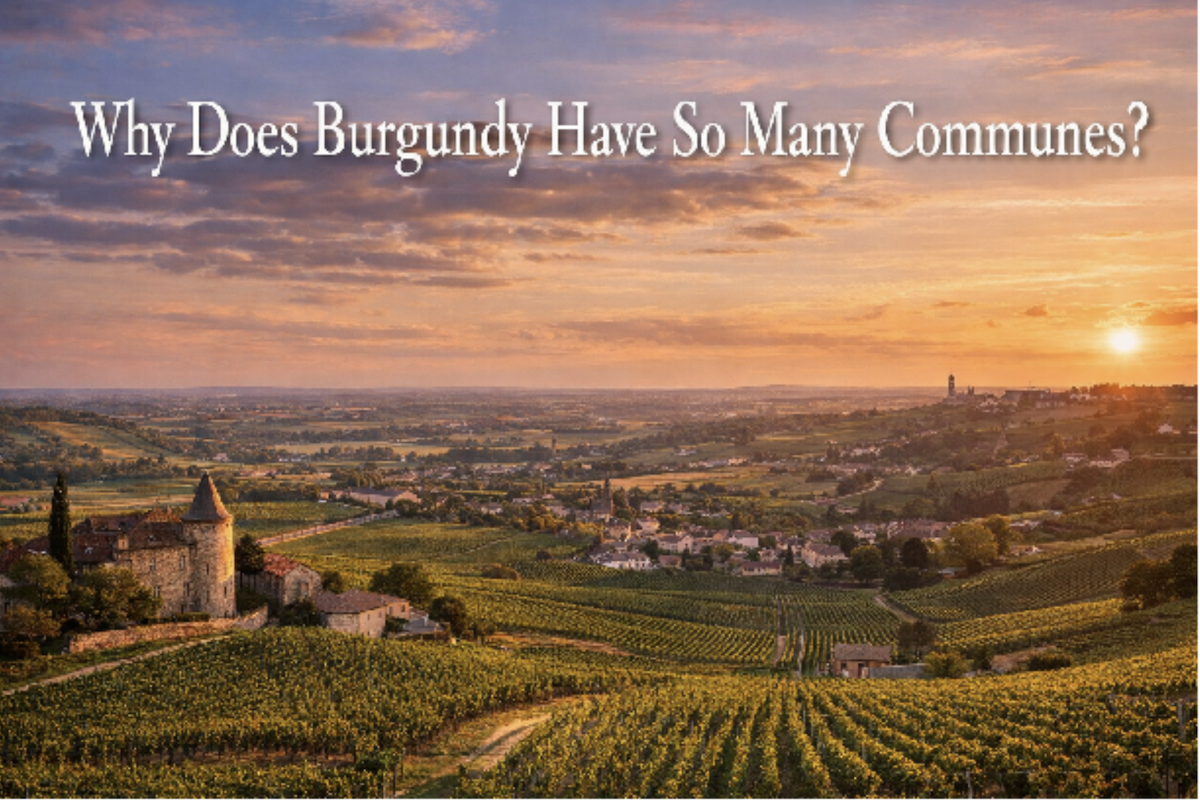

Why Does Burgundy Have So Many Communes?
Burgundy can be difficult for new wine drinkers because it asks them to understand places before grapes. In many wine regions, the label begins with a grape name, such as Cabernet Sauvignon, Chardonnay, or Pinot Noir. In Burgundy, the label often begins with a place: Bourgogne, Chablis, Gevrey-Chambertin, Meursault, Pommard, Volnay, Puligny-Montrachet, Chassagne-Montrachet, or one of many other names. These names are not brands. They are legally protected wine places.
A commune is a village or local municipality. In Burgundy wine, the word usually refers to a village area whose name can appear on a wine label. A wine labeled Meursault comes from the Meursault commune. A wine labeled Pommardcomes from the Pommard commune. A wine labeled Gevrey-Chambertin comes from the Gevrey-Chambertin commune. In many cases, the commune and the village appellation share the same name. Meursault is both a commune and a village appellation. Pommard is both a commune and a village appellation. But the two terms do not mean the same thing. A commune is the village itself. An appellation is the legal wine name attached to a defined growing area.
An appellation is the official legal name for a wine-growing area. It defines where the grapes can come from and what rules the wine must follow. Those rules can include the boundary of the vineyard area, the grape varieties allowed, yields, minimum ripeness, and production requirements. Burgundy has 84 appellations in all: 7 regional appellations, 44 village appellations, and 33 Grand Cru appellations. The 44 village appellations usually take their names from the communes where the grapes were grown, but appellation and commune are not always identical. Some appellations cover several communes, such as Côte de Nuits-Villages or Mâcon-Villages. Grand Cru appellations, such as Montrachet, Chambertin, Musigny, or Romanée-Conti, are named after specific vineyards rather than communes.
The reason Burgundy needs so many commune names begins with the land itself. Burgundy’s vineyard belt is narrow, especially in the Côte d’Or, the famous slope running south from Dijon toward Santenay. Yet that narrow band changes constantly over short distances. One village may sit on deeper clay. Another may have thinner limestone. One slope may face the morning sun more directly. Another may be cooler, higher, windier, or better drained. These differences affect how the grapes ripen, how much water the vines can reach, how quickly the soil warms, and how firm or generous the finished wine may feel.
This is where the word terroir needs a plain definition. Terroir means the physical growing conditions of a place: soil, bedrock, slope, drainage, altitude, exposure to sun, temperature, rainfall, and the farming habits that develop around those conditions. It does not mean that wine is mystical or impossible to explain. It means that vines growing in different places do not behave in exactly the same way, even when the same grape is planted.
Those differences are not just flavour descriptions. They become farming problems. A grower on heavier clay has different work than a grower on thin limestone. Clay holds water longer and warms more slowly in spring. In a wet, cool year, that can delay early vine growth, increase disease pressure, and make it harder to reach full ripeness. Disease pressure means the risk of fungal problems such as mildew or rot, especially when moisture remains in the canopy, the leafy part of the vine. A grower in that setting may need careful canopy work, more frequent vineyard passes, and precise timing to keep air moving around the fruit.
A grower on thin, well-drained limestone faces another set of pressures. Limestone soils can shed water quickly and warm earlier. In a cool year, that can help the vines ripen. In a hot, dry year, the same site may move too fast. Sugar can rise before flavor and tannin are ready. The berries may become smaller, acidity may drop, and the wine may lose the freshness expected from the commune. This is why Burgundy’s commune names cannot be understood as fixed style labels. They describe places, but every vintage tests those places differently.
Burgundy makes this unusually visible because its main grapes are Pinot Noir for red wine and Chardonnay for white wine. Pinot Noir is a thin-skinned red grape that responds sharply to differences in ripeness, soil depth, water availability, and temperature. Chardonnay is a white grape with enough range to show site differences clearly. In Burgundy, the same grape can produce wines of very different weight, aroma, acidity, and texture depending on where it is grown. That is why the village name gives a drinker information that the grape name alone cannot provide.
The differences can be seen clearly in neighboring red-wine communes. Volnay and Pommard both grow Pinot Noir in the Côte de Beaune. They are close to each other, but they do not usually produce the same kind of wine. Volnay is often associated with fragrance, fine tannin, and a more delicate feel. Tannin is the dry, gripping sensation in red wine that comes mainly from grape skins, seeds, and sometimes oak barrels. Pommard, with more clay-rich soils in many sites, often gives darker, firmer, more tannic wines. A buyer who knows the village names has a first clue about what may be in the glass.
The grower still has to earn that result. If Pinot Noir from a warm, shallow, quick-ripening site is picked too late, the wine may become broad, alcoholic, and less precise. If Pinot Noir from a deeper, cooler, clay-influenced site is picked too early, the tannins may stay green and severe. Green tannin means tannin that feels raw, bitter, or drying because the skins and seeds did not ripen fully. In that case, the wine may carry the commune name, but it will not show the balance associated with good Burgundy. Commune names give expectations, not protection from poor decisions.
The Côte de Nuits gives another set of examples. Gevrey-Chambertin often produces Pinot Noir with darker fruit, more depth, and firmer tannin. Chambolle-Musigny, only a short distance away, is usually finer, more perfumed, and lighter in touch. Vosne-Romanée is known for red wines with depth, polish, and spice. Nuits-Saint-Georges often gives firmer wines, especially from parts of the southern side of the commune. These are general patterns, not guarantees. Vintage, producer, farming, and cellar choices still shape the final wine. Even so, the commune name gives a useful starting point that “red Burgundy” cannot provide.
White Burgundy works the same way. Meursault, Puligny-Montrachet, and Chassagne-Montrachet all make Chardonnay, and they sit close to one another. Yet they have long been separated because their wines usually differ in weight, flavor, and texture. Meursault is often broader, with flavors that can suggest ripe apple, hazelnut, butter, and a rounded middle. Puligny-Montrachet is usually tighter, more precise, and more closely associated with limestone firmness. Chassagne-Montrachet can be fuller and earthier, with both white and red wine traditions. The grape alone does not explain those differences. The commune helps explain them.
Chardonnay also shows how site differences become harvest decisions. In a cooler, slower-ripening parcel, the grower may need to wait for enough sugar and flavor while protecting acidity and avoiding rot. Acidity is the fresh, mouthwatering quality that gives white wine lift and keeps it from feeling heavy. In a warmer site, the grower may need to pick earlier to preserve that acidity before the wine becomes too rich or soft. A village name such as Meursault or Puligny gives a broad expectation, but picking date, vine health, and cellar choices determine whether the wine fulfills it.
Burgundy becomes more detailed below the commune level. A climat is a named vineyard parcel with a specific historical boundary and reputation. Burgundy uses this word in a very specific way. A climat is not climate in the everyday weather sense. It is a named vineyard place. A lieu-dit is also a named place, often an older field name. The two terms can overlap, but the basic idea is simple: Burgundy names not only villages, but individual vineyard sites inside those villages.
This is where Premier Cru and Grand Cru enter the system. A Premier Cru is a recognized high-quality vineyard site inside a village appellation. A label might say Meursault Premier Cru Perrières. That means the wine comes from Meursault, from a specific Premier Cru vineyard called Perrières. A Grand Cru is the highest official level. Grand Cru names usually stand on their own as appellations, such as Montrachet, Chambertin, Musigny, or Romanée-Conti. This is why Burgundy can seem crowded with names. The map does not stop at the commune. It continues into named vineyards.
History made the map even more divided. Burgundy was farmed and recorded long before modern wine law existed. Monasteries, especially Benedictine and Cistercian houses, owned and worked vineyards for centuries. They observed which slopes ripened better, which parcels produced more reliable wine, and which fields deserved separate treatment. Noble families later held many vineyards as well. These owners did not work with an abstract idea of Burgundy as one large region. They worked with named pieces of land.
The French Revolution changed ownership but did not erase the place names. Church and aristocratic properties were confiscated and sold. Later inheritance practices divided land among children. Over generations, vineyards became split into small holdings. One grower might own a few rows in one vineyard, a small parcel in another, and another parcel in a different commune. This is one reason Burgundy remains difficult to learn. The same vineyard name may appear on bottles from several producers, because several families may own small pieces of it.
The modern appellation system gave legal form to older divisions. It did not invent Burgundy’s complexity from nothing. The village names, vineyard names, ownership records, and market distinctions were already there. Appellation law placed official boundaries around many of these places and protected the names on labels. That legal protection is important because it prevents a producer outside Meursault from calling a wine Meursault, or a producer outside Pommard from calling a wine Pommard.
So Burgundy needs many communes because broad labels would erase useful information. Burgundy tells the buyer the region. Meursault tells the buyer a more specific village area. Meursault Premier Cru Perrières tells the buyer an even narrower vineyard source. Each step gives more information about where the grapes were grown and what kind of wine the buyer might expect.
A novice does not need to memorize all 44 village appellations. The first step is simpler. In Burgundy, place names do much of the work that grape names do elsewhere. The commune name tells you that Burgundy is not one uniform wine area. It is a collection of villages, slopes, soils, and vineyard parcels that have been separated by farming, ownership, law, and taste over many centuries. The system is complicated because the differences are small, but in Burgundy small differences have long been treated as worth preserving.
Mitchell Rabinowitz
I’m a retired university professor with a Ph.D. in cognitive and developmental psychology. I taught cognition and education starting in 1984. In retirement I decided to take wine seriously, and I’ve been using AI to help me learn faster and create better. I’ve also learned you can’t just ask AI one question and call it done.
For me, an essay usually takes a number of iterations. I create a draft, then I check accuracy, hunt for gaps, revise the structure, and do it again until the piece feels coherent and useful. I also use other AIs as collaborators. It is an extensive process creating the essays.
I try to create these as stories because that is the format that sticks for most of us. Facts land better when they have a sequence and a few turning points.
