
 Château Ausone: History and Portfolio
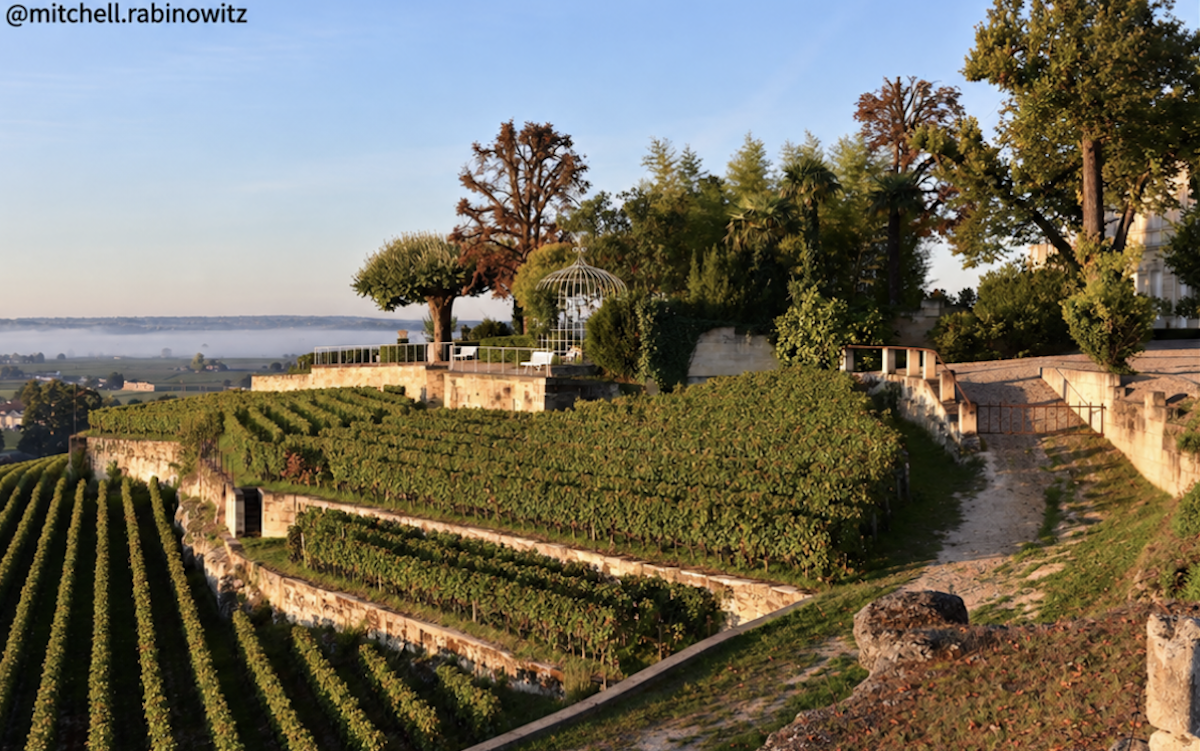
Château Ausone occupies one of the smallest and most exacting great sites in Bordeaux. The vineyard covers about 7.25 hectares on the southern edge of Saint-Émilion, immediately below the medieval village, where the land descends from the limestone plateau along a steep slope. The upper parcels sit on asteriated limestone, the fossil-rich limestone characteristic of parts of Saint-Émilion, while the slope contains clay mixed with limestone. The vineyard faces mainly east and southeast and is divided into small terraces bordered by stone walls. Beneath it lie extensive limestone quarries that were excavated over centuries and converted into wine cellars during the eighteenth century. Their naturally stable temperature and humidity provide the conditions in which Ausone now ages its wines. A Romanesque chapel stands among the vines, and beneath it is an underground rotunda containing a medieval fresco of the Last Judgment.
Decimus Magnus Ausonius was born in Bordeaux around AD 310 and became a teacher, poet, imperial tutor, and eventually Roman consul. He owned vineyards and wrote about the wines of Bordeaux. Beginning in the late sixteenth century, scholars attempted to identify the location of his estate, Lucaniacum, and the property that became Château Ausone came to be associated with him. Archaeological discoveries in and around the site demonstrate Gallo-Roman occupation and agricultural activity. Among them are the remains known as the Villa du Palat on the lower slopes, along with mosaics depicting vines and fragments of statuary. These discoveries establish Roman activity on and around the site, although they cannot establish that Ausonius himself owned this particular property or provide an uninterrupted line of ownership from his lifetime to the present château. The estate adopted his name by the end of the sixteenth century. Older forms such as Casteau Dauzone and Château Dosone gradually developed into Château Ausone.
Pierre Chatonnet acquired the property in 1690, beginning the family succession that continues at Ausone today. The Chatonnet family, later known as Chatonnet-Cantenat, passed the estate from one generation to another, and the Vauthier name entered the family through marriage generations later. The estate describes the succession as continuing through eleven generations to Alain Vauthier’s children. Ownership eventually became divided between branches of the family, and Alain Vauthier began working on the family properties during the 1970s. For years he shared control of Ausone with his aunt Hélÿette Dubois-Challon, and disagreements over the running of the château complicated decisions concerning both the vineyard and cellar. In 1997, Alain Vauthier and his sister Catherine bought Dubois-Challon’s interest, ending the divided ownership and giving Alain effective control of the property.
Pascal Delbeck arrived at Ausone in 1976 and was responsible for the wine during much of the period when the property was controlled through the Dubois-Challon side of the family. He also worked at neighboring Château Bélair, giving him experience with two of the historic limestone properties immediately around Saint-Émilion. His years at Ausone included a period when the estate’s reputation had declined from its earlier standing and when substantial work was needed in both the vineyard and cellar. Delbeck remained associated with Ausone until Alain Vauthier consolidated control in 1997.
Michel Rolland advised Ausone during the subsequent period, while Philippe Baillarguet became the long-serving cellar master and worked closely with Alain Vauthier. Sources differ on the precise year in which Rolland’s consulting relationship began, but his work belongs to the period in which greater attention was given to individual parcels, harvest dates, sorting, extraction, and barrel ageing. His consulting arrangement eventually ended, and by 2013 the contract had not been renewed. Blending and other major cellar decisions have since remained with the team at the château. Pauline Vauthier, Alain’s daughter, subsequently assumed an increasingly important role in the vineyards and cellar and now makes the wines with her father and Baillarguet. She also works with her siblings Édouard and Constance across the family’s Saint-Émilion properties. Philippe Baillarguet remains identified in recent technical material as cellar master, with Laurent Vallet responsible for vineyard management.
Recent technical material places the vineyard planting at roughly 55 percent Cabernet Franc and 45 percent Merlot, with a small amount of Cabernet Sauvignon used in Chapelle d’Ausone. The average age of the vines is approximately fifty years, but individual parcels are considerably older. Among them is Cabernet Franc planted in 1906. These vines survived the severe frost of February 1956, which destroyed or badly damaged vineyards throughout Bordeaux and led many estates to replant large areas. Ausone’s hillside location and protected terraces limited the destruction, allowing unusually old Cabernet Franc vines to remain in production. Their survival preserved plant material from an earlier period of Saint-Émilion viticulture and provides fruit that can still enter Château Ausone more than a century after the vines were planted.
Merlot dominates many vineyards in Saint-Émilion because it ripens reliably in the region’s clay soils, while Cabernet Franc generally ripens later and requires suitable exposure and drainage. Ausone’s east and southeast-facing terraces, limestone, clay-limestone soils, and protected hillside allow Cabernet Franc to reach full maturity with considerable regularity. Merlot contributes fruit, breadth, and body, while Cabernet Franc contributes floral and herbal aromas, acidity, tannin, and the capacity to develop over long periods in bottle. The proportions vary with the vintage. The 2022 Château Ausone, for example, was composed of equal parts Cabernet Franc and Merlot.
The small vineyard allows harvesting decisions to be made parcel by parcel rather than according to a single date for the property. Grapes are picked by hand into small crates and undergo manual and density sorting, which uses differences in berry density to remove unsuitable fruit. Individual parcels are then fermented separately with indigenous yeasts in small wooden vats. Extraction is controlled through procedures that include removing fermenting juice from a vat and returning it over the grape skins. After fermentation, the wine remains in contact with the grape skins for a period before the wines selected for ageing are transferred to barrels in the underground quarries. Recent vintages have generally spent about twenty months in new French oak.
The estate has moved toward organic agriculture while incorporating selected practices associated with biodynamic farming, an approach that uses vineyard preparations and farming practices intended to support the soil, vines, and surrounding ecosystem. The team chooses among these methods according to the needs of individual parcels and conditions during the growing season. Plant-based preparations made from materials such as nettle, willow, and valerian are among the treatments used. Hedges, fruit trees, aromatic plants, insects, birds, and bats are encouraged within the property, including bats that inhabit the old quarries.
When the Saint-Émilion classification was established in 1955, Château Ausone and Château Cheval Blanc occupied its highest category, Premier Grand Cru Classé A. Unlike the Médoc classification of 1855, Saint-Émilion’s system was designed to be revised periodically. Ausone retained the highest rank through successive classifications. In 2021, the Vauthier family announced that the château would not participate in the process leading to the 2022 classification. Pauline Vauthier explained that marketing and wine tourism had acquired too much weight in the classification and that great wine should be judged through terroir, viticulture, and time. She also objected to a ten-year reclassification cycle using vertical tastings covering fifteen years, which she considered too short a period for judging the ability of wines such as Ausone to develop with age. Château Cheval Blanc withdrew at the same time after raising similar objections. Château Angélus subsequently withdrew in January 2022, and Château La Gaffelière left the process later that year. Its wines continue to receive the prices and critical attention associated with the leading estates of Saint-Émilion.
The château produces only two wines from the Ausone property. Château Ausone is the principal wine of the estate, traditionally called the grand vin in Bordeaux, and receives the fruit selected from the estate’s mature vines and principal parcels. Production is necessarily limited by the 7.25-hectare vineyard and becomes smaller after selection for the grand vin. In a typical year, production of Château Ausone is roughly 1,500 to 2,000 cases, although the amount varies with the vintage and the selection made at harvest and in the cellar. Long barrel ageing precedes an even longer period of development in bottle, and mature Ausone can require decades before the tannins and fruit have fully developed.
Chapelle d’Ausone, introduced with the 1995 vintage, is the estate’s second wine. It is produced primarily from younger vines that are intended eventually to supply Château Ausone as they mature. Some of this fruit comes from east-facing parcels and from the upper clay-limestone slopes near the southern entrance to Saint-Émilion. Cabernet Sauvignon can also appear in Chapelle d’Ausone even though it has little or no role in recent vintages of the grand vin. The 2022 Chapelle d’Ausone consisted of 60 percent Cabernet Franc, 35 percent Merlot, and 5 percent Cabernet Sauvignon. The grapes were hand harvested and sorted, fermented parcel by parcel with indigenous yeasts in small wooden vats, and the wine was aged for twenty months in new barrels in the underground quarries. Vineyard age, parcel selection, and the selection of fruit account for much of the difference between Chapelle d’Ausone and the grand vin, while the basic methods used to make and age the two wines remain closely related.
Beyond Ausone, the Vauthier family directs five other Saint-Émilion vineyards: Château La Clotte, Château Moulin-Saint-Georges, Château Haut-Simard, Château Simard, and Château de Fonbel. Moulin-Saint-Georges lies close to Ausone and has long provided the Vauthiers with another important limestone and clay-limestone Saint-Émilion site. La Clotte, acquired by the family in 2014, occupies a small vineyard near the village with limestone slopes and underground quarries. Haut-Simard and Simard lie farther down the slopes, while the substantially larger Fonbel vineyard includes a broader mixture of soils and grape varieties.
The family can conduct work with vineyard practices, grape varieties, equipment, and winemaking at these properties and evaluate the results for possible use at Ausone. The separate properties also provide the family with considerably more wine than could ever be produced at Ausone. Château Ausone remains confined to its original property, with Château Ausone and Chapelle d’Ausone produced from that land while the other Vauthier châteaux are bottled under their own names.
Mitchell Rabinowitz
I’m a retired university professor with a Ph.D. in cognitive and developmental psychology. I taught cognition and education starting in 1984. In retirement I decided to take wine seriously, and I’ve been using AI to help me learn faster and create better. I’ve also learned you can’t just ask AI one question and call it done.
For me, an essay usually takes a number of iterations. I create a draft, then I check accuracy, hunt for gaps, revise the structure, and do it again until the piece feels coherent and useful. I also use other AIs as collaborators. It is an extensive process creating the essays.
I try to create these as stories because that is the format that sticks for most of us. Facts land better when they have a sequence and a few turning points. Connect with @mitchell.rabinowitz on Instagram
