

Château La Gaffelière: History and Portfolio
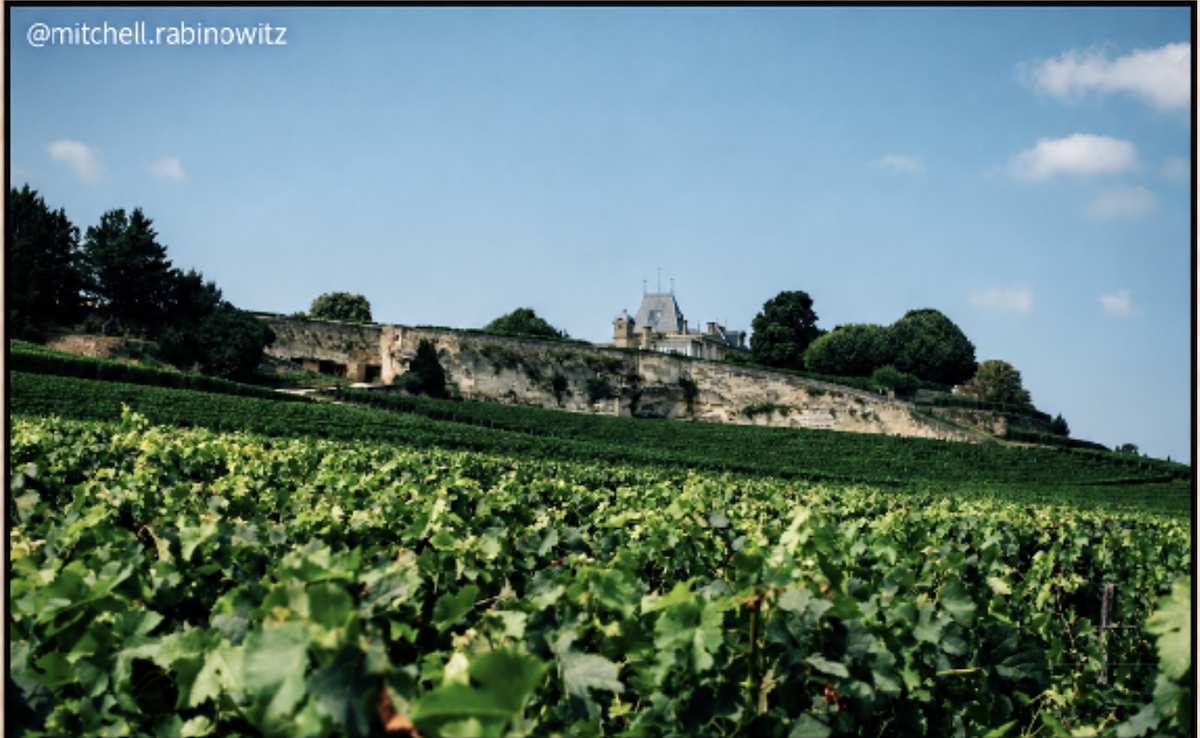
Château La Gaffelière stands immediately south of the medieval village of Saint-Émilion, on the road rising from the Dordogne plain toward the limestone heights of the town. Ausone lies to the west and Pavie to the east, placing La Gaffelière within a small concentration of celebrated vineyards along the southern slope. The house and cellars occupy the lower ground, while the vines extend behind them toward the limestone plateau. Across the property, the ground changes from deeper clay and sand at the foot of the hill to clay over limestone on the slope and limestone near the plateau.
The oldest evidence found on the property predates the château, the Malet Roquefort family, and Saint-Émilion itself. In 1969, Léo de Malet Roquefort uncovered remains of a large Gallo-Roman country house known as the Villa du Palat. Its size and decoration indicate that a prosperous landowner occupied the site during the fourth century. Among the remains was a mosaic floor showing two intertwined vines, evidence that grape growing formed part of life here in the late Roman period. The estate has suggested that the villa may have belonged to Ausonius, the poet and Roman consul whose writings praised the vineyards of Aquitaine. The proximity of Château Ausone makes the association attractive, although no surviving inscription identifies Ausonius as the owner.
Local tradition places a hospital for people with leprosy below the walled town during the Middle Ages, near a road followed by pilgrims traveling toward Santiago de Compostela. Those denied entry to Saint-Émilion could be housed outside its gates, where religious communities maintained hospices for the sick and for travelers. People with leprosy were said to use hooked staffs called gaffes and to have been known locally as gaffets. The district consequently became associated with the name Gaffelière. The present château is said to stand on the foundations of the hospital, although the medieval record is less complete than the Roman remains. The account belongs to the wider history of Saint-Émilion, where churches, monasteries, and hospices grew beside the pilgrimage road from the eleventh century onward.
The family that still owns La Gaffelière arrived through marriage in 1705. The Malet Roquefort branch had acquired its double name in 1654, when Louis de Malet married Marguerite de Calvimont, heiress to Château de Roquefort at Lugasson in the Gironde. Their son, also named Louis, married Isabeau de Bonneau on November 17, 1705. Her father, Hélie de Bonneau, owned La Gaffelière and served as both mayor and jurat of Saint-Émilion. A jurat was a municipal officer who helped govern the town and supervise its commerce. Family histories trace the Malet name to medieval Normandy, although the genealogical connection has not been proved.
Marriage added another Saint-Émilion property to the family holdings in 1807, when Louis Alexandre de Malet Roquefort married Anne de Lavaux and acquired Château Puyblanquet. The family retained Puyblanquet until 1959 and reacquired it in 2020. During the nineteenth century, the larger Gaffelière property was divided. Land that passed outside the family eventually became Château Canon-La Gaffelière, while the Malet Roqueforts retained the portion associated for a time with the names Puygenestous and Naudes. Their wine was sold as Château Gaffelière-Naudes before the name was shortened to Château La Gaffelière after 1963. The similarity between La Gaffelière and Canon-La Gaffelière records their origin in the same historical district.
Saint-Émilion did not appear in the Bordeaux classification prepared for the Paris Exposition of 1855, which concentrated on the Médoc and included Château Haut-Brion from Graves. The appellation established its own classification in 1955 and required periodic reconsideration rather than granting a permanent rank. Château Gaffelière-Naudes entered the first list as a Premier Grand Cru Classé, immediately below the small group that later carried the additional designation A. The estate retained this rank in every completed classification through 2012. Léo de Malet Roquefort arrived for the 1959 harvest at his father’s request and remained closely involved for the next six decades. His tenure began while the wine still bore the Gaffelière-Naudes name and continued long after the shorter name was adopted.
Alexandre de Malet Roquefort began working at La Gaffelière in 2001 and gradually assumed responsibility for the estate. He now shares ownership with his sister Bérangère and his brother Guillaume. The family replanted parcels, gave Cabernet Franc a larger place in the vineyard, separated fruit more precisely according to its source, and renewed the winery. A new vat room entered service in 2013, allowing small lots to ferment separately before the final blends were assembled. Optical sorting was installed during the same year so that a camera could identify unsuitable berries after the bunches had been examined by hand. Consultants associated with Stéphane Derenoncourt advised the estate, while the permanent vineyard and cellar teams continued to follow the individual parcels from one vintage to the next.
La Gaffelière contains roughly twenty hectares of vines, although published figures vary according to whether they count every planted parcel or only the land assigned to particular wines. In the upper vineyard, water moves through fissures in the rock, while the porous limestone and the clay above it retain moisture that the vines can reach during dry weather. The southern exposure supplies abundant sunlight, but elevation and limestone temper the speed at which the upper parcels warm. Merlot ripens reliably on the lower clay and sand. Cabernet Franc benefits from the cooler hillside, where it can remain on the vine long enough to develop ripe skins, seeds, and aromas without accumulating sugar too quickly.
Merlot remains the majority planting, while later-ripening Cabernet Franc has become more prominent in the principal wine. A small amount of Cabernet Sauvignon was once planted, but the recent principal wines have concentrated on Merlot and Cabernet Franc. In several vintages between 2006 and 2014, Château La Gaffelière contained 80 to 90 percent Merlot and as little as 10 percent Cabernet Franc. Cabernet Franc rose to 30 percent in 2016 and to about 40 percent from 2017 onward. Alexandre de Malet Roquefort has connected the change with the La Gaffelière wines of the 1950s and 1960s, when grapes from the limestone hillside contributed more heavily to the blend.
The principal wine draws heavily from the clay-limestone hillside and from the strongest sections of the lower vineyard. The grapes ferment in temperature-controlled stainless-steel vats. Château La Gaffelière then ages for approximately fourteen to sixteen months in barrels, some of them new, within a partly underground cellar where thick masonry and concrete keep temperature and humidity relatively steady. The amount of new oak changes with the vintage. Its role is to soften the young tannins and permit slow exposure to oxygen while leaving the fruit, flowers, and herbal notes of Cabernet Franc recognizable.
The estate received the highest level of France’s High Environmental Value certification, HVE 3, in 2018. The program evaluates biodiversity, crop protection, fertilizer use, and water management, although it differs from organic certification and permits some treatments that organic rules exclude. La Gaffelière has planted about two thousand trees as well as hedges that connect habitats across the property. It maintains beehives, allows permanent or seasonal vegetation to grow between vine rows, and reduces cultivation of the soil when conditions allow. The small Chardonnay parcel used for G La Gaffelière is worked by horse and farmed according to biodynamic practices, which combine organic farming with a prescribed calendar and plant or mineral preparations.
The 2022 Saint-Émilion classification ended La Gaffelière’s continuous presence among the Premiers Grands Crus Classés. The family entered the review and then withdrew its application in June 2022, before the final list was issued. Ausone, Cheval Blanc, and Angélus had also left the process, although they did so at different stages and stated different objections. The Malet Roquefort family said that an initial assessment had questioned the quality of the vineyard site and that the tasting evaluation conflicted sharply with the reception of recent vintages elsewhere. The family declined to request a new examination or appear at a hearing.
Château La Gaffelière can continue to be sold as Saint-Émilion Grand Cru when it satisfies the production rules of that appellation. The words Grand Cru on a Saint-Émilion label describe an appellation with stricter requirements than basic Saint-Émilion; they do not by themselves indicate a place in the separate classification. The estate now calls its principal wine a Grand Cru Historique, referring to its long history and former standing. That phrase is chosen by the property and is absent from the official categories adopted in 2022. It is unclassified under the list governing the 2022 through 2031 harvests.
Château La Gaffelière remains the principal and longest-lived wine in the portfolio. Recent blends have generally contained about 60 percent Merlot and 40 percent Cabernet Franc. Merlot from the lower clay provides plum and black-cherry fruit and fills the middle of the palate, while Cabernet Franc from the limestone slope adds raspberry, violet, dried herbs, acidity, and fine tannin. Cedar can appear while the wine is young, followed with bottle age by tobacco, truffle, and the earthy aromas associated with fallen leaves. Descriptions of a mineral sensation do not mean that limestone enters the grapes or passes into the finished wine. They refer to a combined impression of fresh acidity, restrained fruit sweetness, and finely textured tannin.
Clos La Gaffelière, created in the mid-1980s, is often called the château’s second wine, yet it is based primarily on its own lower-lying section of the property and has separate facilities for fermentation and aging. Young vines from the main hillside may also enter the blend in some years. Merlot normally accounts for 80 to 90 percent, with Cabernet Franc supplying the remainder. The deeper soils contain more sand, and Merlot occupies a larger share of the vineyard. The resulting wine has broader fruit and softer tannins, allowing it to become approachable earlier than Château La Gaffelière.
Dame de Gaffelière appears in the estate’s vintage archive beginning with the 2014 wine, although that date establishes the starting point of the surviving online record rather than the first year in which the wine was made. It came mainly from selected parcels at the foot of the slope and usually contained at least 90 percent Merlot, accompanied by a small amount of Cabernet Franc. Soft tannins and direct cherry and plum fruit made it the most approachable of the estate’s three Saint-Émilion Grand Cru wines. Its territory overlapped with that of Clos La Gaffelière, but the archive presented Dame as the more supple selection from the base of the hill, while Clos retained the history and separate cellar of the vineyard created in 1985. Dame does not appear in the estate’s current catalog and therefore belongs to the historical account of the portfolio rather than the list of wines currently offered.
G La Gaffelière Chardonnay comes from a small Chardonnay parcel on the southern slope. Chardonnay is not authorized for red Saint-Émilion or Saint-Émilion Grand Cru, so the wine cannot carry either appellation name. Episode I came from a single vintage and aged for nine months in barrel. Episode II joined Chardonnay from the brisk 2021 vintage with a fuller component from 2022, while Episode III continues the practice of blending more than one harvest. These tiny releases allow the family to examine how one hillside parcel responds to different growing seasons without changing the established role of the estate’s red wines.
The first G de Gaffelière Cabernet Franc came from the 2022 harvest. It is made entirely from Cabernet Franc grown on 1.5 hectares divided between the Sept Journaux Nord and Grande Côte parcels, both on limestone or clay over limestone within the La Gaffelière vineyard. Half of the wine aged in new barrels and half in wooden vats for eight months, followed by seven months in wooden vats for the complete blend. Production amounted to 2,500 numbered bottles. The family intends to make the wine only in years when these two parcels produce Cabernet Franc suitable for a separate bottling, following the grape’s increased use in Château La Gaffelière after 2017.
The wider Domaines Comte de Malet Roquefort group includes Château Puyblanquet, Château Armens, and Château Chapelle d’Aliénor. Puyblanquet occupies nineteen hectares on a clay-limestone hilltop at Saint-Étienne-de-Lisse and returned to the family in 2020. Armens, acquired in 1999, has clay-limestone soils in its northern parcels and sand mixed with clay over iron-rich sandstone toward the northeast. Château Chapelle d’Aliénor produces Bordeaux Supérieur from a property acquired by Aliénor and Alexandre de Malet Roquefort in 2001. Alexandre also shares ownership of Château La Connivence in Pomerol with Johan Micoud and Arnaud Wiltrand. Its annual output is approximately 2,500 bottles. The group also offers Comtesse de Malet Roquefort, a Bordeaux wine introduced in 2012 and made from grapes selected from family and partner properties.
Mitchell Rabinowitz
I’m a retired university professor with a Ph.D. in cognitive and developmental psychology. I taught cognition and education starting in 1984. In retirement I decided to take wine seriously, and I’ve been using AI to help me learn faster and create better. I’ve also learned you can’t just ask AI one question and call it done.
For me, an essay usually takes a number of iterations. I create a draft, then I check accuracy, hunt for gaps, revise the structure, and do it again until the piece feels coherent and useful. I also use other AIs as collaborators. It is an extensive process creating the essays.
I try to create these as stories because that is the format that sticks for most of us. Facts land better when they have a sequence and a few turning points. Connect with @mitchell.rabinowitz on Instagram
