
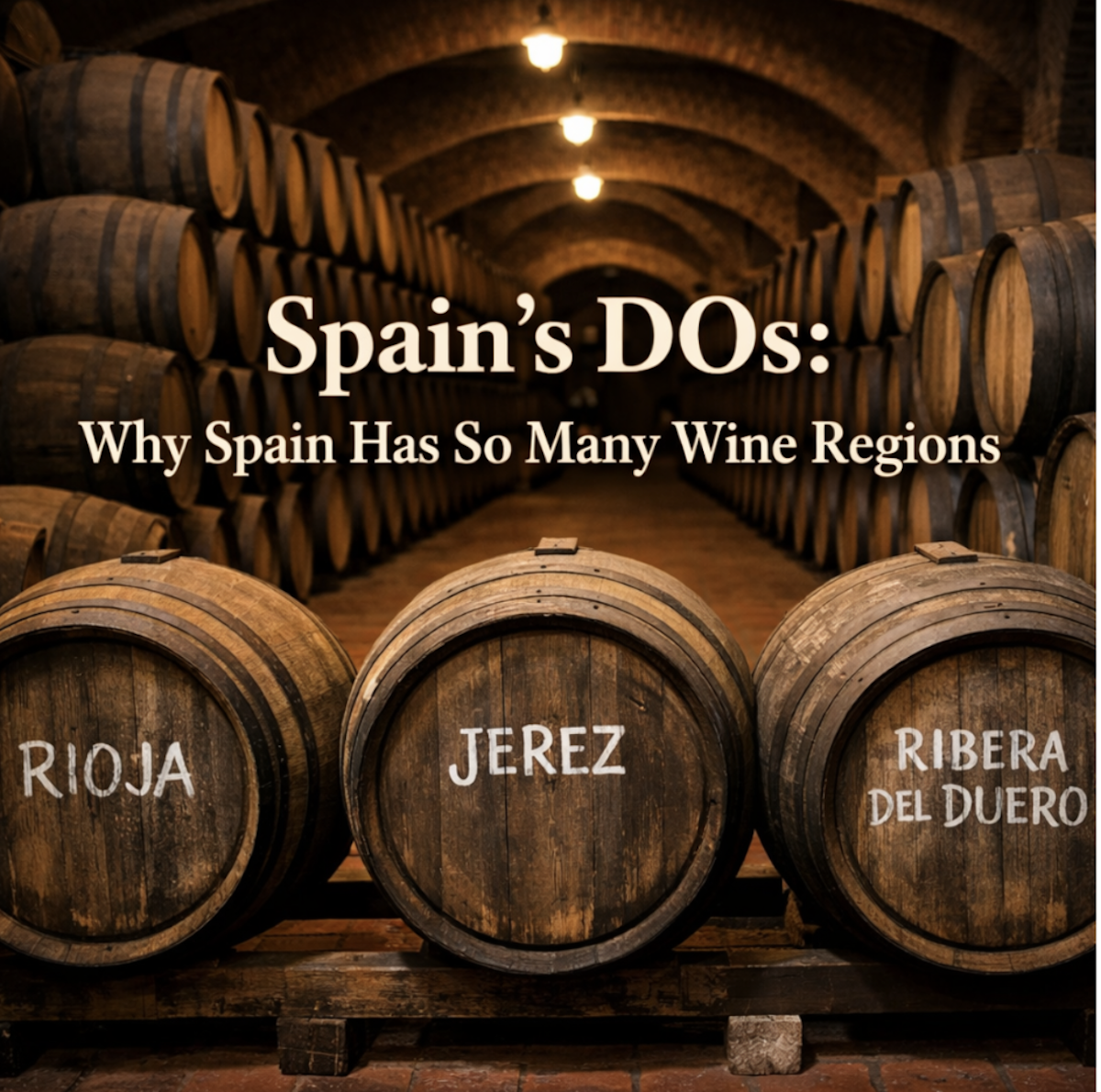

Spain’s DOs: Why Spain Has So Many Wine Regions?
In Spanish wine, place often comes before country. Rioja, Rías Baixas, Ribera del Duero, and Jerez appear first. Those names belong to a legal system. In Spain, the most familiar unit in that system is the DO, short for Denominación de Origen. A DO ties a wine name to a defined area and to rules about what wines may be sold under that name. Spain’s Ministry treats DO as one of the traditional terms used for protected wine origins, and the EU protects such names as geographical indications linked to specific places and production conditions.
That order took time to build. Before Spain had a settled denomination system, wine names were already circulating through trade. Wine moved in cask, through merchants, ports, warehouses, and distant markets. Once that happened, a practical question became unavoidable: how could anyone know that a wine sold as Rioja had actually come from Rioja? The same question applied to other names that had begun to acquire commercial weight. A place-name that succeeded in trade could also be borrowed, stretched, or copied. The legal story of Spanish wine begins there, with names whose market value had outrun the means of controlling them. Rioja’s official history describes the effort to protect the name against usurpers and counterfeiters once the wine had become widely recognized.
The first response did not come from a complete national plan drawn all at once. It emerged where the pressure was strongest. Jerez had long export experience and knew what imitation meant in commercial terms. Rioja had become established enough that misuse of the name had real economic consequences. Spain’s first national wine law, the 1933 Wine Statute, gave formal legal backing to denominations of origin and to the regulatory councils that would oversee them. Jerez’s Consejo Regulador states that it was established in 1935 under the terms of that statute and that its regulation was the first published in Spain under the new law. Rioja’s official history places the recognition of its denomination in 1925, before the statute gave the wider system firmer legal form.
What those early efforts did was plain enough. They drew lines around places and attached legal consequences to those lines. If a wine used the protected name, the grapes had to come from the authorized area and the wine had to meet the rules attached to that area. That did not yet solve every problem of farming, style, or quality. It did something more basic and more necessary. It gave a place-name an enforceable boundary. From there the system spread. Other regions saw the advantage of tying their wines to defined zones with recognized rules and public oversight. Spain’s map of denominations was assembled piece by piece.
The count now shows how far that process went. Spain’s Ministry reports 103 protected wine denominations in the 2023–2024 campaign. Of those, 69 use the traditional term DO, the standard regional designation tied to a defined production area and set of rules. 25 are Vino de Pago, a category reserved for a single estate whose vineyards, production, and bottling are confined to that property. 7 are Vino de Calidad, a transitional classification often used by regions working toward full DO status. 2 have the right to use the stricter term Denominación de Origen Calificada (DOCa), which applies additional requirements such as longer regulatory history, tighter control, and, in practice, restrictions like bottling within the region. The number is high because the country never had one set of growing conditions that could plausibly be governed by one set of rules. In Galicia, rain and disease pressure can define the season. On the central plateau, heat and drought can narrow the harvest window and drive sugars upward. In Ribera del Duero, altitude slows the cycle and changes the balance between day heat and night cooling. In the Canary Islands, island exposure and volcanic soils produce another set of conditions again. The legal map multiplied because the agricultural map was already divided.
Spain’s political order pushed in the same direction. Wine regulation did not sit above the country as a detached national abstraction. It grew through regional institutions, and the consejos reguladores became part of that local life. Ministry documents and council materials describe these bodies as the managing organs of the denominations, representing registered growers and wineries while also supervising the use of the protected name. That made a DO more than a stamp of origin. It became an institution through which a region governed part of its agricultural economy. Once those councils existed, more regions had reason to seek the same recognition rather than fold themselves into a smaller number of broader zones.
Spain also created an upper tier for a very small number of regions. The term is Denominación de Origen Calificada, usually shortened to DOCa. Only two wine denominations currently hold that right: Rioja and Priorat. The category exists to mark places with a longer record of compliance and tighter control. Rioja’s official specification requires bottling within the delimited production area, and its rules set detailed yield limits and production controls. DOCa did not replace the wider system. It introduced a stricter level inside it, which is why it holds a distinct place in the history even though it applies to so few regions.
Later, the Spanish system was folded into a wider European one. The EU’s protected-origin regime did not erase Spain’s denominations, but it did place them inside a common legal order for geographical indications. Under EU rules, a protected designation of origin reserves a name for products whose raw materials and production are tied closely to the defined area. Spain kept its traditional terms, including DO, DOCa, and Vino de Pago, but those names now operate inside a legal environment that extends beyond the country itself. That added another layer of law without changing the basic historical problem the Spanish system had been built to answer in the first place.
By the late twentieth century, the practical consequences were everywhere. Spanish wine was no longer described only by a few famous names. It moved through a dense network of legally defined places, each with its own council, its own rules, and its own claims on the market. For growers, a denomination could offer a route away from anonymous bulk wine and toward a name with legal standing. For merchants and exporters, it supplied a more stable vocabulary for sale. For the state, it created an order that could be supervised, recorded, and defended. What had begun as protection against imitation had become a national system of agricultural naming.
That system, however, never eliminated disagreement inside the larger regions. A broad denomination can contain low warmer sites and high cooler ones, old vineyards and young replanted land, low-yield farming and much looser production. Once those differences become commercially important, arguments follow. Rioja’s recent designation changes, including the creation of village wines and viñedos singulares, show that the old regional name was no longer sufficient for every producer who wanted site distinctions recognized more clearly. In Catalonia, another dispute ran along different lines: Corpinnat was created by producers insisting on stricter sparkling-wine conditions centered on estate-linked farming, organic practices, hand harvest, and longer ageing. These were disputes about yields, sourcing, bottling, ageing, and who had the right to separate one wine from another within the same broader region.
A second source of confusion arrives after the regional terms are settled. Some wines are presented first through place, others through grape. Rioja and Ribera del Duero are places. Mencía is not. It is a grape grown in more than one denomination. The reason the pattern changes is that two habits of presentation grew side by side. The denomination system protects place-names, so regions emphasize origin. The modern market, especially export markets, often recognizes grape names more quickly. Spain never forced one habit to eliminate the other. As a result, one wine may foreground origin, another may foreground composition, and a third may use both. That mixed habit did not create the denomination system, but it does explain why the system can remain difficult to interpret even after its legal basis is understood.
Spain’s answer to that pressure has sometimes been to narrow the unit further. One route was the creation of Vino de Pago, a protected category for a single estate rather than a larger region. The existence of that category shows the direction of change. Spain began by defending large names that had become exposed in trade. It later made room for a form of protection at estate scale when some producers judged the regional unit too broad for the claims they wanted to make.
Spain has so many wine denominations for concrete historical reasons. Names acquired value before the law could fully protect them. Growing conditions varied too sharply for one national rulebook to do the work. Regional institutions had strong reasons to seek their own councils. Internal disagreements kept pushing the system toward finer distinctions. A DO is the product of that long process. It is the point where a place-name, an agricultural zone, a legal boundary, and a market claim were finally forced to occupy the same ground.
Mitchell Rabinowitz
I’m a retired university professor with a Ph.D. in cognitive and developmental psychology. I taught cognition and education starting in 1984. In retirement I decided to take wine seriously, and I’ve been using AI to help me learn faster and create better. I’ve also learned you can’t just ask AI one question and call it done.
For me, an essay usually takes a number of iterations. I create a draft, then I check accuracy, hunt for gaps, revise the structure, and do it again until the piece feels coherent and useful. I also use other AIs as collaborators. It is an extensive process creating the essays.
I try to create these as stories because that is the format that sticks for most of us. Facts land better when they have a sequence and a few turning points.
