
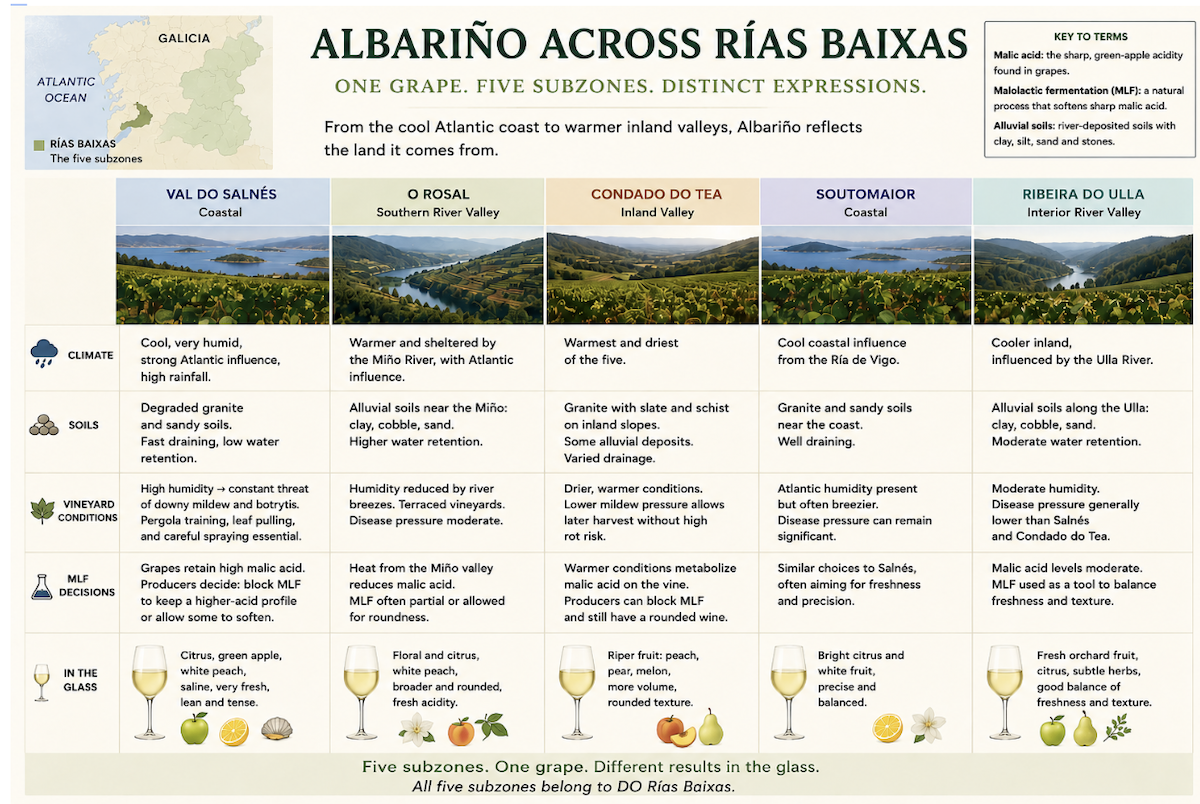

Albariño Across Rías Baixas
Albariño is often introduced as a single Galician white wine: crisp, aromatic, coastal, and useful at the table. That description leaves out the local differences that shape the grape. Rías Baixas is divided into five subzones, and those subzones do not behave alike. Val do Salnés, O Rosal, Condado do Tea, Soutomaior, and Ribeira do Ulla share a grape and an Atlantic inheritance, yet each gives Albariño a different set of pressures: rain, river influence, soil depth, heat, humidity, disease risk, and harvest timing.
The modern account begins with a change in naming. The original designation was tied directly to Albariño. In 1988, the appellation became DO Rías Baixas, a name that placed the grape inside a wider geography. That change was more than administrative. It acknowledged that Albariño did not come from one uniform landscape. The same variety could be coastal and severe in one area, broader and riper in another, and blended with other Galician grapes where heat and river-valley conditions encouraged a different balance.
Val do Salnés remains the reference point for many drinkers. It lies close to the Atlantic, around towns such as Cambados, Meaño, Meis, Ribadumia, and Sanxenxo. The climate is cool, wet, and humid. Rain is not an occasional complication; it is part of the farming calendar. The traditional pergola system developed because vines needed air around the fruit. In this damp coastal setting, downy mildew and botrytis, two fungal diseases encouraged by moisture, are constant threats. Growers manage canopies carefully, pull leaves to open the fruit zone, and time fungicide treatments with precision because a missed window can affect an entire crop. The system is practical before it is picturesque.
The soils of Val do Salnés are often based on degraded granite, with sandy textures and sharp drainage. These soils do not hold water in the same way as heavier river deposits. In a cool, rainy area, that can be helpful because it reduces waterlogging and encourages the vine to work through a leaner soil profile. The wines often carry citrus, green apple, white peach, and a marked saline impression. Their acidity can feel firm because cool conditions preserve malic acid, the sharper natural acid found in grapes. In the cellar, producers must decide how much of that edge to keep. Blocking malolactic fermentation, the process that converts sharper malic acid into softer lactic acid, preserves the wine’s brighter line. Allowing some conversion softens the wine, replacing part of the malic bite with a rounder texture. In Salnés, that choice is central because the vineyard gives the winemaker a naturally brisk starting point.
O Rosal sits farther south, along the Miño River as it approaches the Atlantic and the Portuguese border. The vineyards are warmer and more sheltered than those of Val do Salnés, often planted on slopes and terraces above the river. The soils include alluvial material near the Miño, meaning deposits left by moving water, with clay, cobble, and other river-borne components that hold more moisture than the sandy granite soils of Salnés. That water retention can help vines continue ripening during warmer late-summer periods. The wines often feel broader, more aromatic, and less sharply coastal.
O Rosal also has a different grape culture. Albariño remains important, but the subzone has long relied on other local white varieties. Loureiro contributes floral aroma. Treixadura can add body and a quieter orchard-fruit profile. Caiño Blanco is especially important because it brings high natural acidity and distinctive aromatics, helping growers preserve freshness in warmer terraced sites above the Miño. These blends are practical answers to place. O Rosal shows that Albariño in Rías Baixas has never been only about varietal purity. In some subzones, balance comes from the careful use of neighboring grapes.
Condado do Tea moves farther inland and becomes warmer and drier. The Tea River and the Miño shape the landscape, but the Atlantic influence is less direct. Summer heat builds more easily, and the grapes can reach higher sugar levels than in Val do Salnés. Disease pressure can be lower because the air is drier and less humidity remains trapped beneath the canopy. Growers can sometimes wait longer for ripeness without the same immediate threat of botrytis destroying the crop, giving the fruit more time to accumulate sugar and flavour.
The soils in Condado do Tea are more varied than a simple granite description suggests. Granite remains part of the picture, but slate and schist, two layered rocks that absorb and radiate heat, also appear, along with darker rocky material on inland slopes. Alluvial deposits near the rivers add heavier textures and alter drainage. Clay and cobble can retain enough moisture to support vines through hotter periods. These conditions help produce wines with riper peach, pear, melon, and sometimes greater palate weight. Because warmer summers reduce malic acid on the vine, producers can block malolactic fermentation and still finish with a wine that feels rounded. In Condado, the vineyard has already softened part of the acid profile before the grapes reach the cellar.
Soutomaior is the smallest subzone and is often passed over in general accounts of Rías Baixas. Its scale limits its visibility, but it fills an important place on the map. Located near the Ría de Vigo, it remains strongly influenced by the Atlantic, with fresh conditions and relatively small production. The wines can show precision and brightness without always carrying the same sharp coastal intensity associated with Salnés. Soutomaior reminds us that Rías Baixas is not only a contrast between the famous coast and the warmer inland south. Small local zones can preserve their own balance of exposure, slope, soil, and sea air.
Ribeira do Ulla extends the appellation northward and inland along the Ulla River. It is cooler than many inland wine areas, yet drier than Val do Salnés because it is less exposed to the open coast. River influence is important here too. Alluvial soils near the Ulla, with more clay and cobble than the sandy decomposed granite of Salnés, can give vines steadier access to water during late summer. The wines often show fresh fruit without the same overt saline edge of the coast. They may be more softly aromatic, depending on site and cellar choices, but they still sit within the Atlantic family.
Across the five subzones, the same grape carries different evidence from the field. In Salnés, humidity, granite sand, disease pressure, malic acidity, and the winemaker’s decision about whether to keep or soften that sharpness shape the finished wine. In O Rosal, river terraces, alluvial soils, and companion grapes such as Loureiro, Treixadura, and Caiño Blanco broaden the wine while preserving freshness. In Condado do Tea, inland warmth, slate, schist, river deposits, and lower mildew pressure allow later harvesting and fuller fruit. Soutomaior preserves a smaller coastal variation. Ribeira do Ulla shows how the grape changes when river influence and cooler inland conditions replace direct exposure to the Atlantic.
Albariño became internationally known because it was easy to recognize: pale, fresh, citrus-driven, and suited to seafood. Rías Baixas is more interesting than that reputation suggests. The grape reflects the subzones. Rainfall, mildew pressure, pergola training, granite sand, slate, schist, alluvial clay, malic acid, and local blending traditions all leave practical consequences in the glass. The best way to understand Albariño is to follow it across Rías Baixas, from the wet coastal vineyards of Val do Salnés to the warmer inland slopes of Condado do Tea, and to notice how one grape changes when the weather, soil, and farming demands change around it.
Mitchell Rabinowitz
I’m a retired university professor with a Ph.D. in cognitive and developmental psychology. I taught cognition and education starting in 1984. In retirement I decided to take wine seriously, and I’ve been using AI to help me learn faster and create better. I’ve also learned you can’t just ask AI one question and call it done.
For me, an essay usually takes a number of iterations. I create a draft, then I check accuracy, hunt for gaps, revise the structure, and do it again until the piece feels coherent and useful. I also use other AIs as collaborators. It is an extensive process creating the essays.
I try to create these as stories because that is the format that sticks for most of us. Facts land better when they have a sequence and a few turning points.
