
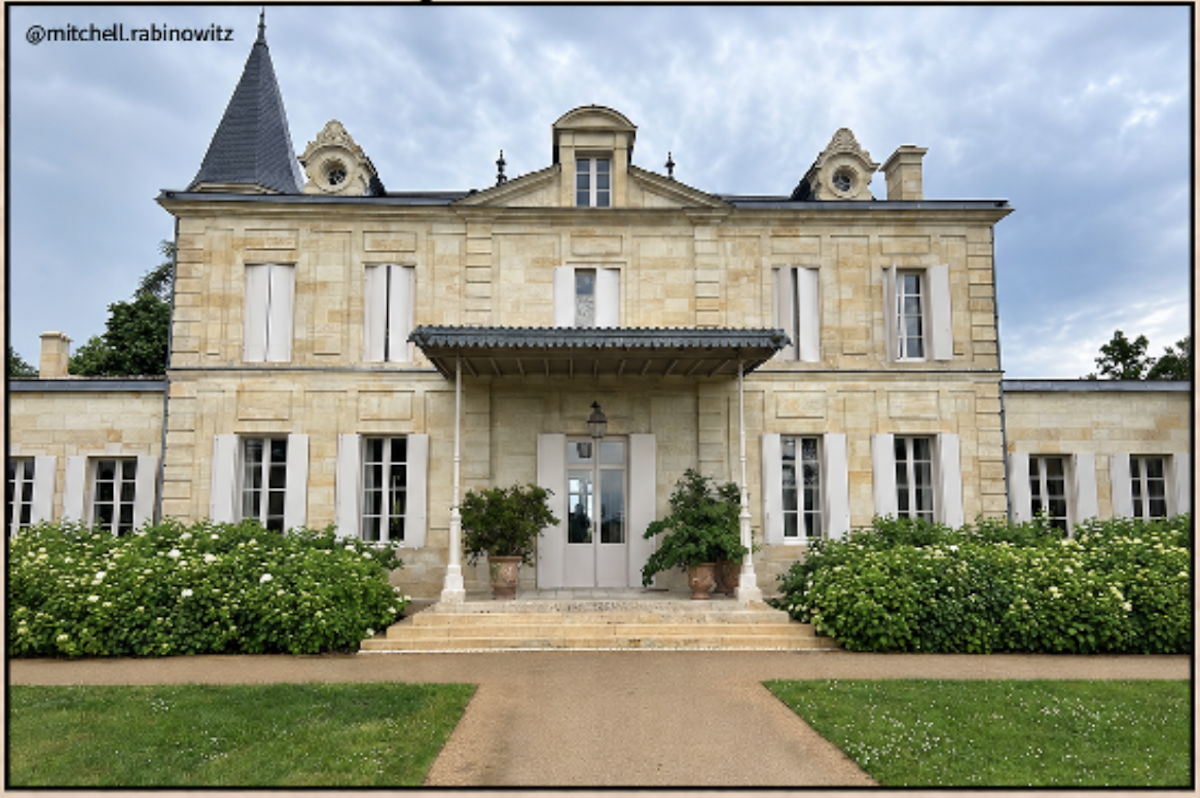

Château Cheval Blanc: History and Portfolio
Château Cheval Blanc begins as part of the old Figeac estate, but its modern history starts in 1832, when Jean-Jacques Ducasse bought the core of the property and began assembling the land that would shape the estate thereafter. Over the next two decades he enlarged it with parcels from Figeac, and the outline he established remained essentially the one the château still farms today. The next phase passed through Henriette Ducasse and her husband Jean Laussac-Fourcaud, whose work in the nineteenth century gave the property lasting technical direction through drainage, replanting, and the steady elevation of Cabernet Franc on a site whose neighbors leaned more heavily toward Merlot.
Documents from the fifteenth century record vines at Cheval Blanc, while archives from 1546 show that vineyards on the property were being leased to a tenant farmer. A contract from 1587 required the tenant to remain at night to guard the harvested grapes. By the following century, a smallholding called Au Cheval-Blanc had acquired the name that the estate would eventually adopt. On the eve of the French Revolution, two winegrowers were living permanently on the property.
Cheval Blanc is located in the commune of Saint-Émilion, at the western edge of the appellation beside the boundary with Pomerol. It differs geologically from many of the best-known Saint-Émilion estates around the limestone plateau and slopes near the town. Cheval Blanc instead lies on Quaternary alluvial deposits associated with the Isle River, giving it non-calcareous soils that have more in common with some of the leading vineyards of neighboring Pomerol. Gravel, clay, and sand occur across the estate, and the château still manages the vineyard as a collection of distinct soils and individual parcels rather than one uniform block of land.
Jean Laussac-Fourcaud recognized those differences during the nineteenth century and altered both the vineyard and the way it was farmed. He installed covered drainage systems in selected parcels to control excess water and, beginning in the mid-1860s, replanted substantial sections of the estate. He planted those new sections with roughly equal proportions of Merlot and Cabernet Franc, an unusual choice on the Right Bank, where Merlot generally dominated. That planting program was completed in 1871. By 1911, Cabernet Franc already accounted for nearly half of the vineyard.
The château’s current vineyard material describes 42 hectares divided into 56 plots, while the vineyard historically associated with the grand vin covers about 39 hectares. Those 42 hectares contain nearly 245,000 vines. Each vine can be identified by its row and position within that row, allowing the vineyard team to follow individual parcels and vines with unusual precision. Soil temperature, vine water status, mineral nutrition, stages of growth, and grape ripening are monitored during the season, and small experimental fermentations are made before harvest as another way of judging the fruit. The boundaries of the main vineyard have remained almost unchanged for nearly a century and a half.
Cabernet Franc remains a major component of the vineyard and contributes significantly to the wine’s ability to age. Merlot contributes additional body and ripeness, while Cabernet Sauvignon occupies a much smaller portion of the vineyard. The proportions in a finished vintage are not determined by a permanent recipe. The individual plots are harvested and vinified separately, after which their wines can be assessed before the final selections are made.
The former Figeac wine was first sold under the Cheval Blanc name in 1852. In 1862 it won a bronze medal at the Universal Exhibition in London, followed by a gold medal in Paris in 1878 and another gold medal in Antwerp in 1886. Those medals still appear on the label. By the second half of the nineteenth century, merchants and collectors were already treating Cheval Blanc as comparable in stature to the leading classified growths of the Médoc, and the wine appeared at important official dinners and in major auctions in Paris and London.
After Jean Laussac-Fourcaud died in 1888, the property remained within the family. His widow inherited the estate and later passed it to their son Albert, who reversed the family name and became Albert Fourcaud-Laussac. He continued his father’s work and installed twelve wooden fermentation vats that remained in service until 1966. His sons Jacques and Joseph later assumed responsibility for the estate. This long period of family ownership allowed vineyard practices, plant material, and cellar knowledge to be carried forward with relatively little interruption. Gaston Vaissière, the estate’s longtime cellarmaster, worked at Cheval Blanc for forty-four years.
The 1947 vintage occurred in extreme heat, with harvest beginning unusually early on 15 September and continuing under torrid conditions into early October. Fermentation took place under difficult conditions, and the wine reached levels of richness and alcohol that were highly unusual for Bordeaux at the time. Yet the finished wine became one of the most famous bottles in the history of Bordeaux. Its importance lies in what it showed so early and so dramatically: Cheval Blanc was not limited to orderly years. It could also produce a wine of extraordinary scale and distinction under conditions that might have undone a lesser estate.
When Saint-Émilion created its classification in 1954, Cheval Blanc received the top rank of Premier Grand Cru Classé A. That status was reaffirmed in successive classifications for decades. In 2021, however, Cheval Blanc withdrew from the process that would lead to the 2022 classification. The château explained that the criteria had moved too far away from the viticultural history, terroir, and wine that it believed should determine the standing of a property.
The estate entered another important phase in 1998, when Bernard Arnault and Albert Frère acquired it and Pierre Lurton took over management. The following year, Cheval Blanc entered into a joint venture with Terrazas de los Andes in Mendoza, creating Cheval des Andes. Pierre Lurton had studied the vineyards at Las Compuertas with Roberto de la Mota, and the project brought Cheval Blanc’s experience with blending into a different environment centered on high-altitude Malbec, Cabernet Sauvignon, and later Petit Verdot.
Rather than reorganizing the Saint-Émilion vineyard around a new system, the owners retained the emphasis on individual plots and long-term vineyard continuity. The modern winery, designed by Christian de Portzamparc and inaugurated in 2011, was built around that same approach. It contains 67 concrete vats in 14 sizes, ranging from 12 to 113 hectoliters. Each vat is assigned to a single plot during fermentation and carries information identifying that plot. The different capacities allow a small parcel to remain separate rather than being combined with fruit from somewhere else because a larger vat must be filled. The building was designed to fit within the historic Saint-Émilion landscape, which has been listed as a UNESCO World Heritage Site since 1999.
Pierre-Olivier Clouet has become increasingly important in the current phase of the estate and today serves as director of Château Cheval Blanc. Pierre Lurton remains closely identified with the property after decades of leadership, while Clouet now carries much of the day-to-day responsibility for the estate’s agricultural and technical direction. Cheval Blanc’s recent work has concentrated heavily on agroecology, including the end of routine ploughing and the use of permanent or seasonal plant cover between the vine rows. When this vegetation is rolled down, it forms mulch that helps retain water and adds organic material to the soil.
Cheval Blanc has planted about 3,000 forest and fruit trees around the vineyard and within vine rows, along with extensive hedges. Orchards and vegetable gardens have also been established across the property. Flower gardens, aromatic plants, beehives, and water features add further habitats for plant and animal life. Sheep graze among the vines from October through March, eating vegetation and returning organic material to the soil. In 2021 the château published an agroecology manifesto setting out these practices and its intention to reduce dependence on intensive cultivation while increasing biological diversity across the estate.
Across Bordeaux, 2021 was a year of spring frost, rain, disease pressure, and uneven ripening, and the château’s own materials describe above-average rainfall during May and June before drier weather arrived later in the summer. Vineyard crews used frost protection during the cold spring and then had to contend with mildew as wet conditions continued. Those problems required repeated decisions about canopy management, disease control, and harvest timing before the fruit ever reached the cellar. At Cheval Blanc, difficult vintages often show most clearly how much work is required to bring healthy Cabernet Franc and Merlot to the point where the final blend can be assembled.
Château Cheval Blanc is the grand vin, made from the parcels selected for the estate’s principal red wine. Le Petit Cheval, first produced in 1988, is made from estate fruit that is vinified with the same attention to individual parcels but selected separately from the grand vin. It is not produced according to a fixed formula, since the parcels and proportions used can change from vintage to vintage according to the character of the fruit.
Le Petit Cheval Blanc developed after Cheval Blanc acquired La Tour du Pin in 2006. Parts of that land had water conditions that made them better suited to white grapes, and the estate began grafting experiments with Sauvignon Blanc in 2008. Sémillon was subsequently identified in an existing vineyard and incorporated into the project. The first released wine was Le Petit Cheval Blanc 2014, presented by the château in 2016. The wine is produced in small quantities from Sauvignon Blanc and Sémillon and extends the estate’s parcel-by-parcel approach to white Bordeaux.
Mitchell Rabinowitz
I’m a retired university professor with a Ph.D. in cognitive and developmental psychology. I taught cognition and education starting in 1984. In retirement I decided to take wine seriously, and I’ve been using AI to help me learn faster and create better. I’ve also learned you can’t just ask AI one question and call it done.
For me, an essay usually takes a number of iterations. I create a draft, then I check accuracy, hunt for gaps, revise the structure, and do it again until the piece feels coherent and useful. I also use other AIs as collaborators. It is an extensive process creating the essays.
I try to create these as stories because that is the format that sticks for most of us. Facts land better when they have a sequence and a few turning points. Connect with @mitchell.rabinowitz on Instagram
