

Rías Baixas: Atlantic Wine in Galicia
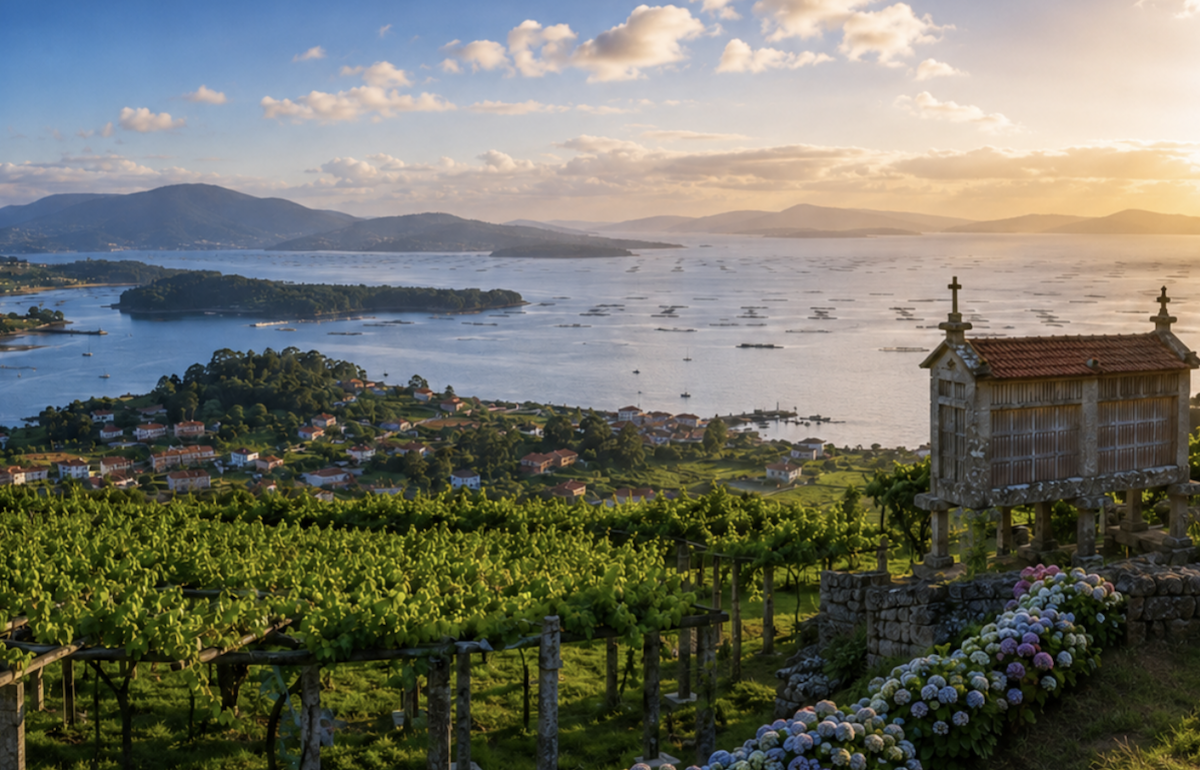
Rías Baixas begins with water. The Atlantic reaches into Galicia’s western coast through long estuaries called rías, where river water, sea air, fog, and rain meet before they move inland across small vineyards. This is one of Spain’s wettest wine regions, and the problem of ripening grapes here has always been practical before it was commercial. Vines must survive humidity, mildew pressure, spring variability, and harvest seasons that can change quickly when Atlantic weather turns. The high pergola system, locally associated with parrales, developed from this reality. By
lifting bunches above the ground and allowing air to move beneath the canopy, growers reduced rot risk while keeping fruit exposed to the limited sun available in a cool, damp place.
Viticulture in this part of Galicia is old, though its history did not move in a clean line from antiquity to modern reputation. Romans, medieval monasteries, local families, and smallholders all left traces, but for much of its history wine here was made in scattered plots for local use. Albariño, now almost inseparable from Rías Baixas, was once surrounded by stories of foreign arrival, including claims that it came with medieval monks or northern European traders. Genetic work has weakened those accounts. Albariño is now treated as an Atlantic Iberian grape, rooted in the viticultural history of Galicia and northern Portugal rather than as a borrowed variety that later found a home.
The Denominación de Origen was approved in 1988, giving legal definition to a region that had long been agricultural before it was internationally known. That change coincided with stainless steel cellars, cleaner fermentations, better vineyard selection, and new export channels. Bodegas Martín Códax, Pazo de Señorans, Do Ferreiro, Terras Gauda, Palacio de Fefiñanes, and other producers helped move Albariño from local reputation to the wider market for Spanish white wine. The result was a recognizable style: pale, aromatic, high in acidity, marked by citrus, stone fruit, salt, and a firm finish. That style brought success by matching the region’s climate, though it risked reducing Rías Baixas to a single commercial profile.
The DO now includes five subzones: Val do Salnés, O Rosal, Condado do Tea, Soutomaior, and Ribeira do Ulla. Val do Salnés, closest to the Atlantic and centered around Cambados, is the historic core and remains the largest and most influential area. Its granitic soils, cool temperatures, and direct maritime influence often produce the sharpest, most saline Albariños. O Rosal and Condado do Tea sit farther south along the Miño River, where the river valley holds more warmth and gives vines greater protection from direct Atlantic wind. This accumulated heat helps Loureiro, Treixadura, and Caíño Blanco ripen more reliably alongside Albariño. Soutomaior is small and historically linked to Albariño grown near the coast. Ribeira do Ulla, added later and located farther north and inland, shows a cooler inland profile, with wines that can carry freshness without the same immediate coastal imprint as Salnés.
The subzone names carry legal requirements. O Rosal wines must contain at least seventy percent combined Albariño and Loureiro. Condado do Tea wines must contain at least seventy percent combined Albariño and Treixadura. These mandates preserve older blending habits in the two warmer southern areas, where Albariño has long shared vineyard and cellar space with other Galician white grapes. They anchor the historical reality that Rías Baixas maintains a mixed varietal tradition despite the current dominance of pure Albariño plantings.
Granite remains central to how many of these vineyards work. In much of Val do Salnés, sandy granitic soils drain quickly after heavy rain, limiting waterlogging in a region where rainfall can be abundant. The soils are often acidic and low in fertility, which can restrain vine growth when canopy pressure would otherwise become excessive. In warmer inland zones, clay, alluvial material, and other soil types alter vine behavior, holding more water and supporting different ripening patterns. These differences affect canopy growth, harvest timing, acidity, alcohol, and the weight of the finished wine.
Albariño dominates Rías Baixas to an unusual degree. The 2025 harvest made that plain: the DO reported a record crop of about 47.5 million kilograms of grapes, with Albariño accounting for nearly 97 percent of production. Such scale confirms Rías Baixas as one of the country’s largest and most widely distributed white wine regions, supported by thousands of growers, more than 160 wineries, and a strong export market. The United States has become its leading export destination, with recent sales reaching record levels. Albariño’s success now supports the region, but it places pressure on producers to show the variations possible within the DO.
The growth of the region has also sharpened questions about planting material. Many newer vineyards rely on productive commercial clones selected for reliability, vigor, and yield. Some quality-focused producers look instead to massal selection from older parrales, taking cuttings from established vines that have performed well in local conditions over many years. This choice affects the vineyard before any cellar decision is made. Planting material influences vigor, bunch size, disease tolerance, and how much fruit the vine tries to set in spring. In a damp region where
canopy density and disease pressure can decide the harvest, the source of the vine helps shape the finished wine.
White varieties such as Loureiro, Treixadura, Caíño Blanco, Torrontés, Godello, and the recently approved Ratiño Gallega show that Galicia’s Atlantic vineyard history extends beyond Albariño. Red varieties, including Caíño Tinto, Sousón, Espadeiro, Mencía, Brancellao, Pedral, Castañal, and Loureiro Tinto, remain far less common but are part of the region’s permitted plantings. These grapes give growers additional ways to work with site, vintage, and local demand.
Stainless steel fermentation still defines much of the DO, especially for wines intended to be bright, direct, and released young. Yet many serious producers now use lees aging, larger vessels, older wood, concrete, foudres, granite eggs, or limited skin contact to test how much depth Albariño can carry without losing acidity. Malolactic fermentation is part of the same decision. Albariño grown in a cool, wet Atlantic climate often retains high malic acid, so winemakers may block malolactic conversion to preserve a sharper coastal profile, or allow it partially or fully to soften the wine and give it a rounder feel. The strongest examples preserve the grape’s acidity while adding texture and aging capacity.
Wine production in Rías Baixas relies on small holdings, family parcels, cooperative labor, and a long habit of making wine close to home. Furanchos, the seasonal taverns where families traditionally poured their own wine with simple food, grew directly from that domestic and agricultural world. They are now more regulated than they once were, but they still point to the same older fact: wine in coastal Galicia was part of ordinary life before it became a polished export product.
Galicia’s wider cultural history remains tied to the wine. Galego links the area linguistically to Portugal as much as to Castilian Spain, and migration has long shaped Galician life. Many families left for Latin America and other parts of Europe, while small vineyards remained behind in villages and coastal towns. The Festa do Albariño in Cambados gathers the public each summer around the grape that carried Rías Baixas into modern distribution, tying the commercial success of the wine back to local food, language, and memory.
Climate change has made the region’s future less predictable. Warmer seasons can help ripen grapes in a damp Atlantic area, but they also bring new risks: higher alcohol, faster acid loss, uneven rainfall, storm damage, and greater disease pressure when heat and humidity combine. Growers are responding through canopy work, earlier picking, site selection, better sorting, and closer attention to subzone differences. The Atlantic remains a moderating force, but it does not remove the need for adaptation. The region’s advantage is that freshness has long been part of its farming logic, so many of the tools needed for warmer years already exist in local practice.
Rías Baixas today is larger, more widely distributed, and more commercially successful than the region described in older accounts of Albariño’s rise. Yet its strongest wines still return to the same basic conditions: rain, granite, wind, pergolas, small growers, acid management, and the difficulty of keeping ripeness and freshness in balance near the Atlantic. Rías Baixas will be judged by how clearly it preserves the differences within its own coastline, valleys, soils, grapes, and cellars.
Mitchell Rabinowitz
I’m a retired university professor with a Ph.D. in cognitive and developmental psychology. I taught cognition and education starting in 1984. In retirement I decided to take wine seriously, and I’ve been using AI to help me learn faster and create better. I’ve also learned you can’t just ask AI one question and call it done.
For me, an essay usually takes a number of iterations. I create a draft, then I check accuracy, hunt for gaps, revise the structure, and do it again until the piece feels coherent and useful. I also use other AIs as collaborators. It is an extensive process creating the essays.
I try to create these as stories because that is the format that sticks for most of us. Facts land better when they have a sequence and a few turning points.
