
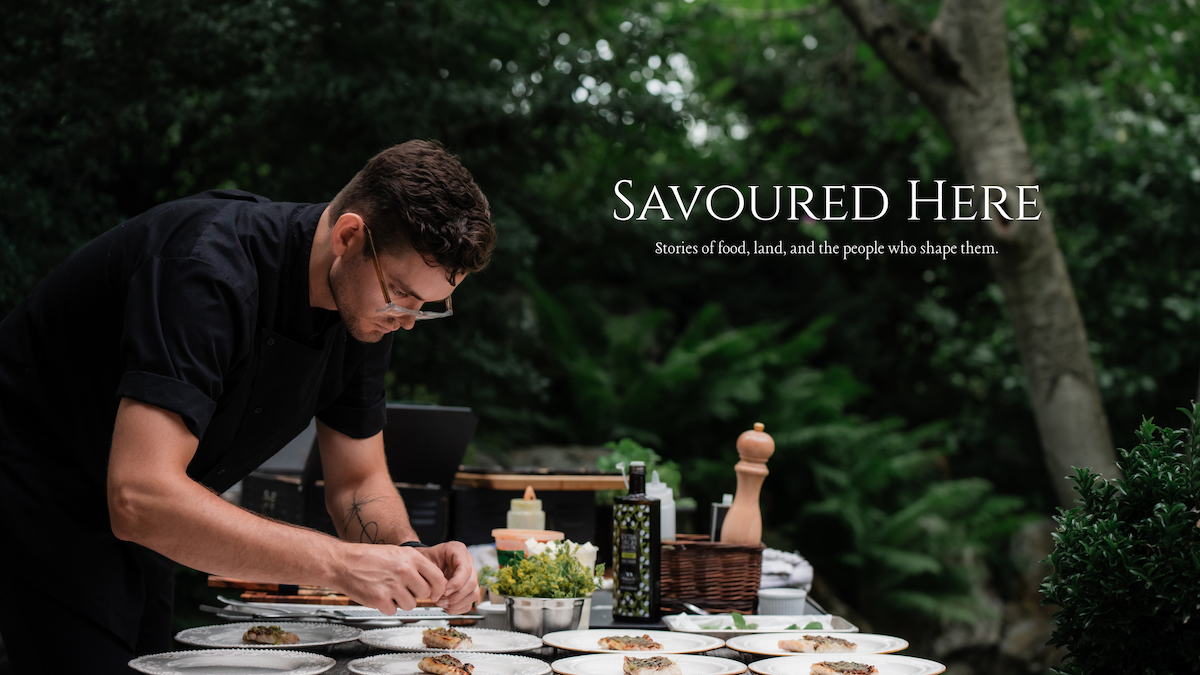

Dining Experiences in the Heart of Nature
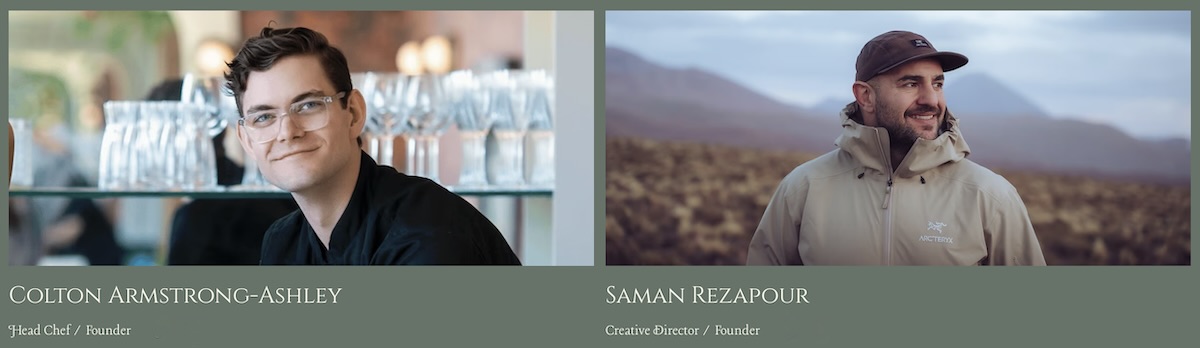
In conversation with Chef / Founder Colton Armstrong-Ashley and Creative Director / Founder Saman Rezapour of Savour the Wild about their upcoming TV series Savoured Here partnered with Telus Storyhive.
- Let’s go way back to how your interest in culinary experiences may have begun.
Sam: I don’t come from a culinary background, but I do come from a culture where food sits at the centre of everything. Growing up with French and Persian influences, meals were never rushed. They were a time to gather, tell stories, disagree, laugh, and connect. As I got older and began travelling, I realized that food is often the quickest way to understand a place and its people. As a filmmaker, that naturally drew me in. I became fascinated not just by what’s on the plate, but by the people behind it: the farmers, fishers, chefs, and communities that shape a food culture.
Colton: Food was what grounded my family, it was the centre of our common time and developed a shared language amongst our immediate household and extended family. Calendar Holidays always felt secondary to the meals that accompanied them, Root Beer Floats were alleged to be medicinal, and we all seemed to align with valuing sharing the time and effort around a meal as of the highest meaning. There was a blend of mysticism and intention around our meals, we were taught to ask about meals to develop appreciation for both the cook and the hidden world behind the ingredients. Growing up in Northern Alberta, there wasn’t such ready access to the best or freshest of anything, a truly good meal was a covetous thing and certainly prized as such.
- What is your very first memory of food, and what feelings does it bring back today?
Sam: One of my earliest memories is sitting around the table with my family, shaped by both my French and Persian roots. Food was never just something we ate. It was how family gathered, how stories were shared, and how culture was passed down from one generation to the next. I remember long meals that seemed to last forever, with adults talking, laughing, and debating while I quietly listened. Looking back, I realize those moments shaped how I see food today. To me, food has always been one of the most powerful ways of understanding people, their history, and their sense of home.
Colton: Visiting my grandparents in Calgary often felt like a culinary adventure. Grandpa was always piling more onto our plates with a wink and a nudge, he was proud to give and for that reason being told I had a “hollow leg” felt like a badge of honour – eating and appreciating was what I could give back. Beyond the restaurants and family dinners, we were a big popcorn family. Granny often had an extensive selection of Popcorn Seasonings for us to doctor up our own bowls with. Everyone had their own go-to, inevitably when they ran out we would all make bowls with varying concentrations of white cheddar seasoning. The process of making the bowls together, competing on who could toss the highest and tidiest, and then critiquing the subtle (if at all real) differences from bowl to bowl stands out to me. It makes me feel connected.
- Let’s start at the beginning of this project, how did you come to be involved in Savoured Here?
Colton: Sam and I have been business partners and friends for somewhere in the ballpark of five years now. Our goal has always been to share experiences and “build rooms we want to be in”. The first iteration of this effort was “Savour The Wild”, our adventure dining series, which generated “Savoured Here” as a very natural extension. We spent a few years hosting unbelievably beautiful dinners all over Southern Vancouver Island, we made a point to bring in farmers, foragers, and creators who inspired us and seemed responsible for part of the tapestry that makes our region so special. The more I cooked with what they were bringing me, the more Sam captured incredible photos of the process, the more we realized that the part we were most proud of was telling the hidden stories of how the food got to the plate and the choices the people behind it made to make it all so good. We were introduced to the Telus Storyhive program and initially pitched a podcast series as we were both independently VERY busy, Telus told us that it would be better as a TV series and rejected the podcast. They were right to do so.
- Was this something that you’ve been planning for some time or just a chance opportunity?
Sam: Honestly, a bit of both. Colton and I had been talking for years about food, culture, and the incredible people shaping Vancouver Island’s food scene. We always felt there was a bigger story there that wasn’t really being told. The opportunity came when STORYHIVE opened up their documentary stream, but the idea itself had been sitting with us long before that. It felt less like starting something new and more like finally giving life to something that had been brewing for years.
- How does the local environment, agriculture, or regional history shape the ingredients you choose to use for this project?
Colton: All the above shaped the menu entirely. Given the nature of trying to create a dish that highlighted the conversations and learning of each episode, we put a lot of thought into what we expected might compliment the interviews. I’d say we were about 25% accurate with our predictions and outcomes, most of the dishes ended up coming together more or less on the fly as whoever we were chatting with taught us things we couldn’t have expected and left us with ingredients we couldn’t have found anywhere else.
- Why was Vancouver Island chosen for this project?
Sam: Vancouver Island has this incredible concentration of people who care deeply about “place.” Farmers, fishers, chefs, Indigenous knowledge keepers, producers, everyone is connected in ways you don’t often see elsewhere. There’s a real sense of stewardship here.
As someone who wasn’t born on the Island, I was fascinated by how strongly people identify with it. The Island almost becomes a character itself. We realized very quickly that this wasn’t just a story about food. It was a story about land, community, and belonging.
- Were you both involved in the choice of the actual locations?
Sam: Absolutely. It was a very collaborative process. Colton brought an incredible knowledge of the food community and relationships he’d built over the years, while I approached it from a storytelling perspective, always asking: whose story can help us understand this place better?
We wanted a mix of voices and landscapes. Farms, oceans, forests, kitchens. We weren’t necessarily looking for the biggest names, but for people whose stories said something meaningful about Vancouver Island.
- Who decided what dishes you would feature?
Colton: We tried to work with the folks who we interviewed to get an idea of what ingredients might best represent the season, our terroir, and what makes them happiest about what they do. That was a big part of my interest in this project, learning first hand from the people who grow and catch as to what they look for in quality, what they see as worth being proud of, and finding ways to celebrate that on a plate.
- Tell us about your philosophy on food in terms of storytelling, culture, and sense of place.
Sam: I think food is one of the most powerful storytelling tools we have. Every ingredient has a story behind it: who grew it, harvested it, cooked it, and passed down the knowledge around it. Food carries history, culture, migration, and identity in a way that feels deeply human and accessible.
As a filmmaker, I’m interested in how food can become a lens through which we understand a place. You can learn a lot about a community by looking at what it eats, what it values, and how it gathers around a table. For me, food is really a story about people and their relationship with the land and with one another.
Colton: I second absolutely everything Sam put forward.
Along with that, I see food as a medium to engage in society that has been underserved for a few generations.
I think that literacy around food, exploring where it comes from, understanding what supports or jeopardizes its production or accessibility, and really questioning the value or utility of a dish or ingredient are integral to being “tuned in”. Every level of the economy, societal and individual health, the environment, and perspectives are tied to and influenced by how we relate to food. As we remove ourselves from those systems, from growing food ourselves and breaking bread with neighbours, we immediately begin to lose our ability to understand and see the world as connected.
- What was it like collaborating with Indigenous knowledge keepers, farmers, fishers, and producers in a more cinematic way?
Sam: It was a privilege, honestly. Our goal was never to speak for people, but to create space for them to tell their own stories.
The cinematic approach wasn’t about making things look beautiful for the sake of it. It was about slowing down enough to notice details that people often overlook: hands harvesting vegetables, the rhythm of fishing, the landscape surrounding a farm. Those moments carry meaning.
I think what struck me most was how generous everyone was with their time and knowledge. We learned far more from them than we could ever capture on camera.
- What kind of planning went into each day of filming?
Sam: A lot more than people probably realize. Every shoot involved location scouting, story research, interviews, weather monitoring, call sheets, gear prep, and figuring out how to capture authentic moments without disrupting what was happening.
At the same time, documentary filmmaking requires flexibility. You can prepare as much as possible, but often the best moments are the ones you never planned for. Our job was to create the conditions for those moments to happen and be ready when they did.
- What was the most challenging aspect of working while filming?
Colton: Time was not our friend. I was uniquely bad at managing it on-camera. Sam and I both had full-time commitments outside of this and Sam managed to balance a move to Vancouver during filming. To compensate, we often sought to organize three interviews per day, each interview had multiple locations and a cookery component. This was abject insanity, borderline hubris.
I genuinely wanted to be having the conversations I was having and was getting so much out of it myself that I had no discipline in cutting interviews off when the clock dictated. As a result, we were 4 for 6 on racing sunsets to shoot the cookery portions.
- Was it stressful working while being filmed?
Colton: Only due to the aforementioned time management issues. From a cookery perspective it was easy. I enjoy the process so much and being able to plate the lessons of the day while looking out at the settings we found ourselves in was an absolute treat. In our episode about local wine history I attempted to host an interview whilst cooking, we flew a little close to the sun there. It would’ve been my fourth interview of the day, each of them taking about two hours, and I can see myself slipping into “chef mode” just to stay on my feet and execute the meal. Thankfully Sam is a wizard in the edit, so the viewer can catch a cheeky glimpse of me blocking out the world to focus on the plate as a survival mechanism, but that was certainly the most stress I felt; racing the sunset, calorie deficient, and trying to manage a conversation and hibachi grill.
- Did you have any unexpected culinary disasters that you would share?
Sam: There were definitely a few moments where things didn’t go according to plan. One that comes to mind was filming at Neighbourly Wine Co. when the sprinklers unexpectedly turned on in the middle of a setup. Suddenly everyone was scrambling to move cameras and gear before they got soaked.
Documentary filmmaking teaches you very quickly that you can’t control everything. Sometimes those unexpected moments end up becoming some of the most memorable parts of the experience.
- Share with us what you felt were some of the highlights of your experiences.
Sam: There are so many, but I think the biggest highlight was seeing how interconnected this community really is. Everywhere we went, people spoke about supporting one another. Farmers talked about chefs, chefs talked about fishers, fishers talked about the land.
There were also moments during interviews where people shared stories that were deeply personal and vulnerable. Those moments remind you that food is never just about what’s on the plate. It’s about identity, memory, and community.
- Tell us about the evolution from immersive dining experiences into documentary filmmaking
Sam: Savour the Wild was always about creating connection through food and place. Documentary filmmaking felt like a natural extension of that.
At some point, we realized that while the meals were powerful experiences, there were incredible stories behind the ingredients and the people producing them. Film allowed us to preserve those stories and share them with people who might never attend one of our dinners.
In many ways, both projects are trying to achieve the same thing: helping people feel more connected to where their food comes from.
- What are the major challenges of capturing hospitality and atmosphere on screen?
Sam: Hospitality is really about feeling, and feelings are difficult to film.
You can capture beautiful images of food or landscapes, but hospitality lives in small moments: someone welcoming a guest, laughter around a table, the way people care for one another. Those moments are often subtle and fleeting
The challenge is creating a film that doesn’t just show people what happened, but helps them feel what it was like to be there.
- How about giving us a few hints about what to expect.
Colton: Passion and enthusiasm. The through line amongst all the guests is that they genuinely care about what they’re doing. It’s not a job for anyone, quality isn’t negotiable, the outcomes are directly tied to the inputs. Everyone lives and breathes what they’re participating in. The cinematography is lush and slow moving, I find myself really sinking into watching the conversations.
- How did this become a series rather than a one-of project?
Sam: Very early on, we realized there was simply too much story for a single film. Every person we met opened the door to three more stories.
The deeper we went, the more we realized Vancouver Island’s food culture couldn’t be captured in ninety minutes. A series gave us the space to explore different perspectives while still weaving them into a larger story about place and community.
- Any hints into what the future holds for both Savour the Wild and Savour Here?
Sam: I think this project confirmed that people are hungry for stories that feel rooted in place and community. We’re already exploring what future seasons of Savoured Here could look like and where those stories might take us next.
The series will premiere September 22, 2026 across TELUS Optik TV and TELUS Stream+, before releasing on STORYHIVE’s YouTube channel on November 24, 2026. Positioned to reach a broad national audience, the series further elevates Vancouver Island as a leading culinary and tourism destination. Supported by aligned partners including Volkswagen, Weber, Blundstone, BC Dairy, Search & Rescue Denim, and House of Epula the project extends beyond the screen through integrated brand collaborations, curated screenings, and live activations.
See the official trailer here:
