
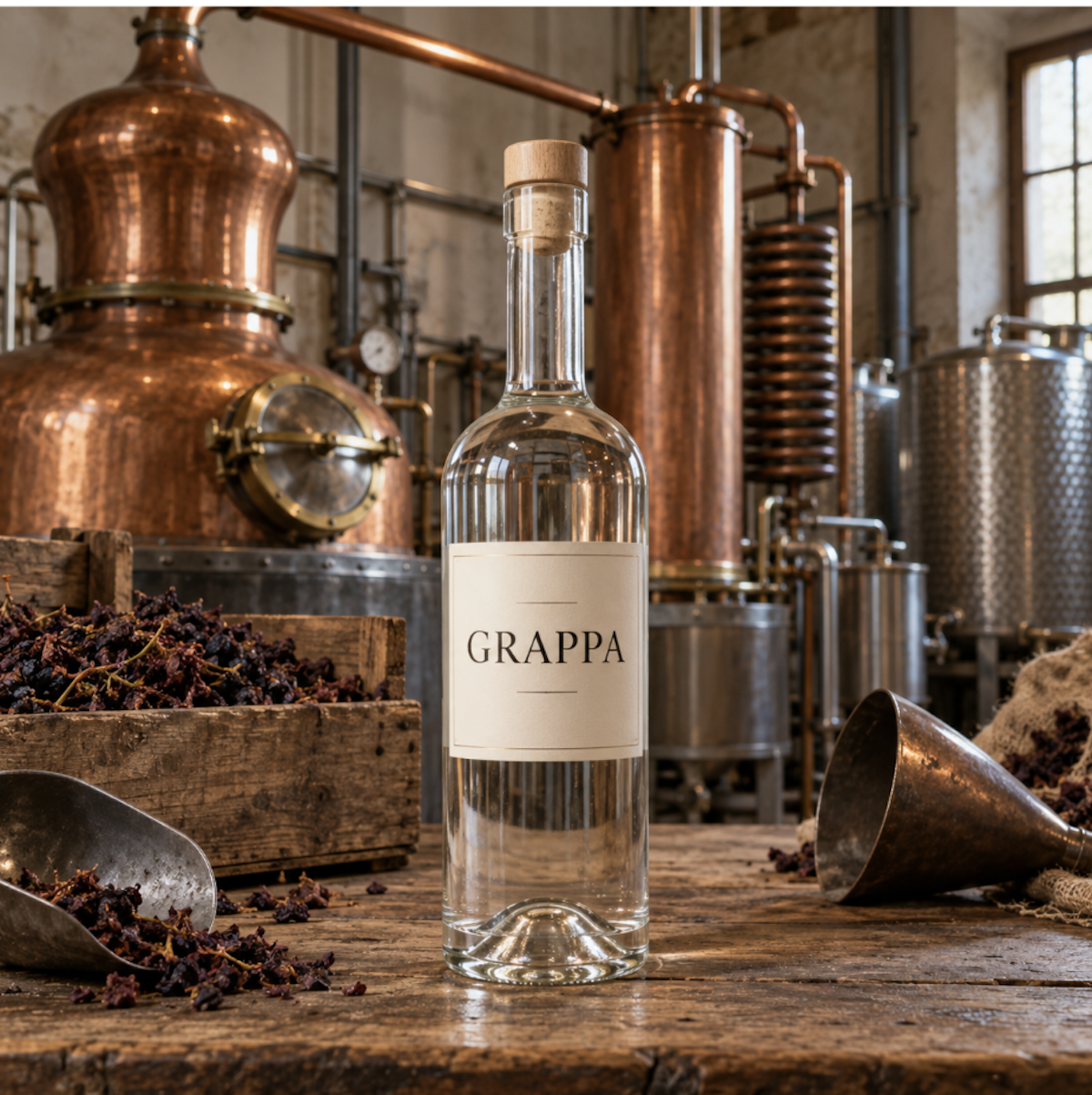

Grappa: Italy’s Pomace Spirit
Wine production leaves behind a substantial amount of solid material after grapes have been
pressed. The skins, seeds, pieces of pulp, and sometimes stems are collectively called pomace, or
vinaccia in Italian. For centuries, much of this material had little commercial value once the juice
had been removed. It still contained water, aromatic compounds, and, under the right circumstances, alcohol. Distillation provided a way to recover that alcohol. The result became grappa, one of Italy’s most distinctive spirits.
Grappa belongs to a larger European family of spirits made from grape pomace. France produces marc, Spain orujo, and Portugal aguardente bagaceira, while other wine-producing countries have their own versions. Grappa is the Italian member of this family, and the name now carries legal protection. Under current European rules, grape-marc spirit must be produced from fermented grape pomace and distilled with the solid material present during the first distillation. The finished spirit must contain at least 37.5 percent alcohol by volume. Distillation must take place below 86 percent alcohol, which prevents the producer from distilling the spirit to such a high degree of purity that the characteristics derived from the pomace disappear. The law also limits methanol and regulates how much wine lees, the sediment remaining after fermentation, may be included. Within the European Union, Grappa is registered as an Italian geographical indication, and several more specific Italian geographical indications also exist.
The word grappa itself is considerably newer than the practice of distilling alcoholic liquids. Distillation was known in antiquity in several forms, although the efficient production of beverage alcohol developed much later. Medieval European physicians, apothecaries, and alchemists expanded the use of distillation, and distilled wine became known as aqua vitae, or water of life. In fifteenth-century northern Italy, Michele Savonarola, a physician associated with Padua, wrote De Conficienda Aqua Vitae, an important early treatise describing wine distillation. Evidence for the precise moment when Italians began distilling pomace is less certain. It was probably occurring by the late Middle Ages, although stories that assign grappa to a particular inventor or single documented event are difficult to verify. Pomace was abundant wherever wine was made, and the economic incentive to recover its remaining alcohol would have been obvious once suitable stills became available.
Wine itself was a valuable agricultural product. Distilled wine was even more expensive because it required sacrificing wine that could otherwise be sold or consumed. Pomace had already served its primary purpose. Distilling it therefore allowed farmers, laborers, and small producers to obtain alcohol from material of relatively little remaining value. Early grappa acquired an association with rural life partly for this reason. The spirit could be harsh, particularly when the raw material was poorly stored or the distillation cuts were imprecise. These early versions should not be confused with the carefully controlled grappas produced today. They were often strong, dry, and pungent, and their quality could vary greatly from one batch to another.
Veneto, Friuli-Venezia Giulia, Trentino-Alto Adige, Piedmont, and Lombardy all developed strong traditions of pomace distillation. These regions had extensive wine industries, cool autumn and winter weather that helped preserve pomace after harvest, and a long history of small agricultural holdings in which every usable component of the grape crop had economic value. Venice also became an important center for the trade and production of distilled spirits. By 1601, makers and sellers of acquavite in Venice had formed a guild, indicating that distilled beverages had already become an established commercial activity.
Improvements in still design during the nineteenth century allowed alcohol to be separated more efficiently and with greater control. Enrico Comboni, who worked at the Enological Institute of Conegliano during the nineteenth century, helped refine steam distillation techniques that became highly important to the Italian grappa industry. Scientific research on fermentation clarified the role of yeasts, while better instruments allowed producers and tax authorities to measure alcoholic strength more accurately. Distilling also began to move away from purely household and farm production. Mobile distillers traveled through wine-producing areas with equipment mounted on carts, processing pomace for growers who lacked their own stills. During the middle of the nineteenth century, permanent family distilleries became increasingly common. Some of the names now associated with Italian grappa developed from this period of professionalization.
Government involvement increased along with commercial production. Distilled alcohol was taxable, and authorities wanted accurate measurements of what was produced. Earlier systems often depended on declarations of quantity. As production expanded, fiscal meters and sealed storage systems gave tax officials greater control. Home distillation, once common in some rural areas, became increasingly restricted as excise laws and safety requirements tightened.
Continuous distillation equipment spread rapidly during the 1960s. Large producers could process pomace more cheaply and efficiently, which placed considerable pressure on small distilleries. Italy once had roughly two thousand distilleries, according to historical material compiled by the Poli Grappa Museum. That number fell dramatically as industrial production expanded, leaving a much smaller number of firms. Some surviving artisanal producers responded by concentrating on quality, individual grape varieties, specialized stills, and higher-priced bottlings.
In 1973, Giannola and Benito Nonino distilled and marketed a single-variety grappa from Picolit pomace. Their Monovitigno Picolit helped establish the idea that grappa could be presented according to grape variety and origin instead of being treated primarily as an anonymous pomace spirit. By the late twentieth century, grappa had begun to lose some of its older reputation as a rough spirit consumed primarily by agricultural workers. Producers improved pomace handling, fermentation control, still design, distillation cuts, packaging, and aging. Single-variety grappas gave consumers an obvious connection to familiar wine grapes. Distillers also began separating pomace according to vineyard, appellation, or individual wine producer. A grappa made from the pomace of Barolo, Amarone, Brunello di Montalcino, or another recognizable wine could be presented as a product with a specific vinous origin instead of as an anonymous byproduct.
The composition of pomace varies considerably according to how a wine is made. When red wine is produced, the skins generally remain in contact with the fermenting juice. Yeasts convert grape sugars into alcohol while the skins are present. Once the wine is pressed, the resulting red-wine pomace already contains alcohol. It can therefore proceed relatively quickly to distillation. Most white wines are made differently. The grapes are usually pressed before fermentation, leaving pomace that still contains sugar but little or no alcohol. This is often called virgin pomace. Before it can be distilled, its remaining sugar must first undergo fermentation because distillation concentrates alcohol that already exists; it does not create alcohol from sugar.
Pomace is biologically unstable. Once it leaves the winery, exposure to oxygen, microorganisms, and heat can alter it rapidly. Poorly stored pomace may develop acetic, moldy, or other undesirable aromas. A distiller producing high-quality grappa therefore pays close attention to how quickly the pomace arrives, its temperature, its moisture, the condition of the skins, and whether fermentation has proceeded cleanly. Freshness is especially important because many of the compounds responsible for floral and fruity aromas are volatile. Prolonged or careless storage can reduce these aromas before the pomace ever reaches the still.
Moscato varieties contain high concentrations of aromatic compounds known as terpenes, which can produce pronounced floral, citrus, and grape aromas in the finished spirit. Gewürztraminer can contribute rose, spice, and intensely aromatic fruit characteristics. Prosecco pomace from Glera tends to produce a different set of aromas, while Nebbiolo, Barbera, Sangiovese, Corvina, and other red grapes provide their own combinations of volatile compounds. This is why the rise of monovitigno, or single-variety grappa, was significant. Distillers had long produced spirits from individual varieties such as Moscato and Malvasia, but the deliberate marketing of grape variety became much more prominent during the twentieth century.
A famous grape cannot compensate for spoiled pomace or careless distillation. The distiller begins with material that has already undergone pressing and, frequently, fermentation. The most valuable liquid has been removed for wine. What remains contains alcohol and aromatic compounds in a relatively difficult solid medium. The distiller’s job is to recover desirable volatile substances without bringing excessive quantities of undesirable ones into the final spirit.
Traditional grappa production relied on small pot stills heated directly by fire. Direct heating posed a practical difficulty because pomace is solid and can scorch. Burned skins produce unpleasant flavors that can pass into the distillate. In a bain-marie still, an outer vessel of hot water or steam heats the inner vessel containing the pomace more gently. Another important development was the steam still, in which steam passes through the pomace instead of placing it directly over a flame. The steam releases alcohol and volatile aromatic compounds, which rise through the still, pass through any rectifying equipment used by the distiller, and eventually condense back into liquid.
Batch distillation remains strongly associated with artisanal grappa. Pomace is loaded into one or more vessels, distilled, removed, and replaced with another batch. The process gives the distiller close control over individual lots of raw material. Continuous stills operate differently. Pomace enters a system in an ongoing flow while alcohol and aromatic compounds are extracted continuously. Continuous technology became much more important in Italy after the middle of the twentieth century because it allowed large quantities of pomace to be processed efficiently. Neither method guarantees quality by itself. A small batch still can produce poor grappa if the pomace or distillation is mishandled, while sophisticated continuous equipment can produce clean and carefully controlled spirit.
Distillation works because alcohol, water, and the numerous volatile substances in fermented pomace evaporate at different rates. Heating does not separate ethanol from everything else at one exact temperature. The vapors contain many compounds whose concentrations change during the course of a distillation. The distiller therefore divides the output into portions traditionally called the heads, heart, and tails. The heads emerge early and contain a higher proportion of volatile substances, some of which can smell sharp, solvent-like, or chemically aggressive. The distiller selects the heart for the grappa itself because it carries ethanol and many of the aromas the producer wants to retain. The tails arrive later and contain higher-boiling compounds that can create heavy, oily, or unpleasant sensations. Determining the points at which one portion ends and another begins is one of the central practical decisions in batch distillation.
Methanol can form naturally during the fermentation and processing of fruit because pectins in plant tissue can release it. Grape skins contain pectin, so pomace spirits require careful control. Methanol cannot be treated as a substance that disappears entirely when the heads are removed. Its behavior during distillation is more complicated because it can occur across a distillation run. Modern producers therefore rely on controlled fermentation, professional distillation, analytical testing, and legal limits. European regulations impose a maximum methanol concentration of 1,000 grams per hectoliter of pure alcohol for grape-marc spirit.
Grappa also needs to be distinguished from acquavite d’uva, or grape spirit. Grappa must be made from grape pomace, the solid residue left after winemaking. Acquavite d’uva begins with fermented grapes or grape material that still includes the juice. The distinction affects both composition and flavor because the starting materials contain different proportions of alcohol, water, sugars, aromatic compounds, skins, pulp, and seeds. Two spirits made from the same grape variety can therefore be legally and chemically different depending on whether the distiller begins with pomace or with the fermented grape itself.
The strength of the distillate coming from the still is usually higher than the strength at which grappa is eventually bottled. Water is added after distillation to reduce the alcohol concentration to the desired level. Dilution can change aroma, texture, and the solubility of certain compounds. Producers generally use carefully treated water and reduce strength under controlled conditions. Dilution can also cause oily compounds in the distillate to become insoluble and make the spirit appear cloudy. Many producers therefore chill the grappa, commonly to temperatures between approximately −4°C and −15°C, and filter it before bottling.
A clear, unaged grappa is commonly described as giovane, meaning young. It has not acquired aroma or color from prolonged contact with wood, so its character depends especially strongly on the pomace and distillation. Aromatic grape varieties can be particularly recognizable in this form. A Moscato grappa may show orange blossom, fresh grape, citrus peel, or other floral and fruit aromas. A grappa made from a less aromatic variety can be subtler, with dried fruit, herbs, seed, pepper, or earthy characteristics. Alcohol remains an obvious component because grappa is a spirit, but high quality does not require a burning sensation.
Grappa stored in oak, chestnut, ash, cherry, acacia, or other woods used by producers slowly acquires color and compounds from the vessel. Oak is especially common. Contact with wood can contribute vanilla, spice, toasted aromas, and tannins while oxygen entering gradually through the barrel can alter some volatile compounds. The spirit usually becomes more amber in color as aging progresses. Barrel size, previous use, toast level, wood species, storage conditions, and time all influence the result. A small new barrel has a much greater ratio of wood surface to liquid than a large old cask and can therefore change the grappa more quickly. Excessive wood can obscure the characteristics of the original pomace, particularly in a delicate spirit.
Invecchiata or vecchia indicates grappa that has spent at least 12 months in wooden vessels. Riserva or stravecchia is used for grappa aged for at least 18 months. Consumers may also encounter terms describing the type of wood or vessel used, including barrique, which refers specifically to maturation in the small oak barrels commonly associated with wine production. The central distinction is easier to understand than the vocabulary. Some grappas are bottled soon after distillation to preserve the direct characteristics of the grape and pomace. Others spend months or years in wood, acquiring additional aroma, color, and changes in mouthfeel. Age alone does not determine quality. A precise young grappa from excellent fresh pomace can be more distinctive than a heavily wooded older spirit.
Grappa can also be aromatic, a word that has a specific meaning when discussing the grape itself. An aromatic grappa is made from naturally aromatic grape varieties such as Moscato or Traminer, whose grapes contain unusually high concentrations of identifiable aromatic compounds. This should be distinguished from traditionally flavored grappa, in which herbs, roots, fruits, flowers, or other botanicals are infused or macerated in the spirit where the applicable production rules permit it. These products are commonly described as grappa aromatizzata. Traditional examples have included rue, chamomile, mountain herbs, juniper, and other locally available plants.
A Barolo and a grappa made from Nebbiolo pomace begin with some of the same grapes, but they preserve different parts of those grapes. Wine is produced from fermented juice, with extraction from the skins occurring during winemaking. Grappa begins with the skins after the wine producer has finished with them. Distillation then selects volatile compounds that can survive heating and condensation. Tannins, pigments, sugars, acids, and many other components that influence wine either remain behind or behave differently during distillation. A grappa made from Barolo pomace therefore does not taste like concentrated Barolo. Its connection to Nebbiolo is real, but it comes through the volatile compounds retained in the pomace and recovered during distillation.
Soil composition does not pass directly into a distillate. Vineyard conditions can affect grape ripeness, skin composition, aromatic precursors, acidity, and the health of the fruit, while winemaking determines what remains in the pomace. Storage affects the condition of that pomace, and fermentation alters its chemical composition before distillation. Only part of what is present is selected by the still. Claims that a grappa directly reproduces the mineral character of a soil should be treated cautiously.
Grappa itself is registered in the European Union as a geographical indication associated with Italy, and several more specific geographical indications exist, including Grappa di Barolo, Grappa del Piemonte, Grappa di Lombardia, Grappa del Trentino, Grappa del Friuli, Grappa del Veneto, Grappa dell’Alto Adige, Grappa di Sicilia, and others. Their specifications can establish requirements concerning origin and production that go beyond the general rules for grape-marc spirit.
Young aromatic grappas generally show more detail when served cool, although severe chilling suppresses aroma. Aged grappas are usually served somewhat warmer so that wood-derived and mature aromas can develop. A narrow tulip-shaped glass helps concentrate aroma while reducing the immediate perception of alcohol. Small pours are appropriate because most bottlings contain around 40 percent alcohol, with some reaching considerably higher levels.
Grappa has a long association with the end of an Italian meal and is often treated as a digestivo. The term describes a cultural role more securely than a medical one. There is little reason to assume that a substantial dose of high-proof alcohol improves digestion in a physiological sense. Its importance lies in custom, flavor, and the extended social period following a meal. Grappa also appears in caffè corretto, espresso “corrected” with a small amount of spirit, and in the northern Italian practice sometimes called resentin, in which a small quantity of grappa is used with the final residue of espresso in the cup.
At one end are inexpensive grappas made from mixed pomace and produced in large quantities. At the other are single-variety grappas, single-vineyard bottlings, grappas made from the pomace of specific prestigious wines, long-aged examples, and small batches produced with elaborate steam or bain-marie stills. Price does not always correspond directly to intrinsic quality because famous wine names, elaborate bottles, long aging, and limited production can all increase cost. The most useful evaluation begins with aroma cleanliness, definition, balance of alcohol, persistence, and whether the character of the raw material remains evident.
A good young grappa should smell clean and specific. Fruit, flowers, herbs, spice, grape skin, and other aromas may be present depending on the variety. Sharp solvent aromas, excessive vegetal notes, mustiness, or a heavy oily finish can indicate problems with pomace or distillation. An aged grappa adds another consideration: the wood should contribute without dominating the distillate. Vanilla and toast can be appealing, but a spirit whose only obvious characteristics come from oak offers little evidence of why a particular pomace was worth distilling.
Mitchell Rabinowitz
I’m a retired university professor with a Ph.D. in cognitive and developmental psychology. I taught cognition and education starting in 1984. In retirement I decided to take wine seriously, and I’ve been using AI to help me learn faster and create better. I’ve also learned you can’t just ask AI one question and call it done.
For me, an essay usually takes a number of iterations. I create a draft, then I check accuracy, hunt for gaps, revise the structure, and do it again until the piece feels coherent and useful. I also use other AIs as collaborators. It is an extensive process creating the essays.
I try to create these as stories because that is the format that sticks for most of us. Facts land better when they have a sequence and a few turning points. Connect with @mitchell.rabinowitz on Instagram
