
 Why Merlot Tastes Different in California, Bordeaux, and Italy
A shopper looking for Merlot can find the grape’s name printed prominently on bottles from California and Italy. The same shopper may pass directly by the French version because a Bordeaux label will usually name Pomerol, Saint-Émilion, or another appellation instead of the grape. All three wines may contain mostly Merlot, yet they can differ considerably in aroma and texture. Those differences begin with climate and vineyard soils. Harvest dates and blending decisions add further variation before the wine reaches the cellar.
Merlot was documented in Bordeaux during the late eighteenth century, although the variety was probably cultivated there earlier. It ripens sooner than Cabernet Sauvignon and usually has less forceful tannins. Merlot also begins its spring growth relatively early, leaving newly opened buds and shoots vulnerable to frost. A sudden temperature drop after budbreak can destroy the developing crop before flowering. Its natural acidity is moderate, and fully ripened grapes can accumulate considerable sugar. Merlot is also moderately to strongly vigorous and fertile. Growers commonly prune it short during winter and may remove shoots or immature clusters during summer if the crop remains too large. Excessive yields can delay ripening and produce dilute fruit with persistent herbal flavours. These characteristics were useful in Bordeaux, where rain during the autumn could interrupt the later harvest of Cabernet Sauvignon. They have different consequences in warmer parts of California and coastal Tuscany, where sugar can rise quickly before the grower decides to pick.
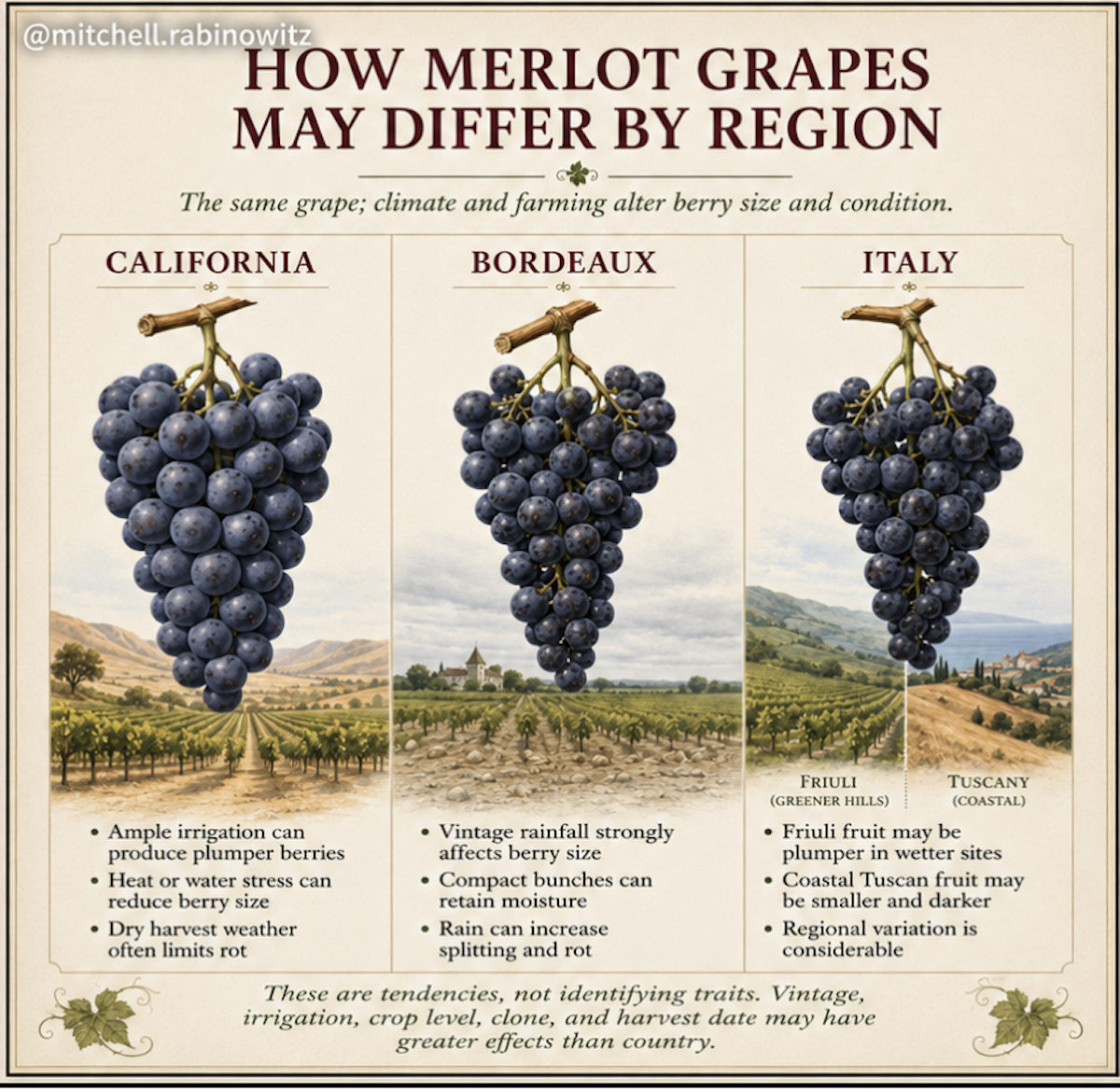
Spring frost can damage early Merlot growth, particularly in low vineyards where cold air collects, and the losses can alter the amount of wine produced before the growing season has properly begun. The widespread frost of 2017 sharply reduced the production potential across much of the Gironde. Rain may fall throughout the growing season, and annual differences in temperature or rainfall can alter the wine considerably. Merlot grows extensively on the clay and clay-limestone soils east of the Gironde estuary. These sites combine clay that retains water during dry periods with limestone that provides drainage in the upper layers of the soil. That water-holding capacity is particularly useful for Merlot, which performs poorly under intense drought. Growers may accept enough water limitation to restrain excessive shoot growth, stopping before photosynthesis and sugar accumulation begin to slow. The clay soils of Pomerol therefore provide a relatively steady supply of moisture without leaving the roots permanently saturated. Merlot now accounts for about 60 percent of Bordeaux’s red grape plantings, with its greatest concentration in the districts surrounding Saint-Émilion and Pomerol.
In Pomerol, where Merlot represents about 80 percent of the vineyard area, it is commonly combined with Cabernet Franc. Saint-Émilion producers also rely heavily on Cabernet Franc, particularly in vineyards with substantial limestone. Cabernet Franc can add floral aromas and firmer tannins to the darker fruit and softer texture of Merlot. On the Left Bank, Merlot usually has a secondary role beside Cabernet Sauvignon, although the percentage varies by estate and vintage.
A young Merlot-dominant Bordeaux will commonly have plum or cherry aromas accompanied by violet, dried herbs, or cedar. The fruit may seem less sweet than it does in many California examples, even though both wines are dry. Acidity is often more apparent, and the tannins may feel drier because Cabernet Franc or Cabernet Sauvignon is present. With age, tobacco and truffle can develop as the primary fruit recedes. Compared with Pomerol’s greater density and darker fruit, many limestone-grown Saint-Émilion wines have a firmer finish and more noticeable freshness.
In a cool or rainy year, Merlot may retain herbal flavors and moderate alcohol along with red fruit. Riper black plum and fig become more common after a warm, dry season, when alcohol can also be considerably higher. Once Merlot approaches maturity, sugar continues to accumulate as malic acid declines, making the harvest date especially consequential. Producers therefore follow both acidity and herbal flavours as harvest approaches. Once those flavours have receded, further delay increases the risk of higher alcohol and insufficient freshness. The available period between those results can become narrow during a warm vintage, which is why two producers working in neighboring vineyards may make substantially different wines. Recent Bordeaux vintages have produced many rich Merlot wines that no longer fit the older expectation of restrained French wine. Even then, the use of Cabernet Franc and the practice of blending separate vineyard parcels can preserve distinctions between Bordeaux and a California wine sold under a varietal name.
Merlot arrived in California during the nineteenth century and was initially valued as a blending grape. Wineries used it to soften Cabernet Sauvignon, much as Bordeaux producers had done. Varietal bottlings became increasingly common late in the twentieth century, and plantings expanded rapidly during the 1990s. American labeling law permits a bottle marked Merlot to contain as little as 75 percent Merlot. The remaining portion may include Cabernet Sauvignon or another variety, allowing the producer to adjust the wine without removing Merlot from the front label.
The grape is planted in warm inland districts and in cooler vineyards affected by Pacific fog or bay winds. Warm sites generally permit greater sugar accumulation and complete ripening of the skins. Rain is scarce during the California summer, so growers frequently use irrigation to control the amount and timing of water available to the vines. Growers regulate irrigation to prevent the vigorous growth and larger crops encouraged by excessive water. As the soil dries, they monitor leaf activity and fruit development so that maturity is not delayed and the grapes do not retain poor color or herbal flavors. Wines from these sites are likely to contain ripe black cherry and dark plum flavors, with a broad texture and moderate tannins. Higher alcohol and new oak can add impressions of chocolate or vanilla, even though the wine contains little or no residual sugar.
Lodi provides many accessible examples of this warmer California style, although cooling air from the Sacramento-San Joaquin River Delta can moderate afternoon temperatures. Napa Valley Merlot is often fuller and more concentrated, particularly when the grapes come from warm valley-floor vineyards. Conditions change in Los Carneros and Coombsville, where marine air produces cooler mornings and slower ripening. Merlot grown in these districts may have brighter cherry flavours and more apparent acidity. Mountain vineyards can produce smaller berries and firmer tannins, giving some California Merlots enough concentration for extended aging.
Some California producers wait for ripe fruit and use a substantial percentage of new French oak. The resulting wine may have concentrated black fruit with cocoa and sweet spice. Earlier harvests and older barrels produce wines with redder fruit and less obvious oak. A California Merlot can therefore approach the restraint of Bordeaux, just as Merlot from a warm Bordeaux vintage can approach California in ripeness and alcohol.
Merlot reached northeastern Italy from France late in the nineteenth century. Its earliest Italian plantings were concentrated in Friuli, after which it spread across the Veneto and into other parts of the country. Italian and European Union rules generally require a wine carrying the name of one grape to contain at least 85 percent of that variety. A bottle labeled Merlot from Italy therefore has a higher required percentage of Merlot than its California counterpart. The remaining portion can still affect the taste, particularly when a producer uses Cabernet or a local Italian grape.
Friuli-Venezia Giulia lies between the Adriatic Sea and the Alps, with vineyards on plains as well as hillsides near the Slovenian border. Rainfall is greater than it is along the Tuscan coast, and cooler nights can slow the loss of acidity as the grapes ripen. Many wines from Friuli have red cherry and plum flavors followed by an herbal or slightly bitter finish. The body may be moderate, and the fruit usually seems less sweet than in a warm-climate California Merlot.
Some Friulian producers reduce yields and age the wine in small oak barrels, producing concentrated examples with 14 percent alcohol or more. Hillside vineyards in Collio or the Colli Orientali can yield wines with dark fruit and enough tannin for several years of aging. By comparison, Merlot from the plains may be lighter and intended for earlier drinking. Veneto Merlot can follow either course, although inexpensive regional bottlings are frequently simple.
Merlot was planted in Tuscany in greater quantities during the late twentieth century as producers increased their use of French grape varieties. In Bolgheri and the Maremma, the Mediterranean climate supplies long periods of sunlight and generally dry weather during ripening. Coastal vineyards receive cooling sea breezes, and their deep soils can retain enough water to support the vines during dry summers. Where those reserves are insufficient, carefully timed irrigation may be used to prevent severe water stress, although the need varies with soil depth and vineyard location. These conditions permit Merlot to reach full ripeness without the same autumn rain risk faced in Bordeaux.
Tuscan Merlot can have black plum and blackberry flavors with substantial body. Oak aging may add cocoa or toasted notes, particularly in wines from Bolgheri and nearby coastal districts. Producers may bottle Merlot alone or combine it with Cabernet Sauvignon or Sangiovese. Blending decisions vary with the intended result: Cabernet may be chosen for tannin and darker fruit, or Sangiovese for additional acidity and red cherry flavors. Coastal Tuscan Merlot can reach the ripeness associated with California before finishing with the dryness common in Italian reds.
Red fruit and herbal notes are common in Friulian Merlot. Farther south, Tuscan examples are often darker and more concentrated, with generous alcohol and extended oak aging contributing additional weight. The word “Italy” on its own provides too little information to predict which one will appear in the glass. The regional designation and producer become especially useful when selecting an Italian Merlot.
A side-by-side tasting works best when the wines come from comparable vintages and price levels. Ripe fruit and evident oak are likely to appear first in the California wine, especially through its round texture. After more time in the glass, Bordeaux commonly develops plum, cedar, and herbal aromas. Compared with the Friulian wine’s fresher red fruit and drier finish, the coastal Tuscan example is more likely to have darker fruit and California-like weight. The shared Merlot character remains in the plum flavors and relatively soft tannins, although each growing region gives those characteristics a different form.
Mitchell Rabinowitz
I’m a retired university professor with a Ph.D. in cognitive and developmental psychology. I taught cognition and education starting in 1984. In retirement I decided to take wine seriously, and I’ve been using AI to help me learn faster and create better. I’ve also learned you can’t just ask AI one question and call it done.
For me, an essay usually takes a number of iterations. I create a draft, then I check accuracy, hunt for gaps, revise the structure, and do it again until the piece feels coherent and useful. I also use other AIs as collaborators. It is an extensive process creating the essays.
I try to create these as stories because that is the format that sticks for most of us. Facts land better when they have a sequence and a few turning points. Connect with @mitchell.rabinowitz on Instagram