Dining Experiences in the Heart of Nature
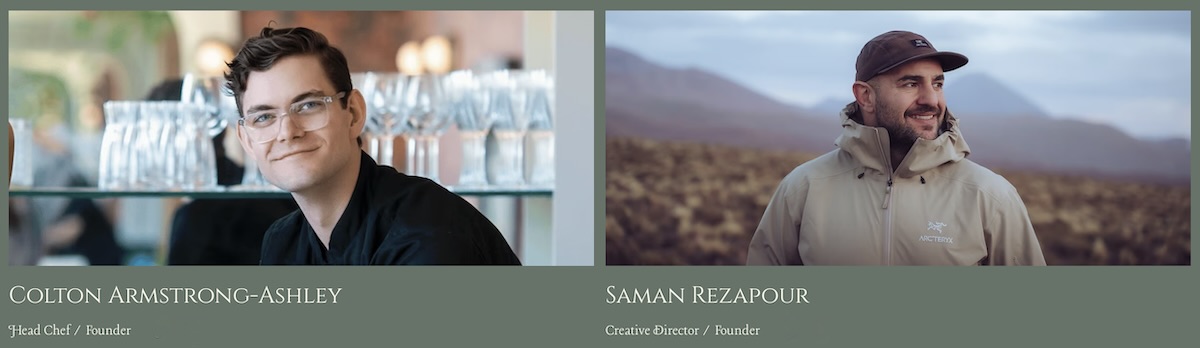
In conversation with Chef / Founder Colton Armstrong-Ashley and Creative Director / Founder Saman Rezapour of Savour the Wild prior to their appearance at Culinaire in Victoria. The BC duo redefining live-fire dining.
When did you first develop an interest in cooking?
As soon as I had a concept of what a career was, I wanted to be a chef. There are drawings and plans from my early school days of the restaurant I wanted to build in our family backyard, along with all the jobs we’d take care of during service as a family. My mother and I really connected in the kitchen. “What’s for dinner” quickly turned into “what are we going to make for dinner,” and most of our travel plans and discretionary time revolved around either learning about food or producing it.
Was there someone who inspired you?
My grandfather taught me a lot about what it means to offer and provide food. When he cooks for us, there is always so much joy in the process — not because he loves the work, but because he loves providing. Once you’re eating, he’ll have a twinkle in his eye that feels rooted in gratitude and pride for being able to share the meal. He taught me how to shake hands and say thank you, and he made sure I used that when we ate out. He inspires me to respect food, to understand what goes into it, and to be grateful to both share and receive.
How did you pursue your training?
Eclectically, and ongoing. I’ve taken on mentorship from all corners in the 15 years I’ve worked in and around restaurants or catering. Formally, at Camosun College — but every little piece from elsewhere adds up.
Where did you work before starting Savour the Wild?
While starting Savour the Wild, I was working at Marilena Café & Raw Bar in Victoria.
When did you start Savour the Wild?
In 2023. We had our launch dinner on December 2nd as an early birthday present to myself.
How did you come to partner with Saman Rezapour?
The abridged story is that I was struck by his photography work and quite enthused by his adventurous lifestyle; we both aligned in excitement for building community and celebrating the sharing of food. We developed the concept as an opportunity to spend time in beautiful places while bringing people together to tell and create stories with our seemingly unrelated skill sets.
Do you keep your duties and responsibilities separate?
We collaborate on the vision and both take responsibility for the big-picture execution, especially the guest experience. There’s a natural synergy in having a photographer work in concert with a chef. I am challenged to work beautifully and keep high standards from start to finish. Sam doesn’t touch the food; I am useless behind a camera — though we’re constantly trying to find ways to make our work elevate each other’s, which seems to raise the bar for everything we do.
If Savour the Wild is a collaboration between the two of you, does this present any challenges?
We both take a very opportunistic approach to challenges. Problems are something to solve, not avoid. The issues we run into are often about workflow — something like Sam imagining a shot or a specific moment for guests that feels out of my rhythm or inefficient to execute. It gives us an opportunity to reflect on the value of that moment to the guest and work to make it real if it seems worth it.
I can think of a dinner we hosted at an outdoor sauna in the woods. Sam had the idea to get a photo of me carrying plates between a few magnificent trees. We placed our cook fire and the dinner table so the trees stood between them, which made for an awkward walk over roots and under branches. The photo ended up being gorgeous, as expected, but the impact on service was greater. We served around eight courses off the fire, so each time I took plated dishes from the fire to the table, our guests got to live that moment — looking up in anticipation to see me walking through stunning trees, a fire and forest behind me, delivering the dishes that hooked them on joining us. The inconvenience was worth it, and I would not have chosen to do that without Sam seeing the big picture.
Who decides the concept of an experience?
It varies. Sam and I often start by finding a venue or farm partner, then exploring how we can highlight its uniqueness and offerings. Our two main pillars are place and season; they guide our menu, how we organize or deliver our courses, and what we can offer guests beyond a meal.
Often, we will invite someone who can tell stories of the space and encourage guests to engage with where they are. One of the best examples of this was having our friend and frequent collaborator Robin Jackson — a mycologist and incredible speaker — take guests on a tour from the forest to the beach. Robin helped them explore foraging the land and sea before the meal, seeing much of what would end up on their plates in its natural environment. Each guest collected something on that walk that they later used to decorate the table before dinner, making themselves part of the experience.
Place and season start the conversation of concept; then Sam and I ask a lot of questions about what we can do and who we can bring along to help finish the conversation.
How do you work together to resolve challenges?
Excitedly and curiously. We both understand and respect what we don’t know about each other’s skill sets and mediums, while remaining open to sharing ideas about what the other should try. Much of my most interesting work comes from Sam suggesting or asking questions I would never consider because I “know too much” about what I do. There’s a lot of playful beauty that can be lost when we focus too much on the top end of our skills. “It’s so simple, it just might work” resonates with us.
Do you have times when you don’t agree, and how do you make the final choice?
We have a very strong dialogue and both accept our gaps in perception; it’s a treat. The language is never “I think you’re wrong,” but rather, “I don’t understand this yet — help me.” We give each other time to fumble through ideas and often trust the outcome even if we can’t yet see it ourselves. It helps that we’re making decisions around how to enrich lives and create moments, so we’re never tearing down each other’s ideas — just building on them.
What is your inspiration for your culinary experiences?
Place, season, and challenge. The first two pillars start the conversation; the exploration of challenge is what makes them interesting on the plate. We push the limits of my capacity as a chef, creating striking dishes with limited equipment and support, while taking people to places they wouldn’t have imagined sharing a meal. We’re slowly developing a mission statement around “creating unforgettable experiences in unbelievable places.”
Do your culinary experiences involve travel?
They do. Travel is often essential to what we’re trying to create. Many of the places we cook are intentionally off the beaten path, from beaches, forests, farms, and coastal landscapes that require time, planning, and commitment to reach. The journey itself becomes part of the experience, shaping how guests arrive, how they engage with the setting, and how the meal unfolds. Travel allows us to work directly with specific landscapes, seasons, and producers, and to create experiences that feel rooted in place rather than transported into it.
How many guests would be included in your “average” experience?
We like to host eight to twelve people at a time. It’s the perfect number for guests to interact as a group, make friends with strangers, and for me to engage meaningfully with each person. You can speak from one end of the table to the other without losing anyone, and conversations are shared rather than siloed. It’s also the limit of how much plateware and food we can hike into the forest — which is a win in its own right.
What kind of challenges does working outdoors bring?
Hiking hundreds of pounds of food and equipment wherever we go is the first thing that comes to mind. Our trial dinner was held at Sombrio in December — foolish, but so fun. We had a 30-minute walk down a steep, rutted hill to the beach in sideways rain. It took four trips to get everything down, including two canopy tents, a cast-iron cookstove, and enough ceramic plateware to feed twelve people nine courses.
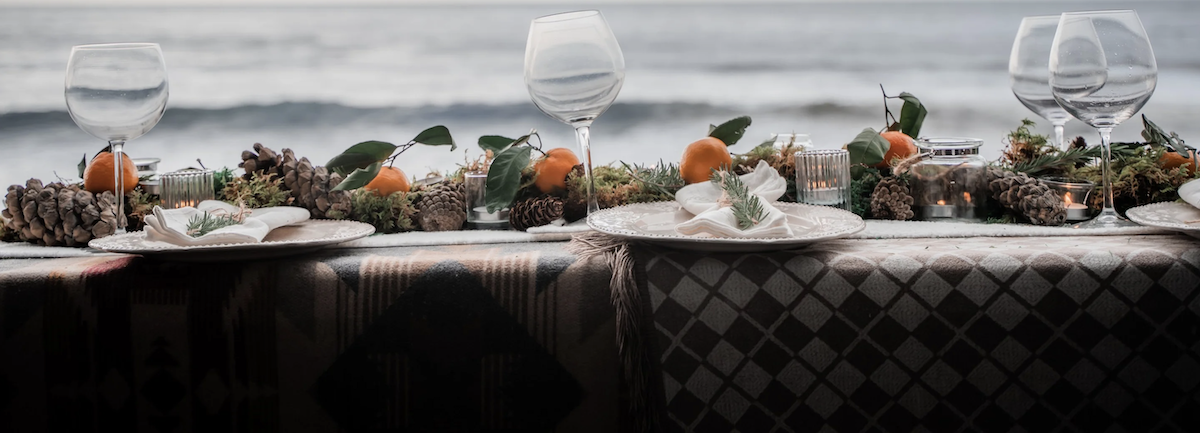
Once service starts, that exhaustion washes away. I remember looking out over the table as the sun broke through the clouds, surfers dotted the waves behind us, and asking guests to turn around and take the moment in. There were few dry eyes.
Are there specific criteria that determine if a venue is right or wrong for your purpose?
It’s important to us to leave no trace, so we carefully choose natural spaces that won’t be meaningfully impacted by our time there. With tended land, like farms or vineyards, we only work with people we fully align with and can celebrate. Having hosts join us at the table as guests, using what they produce throughout the meal, and seeing them enjoy their land through a different lens is beyond fulfilling.
Do you provide culinary experiences in a guest’s own home or environment?
Environment, absolutely — though only if it’s a productive space, like a farm or garden. It’s important to us that the experience is rooted in where guests are sitting, so they can see or interact with what grew to be on their plate.
Are the locations of your experiences a secret?
Occasionally. We’ve hosted excursions where only a handful of guests knew what they were in for; the rest were told to dress for rain and hop on a bus. Watching people crest a hill to see a 26-person table set on the beach was pretty magical.
Many culinary adventurers are concerned about the environment. What are your objectives and goals for outdoor experiences, and how do you protect the locations you choose?
“Leave no trace” is our mantra. Ideally, we leave a space better than we found it by cleaning up what others may have left behind. We ensure paths and gathering spaces are suitable for bringing in gear and safe for fire. We don’t clear growth or trample moss or new vegetation.
Speaking of the environment — and organic, local, and sustainable sourcing — what is your approach?
All three, as often as possible. We’re not yet at a stage where we can rely 100% on locally sourced goods, but it’s something we constantly work toward. We’re happy to use imported options when they are significantly better than what’s available locally. Olive oil is my classic example, though even there I’ve begun exploring local alternatives — like blended radish and turnip-top oils made from what is often a waste product — to achieve similar aromas and that beautiful polyphenol bite. Alternatives are always on our minds.
Where do you source your supplies and ingredients from?
Straight from farms whenever possible. The Saanich Peninsula is an incredible breadbasket — Square Root Farm, Moonlight Farm, Dan’s Farm, Silver Rill all deserve honourable mentions. Learning which butchers carry which farms has been eye-opening, and I keep an eye out for meats from Stillmeadow and Parry Bay Farm. Because our seatings are small, we can shop for everything in person, which makes sourcing both easy and enjoyable.
Why did you choose those specific suppliers?
Quality, consistency, values, and availability.
How have you developed relationships with your suppliers?
I ask questions. I genuinely want to understand our food, and I naturally align with farmers and suppliers who share that enthusiasm.
What is the most challenging aspect of your culinary experiences?
Accepting that no matter how much control I have over the plate, I don’t control most of the environment. In a restaurant, everything is curated — lighting, temperature, music, bathrooms, artwork. In the forest, I’m mostly hoping it doesn’t rain — or at least not hard enough to disrupt the experience. Often, even a bit of rain becomes part of an unforgettable story. That stress disappears as soon as I start cooking.
What is the worst disaster you’ve experienced in your work?
A mandolin with the julienne attachment. Same finger. Twice. Two weeks apart.
Chef, do you cook at home?
Absolutely — especially for family.
What is your go-to dish?
It varies with what’s best at the market. Pork features heavily throughout the year; it adapts beautifully to all four seasons.
Tell me something about yourself that most people don’t know.
Colton: I am unreasonably competitive in Scrabble. Not necessarily good — just competitive.
Sam: I was on the Luxembourg National Rugby Team and have recently started playing again, possibly rejoining the national team.
Where do you see yourself — and Savour the Wild — in five or ten years?
We’d love to act as educators, whether through Savour the Wild experiences or by teaching communities how to connect more deeply with their food systems and natural spaces. We’re working to travel more, learn from other regions, connect with chefs and producers, and build our recipe books. A spinoff interview series from our adventure dinners, Savoured Here, launches via TELUS Storyhive in September 2026, with hopes for future seasons.
What should a guest expect from your culinary experience?
Connection. Connection to the sea breeze, the scent of cedar, and the warmth of the fire. A gathering where strangers become friends, and every dish becomes a shared memory. A chance to learn something about where they are — and why that place, wherever we gather, is special.

At Savour the Wild, our team is a passionate collective of culinary artisans, each dedicated to the craft of creating unforgettable dining experiences. Led by visionary chef Colton Armstrong-Ashley, our chefs, foragers, and local suppliers work in harmony to bring the freshest seasonal ingredients to your plate. Creative Director Saman Rezapour brings Chef Colton’s culinary art to life through stunning visuals, ensuring that every aspect of the dining experience is as visually captivating as it is delicious. With a deep respect for the environment and a commitment to sustainable practices, every member of our team plays a vital role in crafting meals that celebrate the natural beauty and bounty of coastal British Columbia. Together, we create not just food, but meaningful connections and lasting memories.