

Why Grape Varieties Came to Have Fixed Descriptions
For much of European wine history, a buyer ordered Chablis or Sancerre; the grape names Chardonnay and Sauvignon Blanc usually remained unstated. Someone choosing Pauillac was expected to know that Cabernet Sauvignon would probably have an important role, although the label did not need to say so. The place name referred to a defined area along with its permitted grapes and production customs.
American producers faced a different problem after Prohibition ended in 1933. Much of the domestic industry had been destroyed, and consumers had little experience with the wines being produced as California vineyards recovered. Wineries frequently used familiar European names such as Burgundy and Chablis for American wines that had no direct connection to those regions. The names offered consumers a general suggestion of color or style, but they provided little information about the grapes or the place where the wine had been made.
Wine writer and merchant Frank Schoonmaker began encouraging California wineries to use grape names during the 1930s. Varietal labeling gave American producers a way to distinguish their wines from European appellations while telling customers something concrete about what they were buying. Cabernet Sauvignon and Pinot Noir could be grown in California without claiming that the resulting wines were Bordeaux or Burgundy.
Ernest Wente had spent decades selecting Chardonnay vines that displayed characteristics he wanted to reproduce. In 1948, Fred and Eleanor McCrea took cuttings from the Wente vineyard and planted them at Stony Hill in Napa Valley. Other growers later obtained Chardonnay material through Stony Hill, while separate Wente selections entered university propagation programs.
An American restaurant wine list from the early 1950s had to explain that California producers were beginning to place the name of the European grape on the bottle. Such explanations were necessary because most customers did not yet think of wine according to variety. The label gave no indication of the differences among the plant selections producing the grapes.
By 1960, California had only about 230 acres of Chardonnay. Some of the older Wente material produced small clusters with numerous undeveloped berries. Heat-treated selections distributed through the University of California were more productive and did not show the same tendency.
The Wine & Spirit Education Trust was established in Britain in 1969 to serve the educational needs of the wine trade. Its students needed a practical way to organize countries and regions. Federal regulators adopted the same approach in the United States. Rules published in 1970 permitted a wine to carry a grape name when at least 51 percent of the wine came from that variety and the wine derived its predominant taste and aroma from it. The minimum was later raised to 75 percent, which remains the general federal requirement. The earlier wording directly connected the grape to the wine’s sensory characteristics, even though almost half of the wine could come from other varieties.
A customer who enjoyed one Chardonnay could look for the same name the next time. Retailers could arrange their bottles by grape, and restaurants could present familiar categories without expecting customers to understand dozens of appellations. Producers of widely distributed brands also needed the next bottle to resemble the previous one. They could blend wines from several vineyards or regions where the law allowed it. Winemakers could combine lots with different levels of ripeness and acidity. Yeast selection and fermentation temperature offered further control over aroma. The resulting wine could remain familiar even when the growing season changed.
When Ann Noble joined the University of California at Davis in 1974, wine professionals lacked a widely accepted vocabulary for aroma. Tasters used subjective terms that were difficult to define or reproduce. Noble and her colleagues collected descriptive words from sensory research and arranged them according to related aromas.
The Court of Master Sommeliers was established in 1977 to standardize training and certification. Students had to identify wines under examination conditions, so instructors selected examples displaying recognized regional and varietal tendencies. Cabernet Sauvignon commonly showed substantial tannin and black-fruit aromas. Such descriptions gave students a practical beginning, although repetition could make a qualified tendency sound like a rule.
In 1984, Noble published the Wine Aroma Wheel. She intended the wheel to help tasters describe what they smelled. It included fruity and floral terms along with oak-related aromas and fermentation effects. It did not assign a fixed group of aromas to each grape. A taster could use the wheel after smelling a wine without knowing its variety.
Publishers and course writers gradually combined varietal labeling with the standardized vocabulary Noble had helped develop. Publishers used the grape name as the category and the aroma terms as its description. Chardonnay received apple and butter. Students could memorize the associations before they had tasted enough wines to determine how often they applied.
Producers could make a Sauvignon Blanc that emphasized grapefruit and repeat the result across several vintages. Chardonnay producers could use malolactic fermentation, which converts sharper malic acid into softer lactic acid, to encourage diacetyl, which contributed a buttery aroma. Maturation in oak supplied vanilla or toast. Students encountering these wines repeatedly learned to treat production choices as characteristics of the grapes themselves.
From 1996 through 2003, a group working in Saint-Émilion studied Merlot and the two Cabernets across three nearby vineyards. Each variety was grafted onto the same rootstock, the lower portion of a vine that supplies the roots. The first vineyard had gravel soil, and the second had heavy clay beneath the surface. Sandy soil covered the third vineyard, with a water table accessible to the roots. The researchers followed the vines through eight growing seasons and measured ripening along with water status.
The year accounted for most of the difference in the timing of veraison, when grapes begin to ripen, and in grape acidity. Soil had a stronger association with berry weight than the variety did. The gravel site frequently produced substantial water stress because it retained little water. Vines in the sandy soil avoided that stress because their roots could reach the water table. The clay site produced a longer period of moderate water deficit. Cabernet Sauvignon contained more malic acid than Merlot or Cabernet Franc in the study. Vintage nevertheless accounted for considerably more of the total variation in acidity.
In 2008, Australian researchers identified rotundone as the compound responsible for the black-pepper aroma in many Syrah wines. At first, the discovery appeared to provide exactly what varietal charts promised. Syrah had a measurable compound corresponding to one of its familiar descriptions. Approximately one-fifth of the original sensory panel could not detect rotundone even at high concentrations. Later vineyard work found that rotundone varied greatly according to season and growing conditions. More than a fortyfold difference could occur between vintages in the same vineyard.
Commercial practice still favored predictable results, and examination systems continued to require recognizable examples. The simplified descriptions consequently remained in introductory books and tasting sheets. They were easy to teach and corresponded with many of the branded wines students could buy.
Growers had long been told that fewer grapes produced more concentrated and better wine. Some reduced the number of clusters during the growing season so the vine could direct more of its resources toward the remaining fruit. Individual trials sometimes supported the practice, while others found little improvement. In 2025, researchers at Texas A&M reviewed forty-nine studies of cluster thinning and wine quality. The results varied according to grape variety and vineyard conditions. Timing and the severity of thinning also affected the outcome. Removing fruit could assist a vine carrying more grapes than its leaves could ripen adequately. The same operation could produce little change when the vine already carried an appropriate crop.
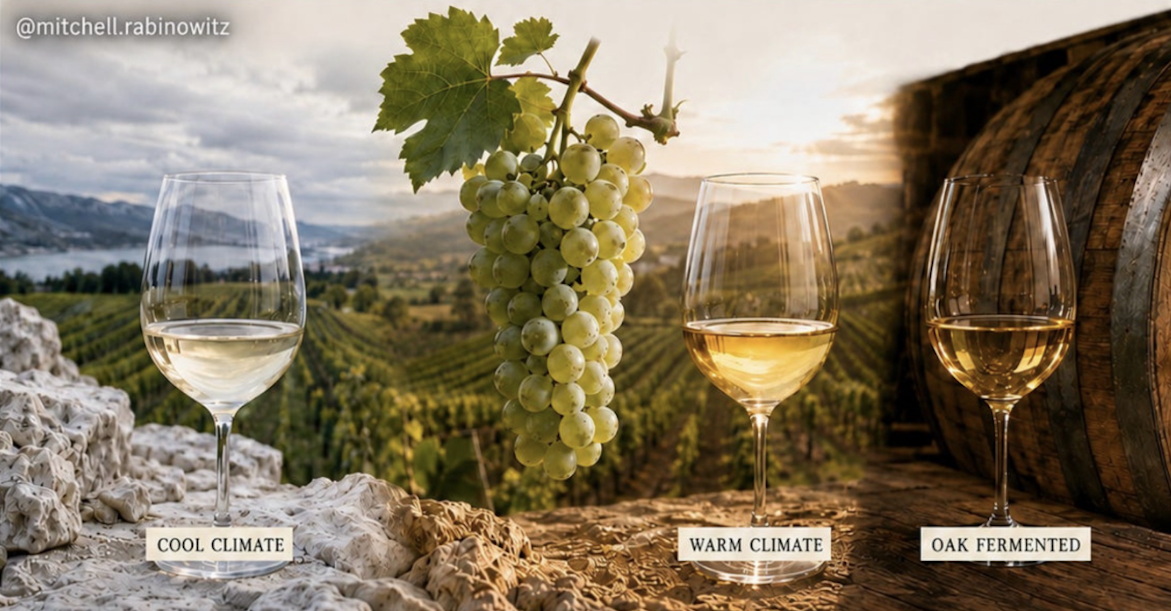
An unoaked Chardonnay from a cool site could bear little resemblance to a warm-region Chardonnay fermented in a new barrel. A young Riesling could show fresh citrus and floral aromas, while time in the bottle produced honeyed or petroleum-related characteristics. Candidates in blind tastings learned the examples that examination panels were likely to select and the characteristics considered representative of each variety. A correct identification could reflect familiarity with those selected wines. A producer using an unusual clone or harvesting earlier than neighboring estates might make a legitimate wine that supplied few of the expected clues.
A class can begin by comparing two Chardonnays from different climates before students receive customary varietal descriptions. Another comparison can place an unoaked Chardonnay beside one that underwent malolactic fermentation and barrel maturation. Several vintages from one vineyard can then show how weather and bottle age change the result. Students can record their observations before learning which wine they tasted. After the bottles are revealed, they can consider which characteristics may have come from the variety and which resulted from the site. Information about the clone and crop level can be added when it is available. Charts should be used only as records of common expectations.
Mitchell Rabinowitz
I’m a retired university professor with a Ph.D. in cognitive and developmental psychology. I taught cognition and education starting in 1984. In retirement I decided to take wine seriously, and I’ve been using AI to help me learn faster and create better. I’ve also learned you can’t just ask AI one question and call it done.
For me, an essay usually takes a number of iterations. I create a draft, then I check accuracy, hunt for gaps, revise the structure, and do it again until the piece feels coherent and useful. I also use other AIs as collaborators. It is an extensive process creating the essays.
I try to create these as stories because that is the format that sticks for most of us. Facts land better when they have a sequence and a few turning points. Connect with @mitchell.rabinowitz on Instagram
