
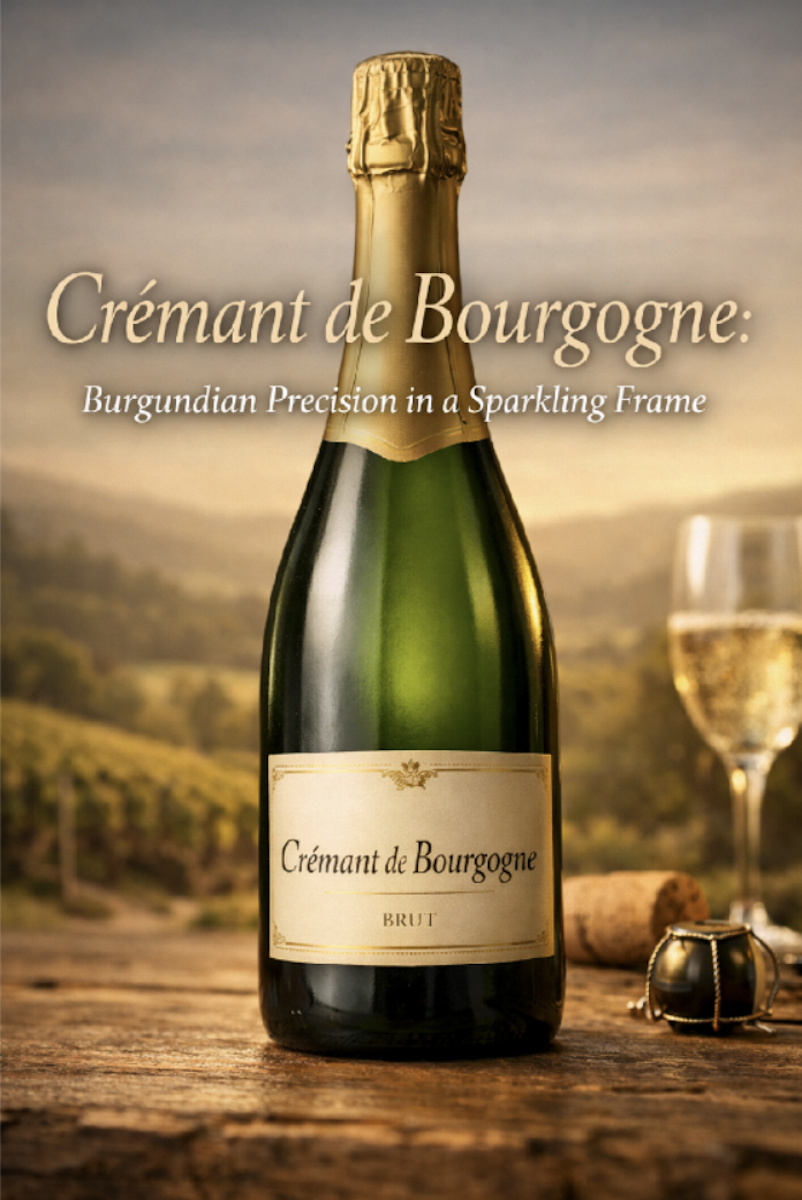

Crémant de Bourgogne
Crémant de Bourgogne is easier to understand when it is treated as one of Burgundy’s wine categories rather than as a secondary alternative to more famous sparkling regions. It is made by the traditional method, and it shares Chardonnay and Pinot Noir with Champagne, but those facts do not tell the reader enough about the wine itself. What matters is that it comes out of Burgundy’s grape mix, Burgundy’s spread of vineyard areas, and Burgundy’s long practice of paying close attention to fruit quality, pressing, and blending. Over the last two decades, the
category has become more consistent, more visible in export markets, and more convincing at the upper end. The formal turning point remains October 17, 1975, when the Crémant de Bourgogne AOC was established. The fiftieth anniversary in 2025 offered a useful occasion to mark how far the appellation has moved from its older image as a minor corner of Burgundy production.
Its present scale deserves to be stated carefully. Older summaries often repeated figures around 18 million bottles, but more recent reporting points to a substantially larger category, with about 22 million bottles cited for 2023, further growth in 2024, and exports passing half of total volume in 2025. Those numbers should be treated as current trade reporting rather than as permanent baseline figures, but they are enough to show that Crémant de Bourgogne now occupies a meaningful place within Burgundy’s economy and has become increasingly visible abroad. The grape list helps explain why the style range is wider than many casual drinkers assume. Chardonnay and Pinot Noir remain central, but the appellation also permits Aligoté,
Gamay, Melon, Pinot Blanc, Pinot Gris, and Sacy in specified contexts. In practical terms, that allows wines with different balances of citrus, orchard fruit, body, and freshness depending on blend and source. The Châtillonnais remains the historic center of Burgundy’s sparkling production, but the Mâconnais and Beaujolais also play important roles today, so the category does not come from one uniform geological setting or one single climatic pattern.
The technical basis of the appellation is straightforward. Crémant de Bourgogne is made by second fermentation in bottle. Hand harvest is required, and the wines must spend at least nine months on the lees, with Burgundy trade material also noting a short additional period before release. That legal minimum is shorter than Champagne’s, but time on lees is only one part of the result. Pressing, picking dates, acidity retention, and base-wine blending carry equal weight. The rise in quality has also been supported by a more visible premium tier. Burgundy sources describe Eminent as requiring at least 24 months on the lees and Grand Eminent as requiring at least 36 months, with tighter standards for the higher level. The practical significance is clear even without overloading the essay with decree language. Producers now have an established way to separate routine bottlings from wines made with more time and stricter raw-material selection. That change helps explain why the upper end of the category is stronger than it was twenty or thirty years ago. Large-volume wines still exist, and some remain simple, but the ceiling has risen because cellar work is cleaner, pressing is more careful, and longer aging is now used with greater confidence.
The wines are best described in sensory and culinary terms. Crémant de Bourgogne often shows more immediate fruit than non-vintage Champagne and usually depends less on extended autolytic development for its appeal, even though bottle fermentation and lees contact still give it texture and detail. Chardonnay-led wines can move toward lemon, apple, and floral notes. Pinot-based wines tend to carry more breadth and more orchard fruit, and rosés are strongest when the fruit remains fresh and clearly defined. Prosecco provides the clearest contrast in method, since tank fermentation favors primary fruit and a lighter tactile feel, whereas Crémant de Bourgogne develops through bottle fermentation. Cava is closer in method, so the distinction comes more from grapes, climate, and fruit character. Burgundy generally gives a cooler fruit profile, more emphasis on citrus and apple, and a more restrained weight on the palate. Champagne differs less
by prestige alone than by the way its top wines are often shaped by longer cellar aging and a more elaborate hierarchy of houses, villages, and prestige cuvées. Crémant de Bourgogne is usually more immediately tied to the quality and character of the base wine.
That point helps explain why the category has become more compelling. Burgundy is a region accustomed to thinking carefully about grape source, ripeness, and blending, and those habits carry over into sparkling production. Even in blended wines, the broader regional mosaic still matters. A wine assembled from one part of Burgundy will not necessarily present itself in the same way as one built from another part, even if those differences are sometimes softened by blending and house style. Producers such as Veuve Ambal, Louis Bouillot, and Bailly Lapierre
remain useful reference points because they show different ways scale, reliability, longer aging, and regional specificity can exist within the same appellation. The category’s current place in the market is clearer as well. Price remains one of its advantages, but that is no longer the only serious point in its favour. Crémant de Bourgogne has gained traction because it works well at the table and because it now offers a more convincing range of styles, from simple aperitif bottles to longer-aged wines that reward closer attention. Blanc de blancs bottlings can pair well with
shellfish, white fish, and lighter cream sauces. Fuller blends and blanc de noirs can move toward poultry, charcuterie, or mushroom dishes, and rosé versions can work with salmon, cured meats, or desserts built around red fruit, depending on dosage and body.
Most production remains non-vintage because blending across harvests allows producers to moderate vintage variation and maintain a more consistent style. Vintage still matters in better cuvées, however, because changes in acidity, crop level, and ripeness alter the balance of the base wines and make dosage decisions easier or harder. Cooler years tend to produce firmer wines with less fruit weight. Warmer years can broaden the palate and reduce the margin for error if freshness is not preserved. Longer lees aging changes the picture again. In basic bottlings, the aim is usually early drinkability. In stronger wines, extended aging can add biscuit,
toast, and savory depth without erasing fruit. The best bottles keep both in view. They do not resemble still Burgundy with bubbles, but they do show that the quality of the base material remains central. Crémant de Bourgogne is now easier to define than it was twenty years ago. It is a serious sparkling appellation of Burgundy with clear technical rules, a larger commercial presence, and a more credible upper tier than it once had. It still includes wines made for immediate pleasure, and that remains part of its usefulness. It also now includes longer-aged and more exacting bottles that deserve to be judged on their own terms.
Mitchell Rabinowitz
I’m a retired university professor with a Ph.D. in cognitive and developmental psychology. I taught cognition and education starting in 1984. In retirement I decided to take wine seriously, and I’ve been using AI to help me learn faster and create better. I’ve also learned you can’t just ask AI one question and call it done.
For me, an essay usually takes a number of iterations. I create a draft, then I check accuracy, hunt for gaps, revise the structure, and do it again until the piece feels coherent and useful. I also use other AIs as collaborators. It is an extensive process creating the essays.
I try to create these as stories because that is the format that sticks for most of us. Facts land better when they have a sequence and a few turning points.
