
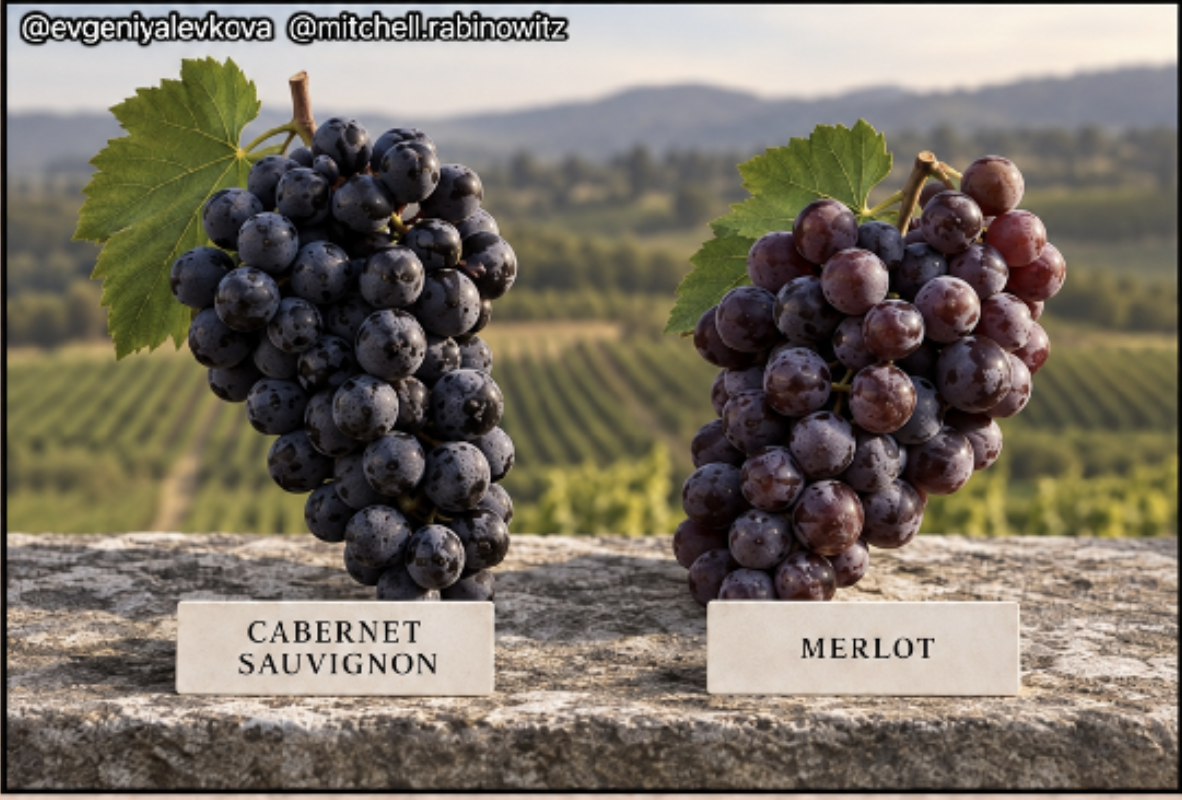

Why Cabernet Sauvignon Is Often Blended with Merlot
Cabernet Sauvignon is often blended with Merlot because the two grapes reach ripeness at different times, respond differently to soil and weather, and contribute different amounts and kinds of tannin, acidity, alcohol, color, fruit, and aroma. Cabernet Sauvignon commonly provides firm tannin, fresh acidity, dark color, and black-fruit flavors. Merlot commonly provides ripe plum and cherry flavors, more body, and a rounder tactile impression. Combining them allows a producer to make a wine with ripe fruit and adequate body while retaining freshness, color, and the capacity to develop over time. The producer can also alter the proportion of each grape after assessing the growing season and tasting the separate wines.
The combination developed in Bordeaux, where Cabernet Sauvignon has been cultivated since at least the seventeenth century and the name Merlot entered the written record near the end of the eighteenth century. Merlot attracted greater attention during the nineteenth century partly because it was less susceptible than Cabernet Sauvignon to powdery mildew, a fungal disease that damaged Bordeaux vineyards. Cabernet Sauvignon and Merlot share one parent, Cabernet Franc, although this genetic relationship does not explain why they can produce successful blends. Their practical use together developed through repeated experience with the soils and variable Atlantic weather of Bordeaux. There is no reliable evidence of one person inventing the blend. Growers planted several local grapes, observed where each performed well, harvested them when they were ready, and retained the freedom to vary the final composition.
The catastrophic winter freeze of February 1956 gave growers an unusual opportunity to reconsider what they planted. Prolonged severe cold killed or seriously damaged vines throughout Bordeaux, with particularly heavy losses in parts of the Right Bank, and extensive replanting followed. Malbec, white grapes, and several older local varieties were frequently replaced with Merlot, Cabernet Sauvignon, or Cabernet Franc. The decisions depended on the soil, the previous performance of each variety, the availability of planting material, agricultural recommendations, production costs, anticipated yields, and demand for red wine. Many growers increased Merlot because it could ripen earlier and produce generous crops under suitable conditions. Others favored the late budbreak of Cabernet Sauvignon, which reduced exposure to spring frost, particularly on warm, well-drained sites where the grapes could complete their long ripening period. Replanting after the freeze helped establish the distribution of the two varieties found in modern Bordeaux.
Phenology is the timing of recurring stages in the vine’s annual cycle, such as budbreak, flowering, the onset of ripening, and harvest. In the French national reference collection, Cabernet Sauvignon opens its buds thirteen days after Chasselas, the traditional benchmark variety used to compare the timing of vine development, while Merlot opens two days after Chasselas. Cabernet Sauvignon reaches maturity three to three and a half weeks after Chasselas, while Merlot reaches it about two and a half weeks after Chasselas. The precise calendar dates change with place and year, although the contrast remains important. Merlot starts growth earlier and is therefore more exposed to spring frost. It can also suffer coulure, the failure of flowers to become berries, when flowering conditions are cold or wet. Cabernet Sauvignon begins growth later and avoids some of that early risk. At the end of the season, their advantages reverse. Merlot can usually be harvested first, before prolonged autumn rain, while Cabernet Sauvignon requires additional warmth and dry weather to complete ripening.
Bordeaux’s Atlantic climate made these differences especially valuable. Rain can interfere with flowering, dilute or split ripening berries, encourage fungal disease, and force harvest decisions before every component has reached its preferred maturity. A cool year may allow Merlot to reach useful sugar and flavor levels while Cabernet Sauvignon still has green aromas and severe tannin. A warm, dry year can favor Cabernet Sauvignon’s longer season, while Merlot may accumulate sugar quickly and lose acidity if it remains on the vine too long. Merlot also has limited tolerance of intense drought. Cabernet Sauvignon is less susceptible to bunch rot and generally tolerates drought better, although it can fail to ripen fully in cool conditions. Because the varieties respond differently to the same season, a producer may still have sound batches, or lots, of one grape when the other has suffered. Merlot can produce generous crops, and in some cool seasons it provided a greater volume of sound, ripe wine when Cabernet Sauvignon remained unsuitable for the principal blend.
Soil reinforces the value of having both grapes. Cabernet Sauvignon often performs well on well-drained, exposed gravel soils, which are common in the Médoc and Graves. Water drains rapidly through these sites, and the vine’s later season can benefit from their warm, open conditions. Merlot is particularly suited to clay and limestone soils, including many sites in Saint-Émilion and Pomerol. Clay retains more water than gravel, which can help Merlot through dry periods, provided that the roots are not left in saturated ground. These preferences help explain why Cabernet Sauvignon is often the largest component in the Médoc while Merlot is often dominant on the Right Bank. The familiar division has many exceptions because properties contain different proportions of gravel, sand, clay, and limestone. Within a single estate, one parcel may be planted to Cabernet Sauvignon and another to Merlot.
Modern planting decisions also include the choice of rootstock, the rooted portion of the vine onto which the fruit-producing variety is grafted. European wine grapes have generally been grafted onto rootstocks derived from American vine species since phylloxera, an insect that attacks vine roots, devastated European vineyards during the nineteenth century. Rootstocks differ in the vigor they confer, the depth and spread of their roots, their ability to obtain water and mineral nutrients, their tolerance of drought or moisture, and their effect on the speed of ripening. A suitable rootstock can help control vigorous Merlot on fertile soil, improve its access to water on gravel, or assist Cabernet Sauvignon on a site where water availability might otherwise interfere with ripening. Rootstock selection modifies the way a variety responds to a parcel without erasing the effects of drainage, temperature, exposure, and water retention.
Cabernet Sauvignon forms small bunches and small berries. A small berry generally has a high proportion of skin and seed relative to juice. The skins contain anthocyanins, the pigments responsible for much of a red wine’s color, and the skins and seeds contain tannins. Tannins bind with proteins in saliva and reduce lubrication in the mouth, creating the drying sensation called astringency. Cabernet Sauvignon can therefore produce deeply colored wines with firm tannin, noticeable acidity, and a long finish. When the grapes are fully ripe, the aromas can include blackcurrant, blackberry, and other dark fruit, along with floral, herbal, and spice notes. When ripeness is incomplete, methoxypyrazines, aromatic compounds associated with green pepper and leafy smells, can become conspicuous. Oak aging may later add cedar, toast, or vanilla, so those aromas should not automatically be credited to the grape.
Merlot usually has medium-sized berries and produces wines that are rich in color and alcohol, relatively low in acidity, and tactilely round. Its fruit commonly recalls plum, black cherry, red cherry, and fig. The usual description of Merlot as a low-tannin grape is too simple. Merlot contains substantial tannin, and some studies have measured high seed-tannin concentrations. A ripe Merlot handled gently in the cellar often feels less austere than a comparable young Cabernet Sauvignon because its acidity is usually lower, its tannins can seem more supple, and its alcohol and ripe fruit give the wine greater body. A Merlot harvested early from a cool clay site can be fresh and firm; careful extraction may give a ripe Cabernet Sauvignon from a warm site a generous, immediately approachable character. Site, crop level, harvest date, fermentation, and aging can make either variety firmer, rounder, fresher, or easier to drink when young.
When Merlot is added to Cabernet Sauvignon, no chemical reaction removes Cabernet’s tannin. If the Merlot component is less astringent, lower in acid, and fuller in body, it changes the concentration and perception of the entire blend. The drying sensation may become less prominent when ripe fruit, alcohol, and body increase the wine’s fullness. Plum and cherry aromas can supplement Cabernet Sauvignon’s blackcurrant and herbal notes. In the other direction, Cabernet Sauvignon can increase the blend’s acidity, color, tannic firmness, and resistance to a flat or overly soft finish. Sensory effects do not always follow arithmetic averages. In a controlled study of Cabernet Sauvignon, Merlot, Cabernet Franc, and fifteen blends, descriptive tasting distinguished the wines more completely than any single set of chemical measurements. This helps explain why an experienced producer works by repeated tasting instead of relying only on laboratory values or a predetermined percentage.
The two grapes are normally harvested and fermented separately because they mature on different dates and because individual parcels require different handling. Fermentation extracts color, tannin, and aroma compounds from the skins and seeds. Cabernet Sauvignon with ripe skins and firm seeds may tolerate a longer period of skin contact, while a strongly tannic lot may require gentler extraction. Merlot may be handled to preserve fresh fruit and avoid excessive seed tannin, although the decision depends on the actual grapes. After fermentation, the producer tastes the separate lots. Some estates decide on the blend before barrel aging. Others age varieties and parcels separately in new barrels, used barrels, large wooden vats, concrete, or other vessels, then conduct the final assemblage, the French term for blending, later.
Separate aging also allows the barrels to be matched to the concentration and flavor of each wine. New oak releases tannins and aromatic compounds associated with cedar, toast, vanilla, smoke, and spice. Cabernet Sauvignon’s concentration of grape tannin, pigment, acidity, and dark fruit can allow a substantial amount of new oak without making the wood aromas excessively prominent. Merlot may require more restrained barrel treatment when its fruit is delicate or its tannin is already firm. Concentrated Merlot grown under favorable vineyard conditions can also be aged in a high proportion of new oak, as many leading wines of Pomerol and Saint-Émilion demonstrate. The concentration and sensory characteristics of each individual lot guide the decision. Barrel size, age, origin, toast level, and length of aging all affect the result.
Within a Cabernet Sauvignon-led wine, Merlot can contribute body and ripe fruit at a modest percentage, then make the wine broader and suitable for earlier drinking as its share increases. In a Merlot-led wine, Cabernet Sauvignon can provide additional acidity and firmer tannin, although Cabernet Franc is also widely used for this purpose on the Right Bank. Cabernet Franc adds another period of vulnerability and ripening to the vineyard. In the French reference collection, it opens its buds five days after Chasselas, placing it after Merlot and before Cabernet Sauvignon. It reaches maturity two and a half to three weeks after Chasselas, overlapping Merlot at the beginning of that interval and extending toward the later-ripening Cabernet Sauvignon. Its inclusion can therefore distribute some weather risk across a third period. Cabernet Franc can also contribute acidity, red-fruit flavors, floral and herbal aromas, and tannins that are commonly less severe than those of young Cabernet Sauvignon, although Cabernet Franc can still be firmly tannic when grown or vinified for concentration.
The year’s weather can alter every choice, since ripe Cabernet Sauvignon may deserve a greater share after a long, dry autumn. When Cabernet Sauvignon has not ripened completely, the producer may rely more heavily on the earlier varieties, provided their fruit escaped frost, coulure, mildew, or rot. Cabernet Franc may be particularly valuable when it achieves ripe aromas and fresh acidity under conditions that leave Cabernet Sauvignon excessively green. The final decision also depends on the estate’s soils, vine age, yields, extraction, barrels, and intended drinking period. A successful blend therefore reflects specific agricultural and cellar decisions, with no standard Bordeaux recipe governing the final percentage.
The combination also influences aging because Cabernet Sauvignon’s tannin, acidity, pigments, and concentrated fruit can allow the wine to develop over a long period in bottle. During aging, tannins interact with pigments and other compounds, their tactile effect changes, and some material eventually forms sediment. Merlot can make the young blend feel more complete, yet it should not be treated as a device for early drinking. Great Merlot-led wines can age for decades because Merlot can also provide ample tannin, color, alcohol, and concentrated fruit. In a well-made blend, the producer considers how the components taste at the blending table and how their acidity, tannin, fruit, and oak are likely to change together. An excessive share of soft, ripe Merlot can leave the finished wine broad and low in freshness; with severe or insufficiently ripe Cabernet Sauvignon, the corresponding risk is drying tannin and persistent green aromas.
The combination became famous through the wines of Bordeaux and was adopted in the United States, Chile, Argentina, South Africa, Australia, Italy, and other countries. Producers may use the traditional Bordeaux red varieties and place Cabernet Sauvignon and Merlot beside Cabernet Franc, Petit Verdot, Malbec, or Carmenère, or they may limit the blend to Cabernet Sauvignon and Merlot. American labeling law helps conceal how common the practice is. A wine sold under a single grape name generally needs to contain at least 75 percent of that grape. A bottle labeled Cabernet Sauvignon may therefore contain as much as 25 percent Merlot or other permitted wine without listing those grapes on the front label. The addition may be small and aimed at texture, or it may substantially alter the wine. Producers in warm, dry places can also bottle Cabernet Sauvignon alone because full ripeness is easier to achieve, and Merlot can make a complete wine by itself.
Climate change is altering the historical balance of risks in Bordeaux. Cabernet Sauvignon once carried a greater risk of failing to ripen before autumn rain, while earlier Merlot reached ripe fruit more dependably. Warmer growing seasons now allow Cabernet Sauvignon to reach full maturity more often. Merlot can ripen during hotter parts of the season, accumulate excessive sugar, lose acidity, and develop cooked-fruit aromas if harvest is delayed. Research on adaptation in Bordeaux has therefore identified a possible increase in the share of later-ripening Cabernet Sauvignon as one response to warming. Extreme heat and drought still threaten both varieties, and no adjustment in percentage can repair grapes damaged by severe water stress or sunburn. The contrast in ripening dates nevertheless continues to give producers choices. What began as a response to a cool, variable Atlantic climate can also help producers manage warmer vintages, although the preferred proportions may differ from those used several decades ago.
Mitchell Rabinowitz
I’m a retired university professor with a Ph.D. in cognitive and developmental psychology. I taught cognition and education starting in 1984. In retirement I decided to take wine seriously, and I’ve been using AI to help me learn faster and create better. I’ve also learned you can’t just ask AI one question and call it done.
For me, an essay usually takes a number of iterations. I create a draft, then I check accuracy, hunt for gaps, revise the structure, and do it again until the piece feels coherent and useful. I also use other AIs as collaborators. It is an extensive process creating the essays.
I try to create these as stories because that is the format that sticks for most of us. Facts land better when they have a sequence and a few turning points. Connect with @mitchell.rabinowitz on Instagram
