
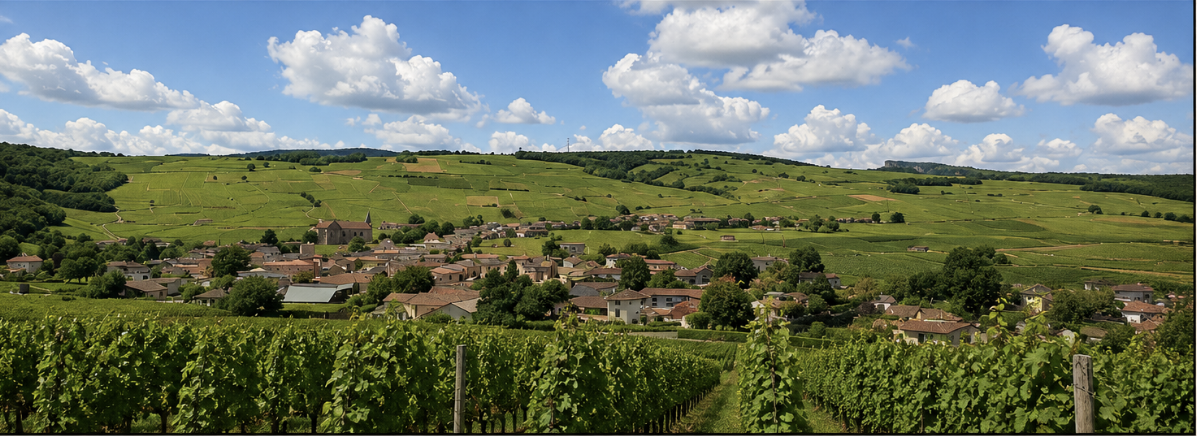

Wine Production in Fuissé: A History
The village of Fuissé sits near the southern end of Burgundy’s limestone belt, where the vineyard land of the Côte d’Or and Côte Chalonnaise gives way, a few kilometers to the south, to the granitic terrain of Beaujolais. It is a small commune in the department of Saône-et-Loire, and for most of its existence it was not sharply distinguished from the other wine-producing villages of the southern Mâconnais. That changed over the course of the twentieth century, when Fuissé became central to Pouilly-Fuissé, the most prestigious appellation in the Mâconnais and the one that has consistently drawn the most attention from critics, merchants, and international buyers. Its history shows how legal protection, commercial demand, vineyard differences, and individual producers gradually turned a small wine village into the reference point for Chardonnay at the southern end of Burgundy.
The geological foundation comes first, because nothing in the production history of Fuissé is separable from the ground on which the vines grow. The appellation sits on fossiliferous limestone related to formations found farther north in the Côte d’Or, and the dramatic escarpments of Solutré and Vergisson, which rise above the vineyards to roughly five hundred meters, owe their profile to hard fossil corals that resisted erosion. The vines grow on the slopes and at the foot of these two hills on clay-limestone soils of Jurassic origin, mixed with scree from upslope and, in one location, schist, with hillsides cut by small steep-sided streams that give many slopes an easterly or south-easterly exposure. Within Fuissé itself, the geology is more varied than a single soil description would suggest. In Fuissé, a third of the vines grow on west-facing granitic soils, with schists, volcanic sedimentary sands, and rhyolitic tuff, while the remainder, facing east, are mostly planted on limestone and Jurassic formations. That split within a single commune gave growers a practical reason to separate parcels long before the Premier Cru classification of 2020 gave those distinctions legal form.
A geological study led by Isabelle Letessier from Sigales found that of all the Burgundy appellations, Pouilly-Fuissé is among the most varied in terms of geology, mixing limestone, clay, marls, schist, and sandstone soils. That range of soils was the working reality of growers in the commune long before any outside authority confirmed it. Fuissé was never a single winemaking proposition. The vineyards to the west of the village, sitting on granitic and schistose material, produced wines with a different balance of weight, acidity, and mineral impression than the limestone-dominated parcels to the east, and the clay-heavy soils at mid-slope behaved differently from the well-drained marl and stone of the higher parcels. Growers who held multiple parcels understood this distinction through repeated harvests. What they lacked for most of the modern period was a classification that could place those distinctions on a label.
Viticulture in the area reaches back well beyond the modern appellation. The first traces of vine-growing appeared more than two thousand years ago around the rocks of Solutré and Vergisson. The Roman occupation of Gaul extended viticulture throughout what is now Burgundy, and the Mâconnais was not exempted from that process, though the evidence for the precise character of early wine production in the Fuissé area is thinner than for regions closer to major Roman commercial routes. The more consequential medieval period began with the expansion of monastic agriculture. In the Middle Ages, helped by the wine trade along the Saône, viticulture accelerated, and the monks of the Abbey of Cluny, as well as those of the Abbey of Cîteaux farther north, played a key role in the development of the vineyard. Their influence extended throughout the region, and the reputation of Mâconnais wines began to take root. The Abbey of Cluny, founded in 909 and for several centuries one of the most powerful ecclesiastical institutions in Western Europe, held vineyard land across the southern Mâconnais, and its agricultural practices helped make local viticulture a repeated and organized activity rather than an occasional one. The monasteries supplied continuity: the durability to maintain parcels across generations and to develop working knowledge of which sites produced reliably and which did not.
At this time, the reputation of Mâconnais wines was less prestigious than that of the wines from the Côte de Nuits or the Côte de Beaune, but viticulture was nonetheless well established and the local crus appreciated. During the Renaissance, demand for wine developed, and the wines from the Mâconnais began to circulate more widely in France and Europe, as winemaking techniques gradually evolved and the interest of aristocrats and bourgeois drinkers in Burgundy wine led to an increase in production and an improvement in quality. By the eighteenth century, the wines of the area were already moving beyond local consumption toward wider commercial circulation, including the Paris market. Once growers were adapting production to external demand, transport and merchant networks, and the requirements of name recognition, the Mâconnais had entered a different phase of its wine history, and the area that would eventually become Pouilly-Fuissé was part of that change before the nineteenth century began.
The pre-modern vineyard was more varied than the current Chardonnay-only appellation suggests. For a long period, Gamay occupied a larger share of the local vineyard than modern readers might expect, and Aligoté was also widely present in the white vineyard of the Mâconnais before the late nineteenth century. It was only after the devastation caused by phylloxera that Chardonnay became dominant in the sector that would later define Pouilly-Fuissé. The phylloxera crisis, which destroyed the majority of French vineyards in the last decades of the nineteenth century, forced reconstruction on American rootstocks, and the Mâconnais, like the rest of Burgundy, had to replant from the ground up. The replanting decision favoured Chardonnay over both Gamay and Aligoté, narrowing the local vineyard toward the grape that gave growers the strongest commercial future in white Burgundy. That choice shaped everything that followed: the commercial reputation of Pouilly-Fuissé as a white wine appellation, its relationship to the white Burgundy market, its place between the Côte de Beaune and the Mâconnais, and its eventual emergence as the benchmark Chardonnay appellation at the southern end of Burgundy.
The legal history of the modern appellation begins in 1922, when fraudulent use of the Pouilly name prompted formal intervention. In response to the fraudulent use of the appellation name and to preserve the distinctiveness of the wines, the court of Mâcon defined the geographical area of the vineyard in 1922. That definition preceded the formal AOC system by more than a decade, indicating that the Fuissé area and its neighboring communes had already acquired enough market recognition to make imitation commercially worthwhile. Legal protection was sought because the name already carried value. In 1929, the mayors of the four communes of the appellation created the Union des Producteurs de Pouilly-Fuissé to protect the future AOC, and this commitment led to the recognition of the Pouilly-Fuissé AOC by the INAO in 1936. At Château Fuissé, the local dimension of this effort is traceable through individual figures: in 1922, Jacques Vincent, mayor of Fuissé, along with other vintners, advocated for the uniqueness of the vineyards surrounding Fuissé and the hamlet of Pouilly. Pouilly was not a separate commune. It was a hamlet historically associated with both Fuissé and Solutré, and Solutré later incorporated the name into the municipal form Solutré-Pouilly. That boundary detail accounts for the hyphenated appellation name and for the fact that the legal area extends across four communes rather than two.
The AOC was created on September 11, 1936. The area had previously been known simply as Pouilly, but when the AOC laws were introduced, it was split into three appellations: Pouilly-Fuissé, Pouilly-Loché, and Pouilly-Vinzelles. That tripartite division kept Fuissé at the head of the local hierarchy through the accumulated weight of the village’s prior reputation. Pouilly-Fuissé covered the largest and most varied terrain of the three, incorporating the four communes of Fuissé, Solutré-Pouilly, Vergisson, and Chaintré, and it quickly became the name under which the region’s best wines were identified internationally. The two smaller appellations, Pouilly-Loché and Pouilly-Vinzelles, remained largely in the shadow of their larger neighbor, producing wines of comparable quality in some parcels but lacking the commercial infrastructure and international profile that Pouilly-Fuissé rapidly developed.
The middle decades of the twentieth century were shaped partly by the market conditions of postwar France and partly by the way production was organized in the appellation. Pouilly-Fuissé was not a landscape of self-contained estates alone. It was a region where the négociant trade, cooperatives, and domaine-bottled production all coexisted, and where the balance among those channels shifted over time. The domaines that would later define the appellation’s highest level, including Château Fuissé and Domaine J.A. Ferret, had been building their vineyard holdings and refining their cellar practices for decades, but for much of the mid-century period a significant share of production moved through merchant channels that reduced the appellation’s internal differences to a single commercial offering. That practice served the market well enough in terms of volume, but it obscured the differences that the best parcels in Fuissé and Vergisson could show. Jeanne Ferret’s work after the Second World War was decisive because it moved in the opposite direction. She expanded estate bottling at Domaine J.A. Ferret, vinified parcels separately, and developed an internal hierarchy that used terms such as Tête de Cru and Hors Classe for the domaine’s most valued sites. Those terms had no INAO standing, but they had practical force because they taught buyers to read Fuissé through named parcels rather than through the appellation alone. In 1948, Marcel Vincent purchased vineyards and developed domaine-bottled sales using nascent marketing techniques, and since 1967 Jean-Jacques Vincent endeavored to vinify wines according to the characteristics of each parcel and to export the image of the domaine. These estate efforts prepared the commercial and practical ground for the later Premier Cru classification by showing that the best wines of Pouilly-Fuissé were not interchangeable.
The fuller style that later helped Pouilly-Fuissé succeed abroad began in the vineyards rather than in the market. The southern Mâconnais is warmer and sunnier than the Côte d’Or, with harvest dates that generally arrive earlier and fruit that can reach generous ripeness without losing the acidity supplied by limestone soils, slope, and diurnal movement. Those conditions gave Chardonnay a different profile here than in the higher-acid villages farther north: broader fruit, more mid-palate weight, and alcohol levels that could feel ample even before cellar choices such as bâtonnage or oak entered the picture. The same climate, however, also exposes growers to increasingly difficult vineyard decisions. Recent vintages have shown that warmth is not a guarantee of either ripeness or yield. Late spring frosts and hail have repeatedly damaged crops, with serious losses in years such as 2016, 2017, and 2021. A damaged vine produces less fruit, rebuilds leaf area, and may carry the effects of stress into the following season. In hot and dry summers, growers must also manage canopy with unusual precision, leaving enough shade to protect Chardonnay from sunburn while avoiding dense foliage that slows drying after rain and increases disease pressure. The appellation’s commercial success rested on natural ripeness, while its present-day farming depends on navigating frost, hail, heat, drought, and disease pressure in the same vineyards.
American demand shaped the appellation’s commercial reputation in ways that had both positive and distorting effects. Pouilly-Fuissé became, particularly in the 1970s and 1980s, a wine that American consumers recognized, sought out, and were willing to pay substantial prices to obtain. The name was pronounceable enough for a restaurant wine list, the wines were reliably rich and full rather than austere, and the Burgundy appellation conferred sufficient prestige to justify the price. The American appetite for the wine drove prices upward, which attracted négociant attention and encouraged the production of larger volumes at a quality level that did not always justify the premium being charged. The trend for oaked wines emerged in the 1990s to meet demand from America, though producers who did not adopt that style tended to remain more faithful to the underlying sites, and oak, while commercially convenient, sometimes obscured the distinctions among parcels. The overproduction and narrowing of style during the boom years created a backlash among critics and more experienced buyers, and for a period in the 1990s and early 2000s Pouilly-Fuissé carried a reputation for being overpriced relative to its neighbors, which included Saint-Véran, Pouilly-Vinzelles, and the better Mâcon-Villages. The appellation recovered from that reputation because production standards improved and more growers returned attention to parcel differences.
The physical character of Fuissé as a commune contributed to that recovery more than the appellation’s general commercial history did. The vineyards within the commune represent some of the most internally varied soils in the appellation as a whole, with the granite and schist of the west-facing parcels producing wines quite different in balance and texture from the limestone and marl of the east-facing sites. Domaine Ferret owns 22.4 of its 42 acres of estate vineyards in the amphitheater of hills surrounding the town of Fuissé, with the native soil mainly argilo-calcareous throughout the growing area, with distinctions from one plot to another. The amphitheater configuration creates a range of exposures and gradients that no single soil description can adequately capture. The Le Clos monopole, a parcel surrounding Château Fuissé, owes its geological particularity to successive strata of calcareous clay, with a southeast-facing orientation and average vine age of over fifty years. It represents one end of the commune’s range. The parcels at Les Brûlés, south-facing and composed of marls, represent another. Both carry the same appellation name, yet they do not produce the same wine. They share the commune, the grape variety, and the broader geological inheritance of the southern Mâconnais limestone band. They differ in orientation, drainage, depth of soil, proportion of clay to limestone, and age of vine.
The movement toward formal Premier Cru classification emerged from this internal diversity and from the longstanding frustration of growers who had been practicing site-differentiated viticulture for decades without any regulatory apparatus to express those differences on a label. The application was made in 2010, and after a decade of review, the INAO gave final approval in 2020, making Pouilly-Fuissé the first appellation within the Mâconnais to receive Premier Cru vineyards and marking the first addition of Premier Cru vineyards in Burgundy since 1943. The designation applied beginning with the 2020 vintage. The 22 new Premier Crus represent a total of 194 hectares under vine, accounting for roughly 24 percent of Pouilly-Fuissé’s total vineyard area, spread over all four communes of the appellation. In Fuissé specifically, the classified Premier Cru sites include Les Brûlés, Les Perrières, Les Vignes Blanches, Le Clos, Les Ménétrières, and Les Reisses, along with Vers Cras, which is shared with Solutré-Pouilly.
The new tier also imposed more demanding vineyard rules, which is why the classification belongs to farming as well as labeling. Yields for Premier Cru parcels were capped at 56 hectoliters per hectare, below the 60 hectoliters permitted for village-level Pouilly-Fuissé. Chemical herbicides were banned in the classified vineyards. A three-year fallow period was required before a pulled vineyard could be replanted, and the eligible altitude was capped at 400 meters above sea level. Those requirements tied the new legal standing directly to work in the vineyard: lower yields, cleaner soil management, slower replanting, and exclusion of higher sites where ripening consistency was judged less reliable. The Premier Cru designation therefore did more than name favored climats. It placed stricter obligations on the parcels that now carried that name.
The classification confirmed a hierarchy that already existed in the vineyard. Growers and critics had long recognized that certain parcels in Fuissé, Vergisson, Chaintré, and Solutré-Pouilly consistently produced wines with greater depth, persistence, and aging capacity than the general village level. What the classification added was the legal authority to make that distinction visible in the commercial market and to protect the best sites from the price flattening that had periodically affected the appellation when merchant-sourced village wine dominated the perception of the name. Whether the classification will hold its value over time depends on whether the producers working the Premier Cru sites can sustain the quality difference that justified the application in the first place. The evidence from the early Premier Cru vintages is encouraging, but the legal category depends on the farming and winemaking that follow it, and the history of Pouilly-Fuissé is long enough to caution against assuming that official recognition and actual quality will always remain aligned.
The history of Fuissé runs from monastic vineyard holdings and mixed pre-phylloxera plantings to Chardonnay replanting, AOC protection, estate bottling, export demand, climate pressure, and Premier Cru recognition. The same village contains limestone and marl to the east, granite and schist to the west, clay-heavy slopes in some parcels, and thinner, stonier soils in others. Its growers moved from mixed plantings toward Chardonnay, from merchant dependence toward domaine bottling, from broad appellation reputation toward named parcels, and from informal site rankings toward formal Premier Cru rules. Fuissé became important because those changes gathered around a village whose vineyards had always been more varied than the old regional shorthand allowed.
Mitchell Rabinowitz
I’m a retired university professor with a Ph.D. in cognitive and developmental psychology. I taught cognition and education starting in 1984. In retirement I decided to take wine seriously, and I’ve been using AI to help me learn faster and create better. I’ve also learned you can’t just ask AI one question and call it done.
For me, an essay usually takes a number of iterations. I create a draft, then I check accuracy, hunt for gaps, revise the structure, and do it again until the piece feels coherent and useful. I also use other AIs as collaborators. It is an extensive process creating the essays.
I try to create these as stories because that is the format that sticks for most of us. Facts land better when they have a sequence and a few turning points.